

This mathematics problem involves applying core mathematical principles and formulas. Below you will find a complete step-by-step solution with detailed explanations for each step, helping you understand not just the answer but the method behind it.
ScanSolve AI Answer
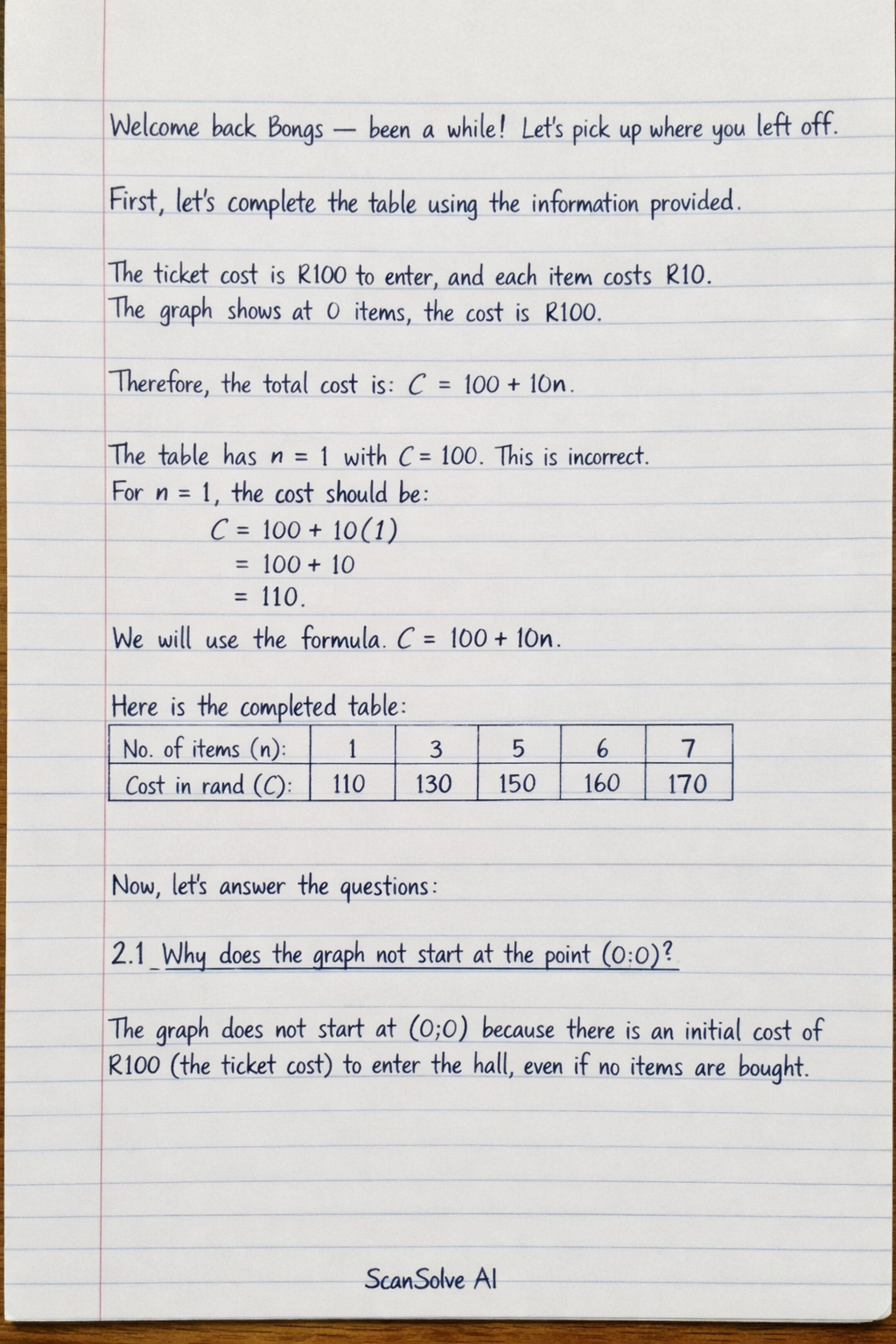
First, let's complete the table using the information provided. The problem states that the ticket cost is R100 to enter, and each item costs R10. The graph also shows that at 0 items, the cost is R100. This means the total cost (C) is R100 plus R10 for each item (n). So, the formula is C = 100 + 10n. The table provided has an entry for n=1 with C=100. This contradicts the problem description and the graph, which show that for n=1, the cost should be 100 + 10(1) = 110. We will proceed with the formula C = 100 + 10n derived from the problem statement and the graph. Here is the completed table: | No. of items (n) | 1 | 3 | 5 | 6 | 7 | | :--------------- | :-- | :-- | :-- | :-- | :-- | | Cost in rand (C) | 110 | 130 | 150 | 160 | 170 | Now, let's answer the questions: 2.1 Why does the graph not start at the point (0;0)? The graph does not start at (0;0) because there is an initial cost of R100 (the ticket cost) to enter the hall, even if no items are bought. 2.2 Determine the cost to enter the hall. Step 1: Identify the cost when no items are bought. From the problem description, "The ticket cost R100, a minimum amount just to enter the hall". From the graph, when the number of items (n) is 0, the cost (C) is R100. The cost to enter the hall is R100. 2.3 Is the given graph increasing or decreasing? Motivate your answer. Step 1: Observe the trend of the graph. As the number of items (n) increases along the x-axis, the total cost (C) increases along the y-axis. The graph is increasing because as the number of items bought increases, the total cost also increases. 2.4 If your bill comes to R110, how many items did you buy? Step 1: Use the cost formula C = 100 + 10n. Step 2: Substitute C = 110 into the formula. 110 = 100 + 10n Step 3: Solve for n. 110 - 100 = 10n 10 = 10n n = (10)/(10) n = 1 You bought 1 item. 2.5 Determine the formula that can be used to calculate the cost for buying a certain number of items if C represents cost and n the number of items bought. Step 1: Identify the fixed cost (entry ticket) and the variable cost (cost per item). Fixed cost = R100. Cost per item = R10. Step 2: Combine these into a linear equation. The formula is C = 100 + 10n. 2.6 How much will you pay if you bought 12 items? Step 1: Use the formula C = 100 + 10n. Step 2: Substitute n = 12 into the formula. C = 100 + 10(12) Step 3: Calculate the total cost. C = 100 + 120 C = 220 You will pay R220. Drop the next question 📸