

This mathematics problem involves applying core mathematical principles and formulas. Below you will find a complete step-by-step solution with detailed explanations for each step, helping you understand not just the answer but the method behind it.
ScanSolve AI Answer
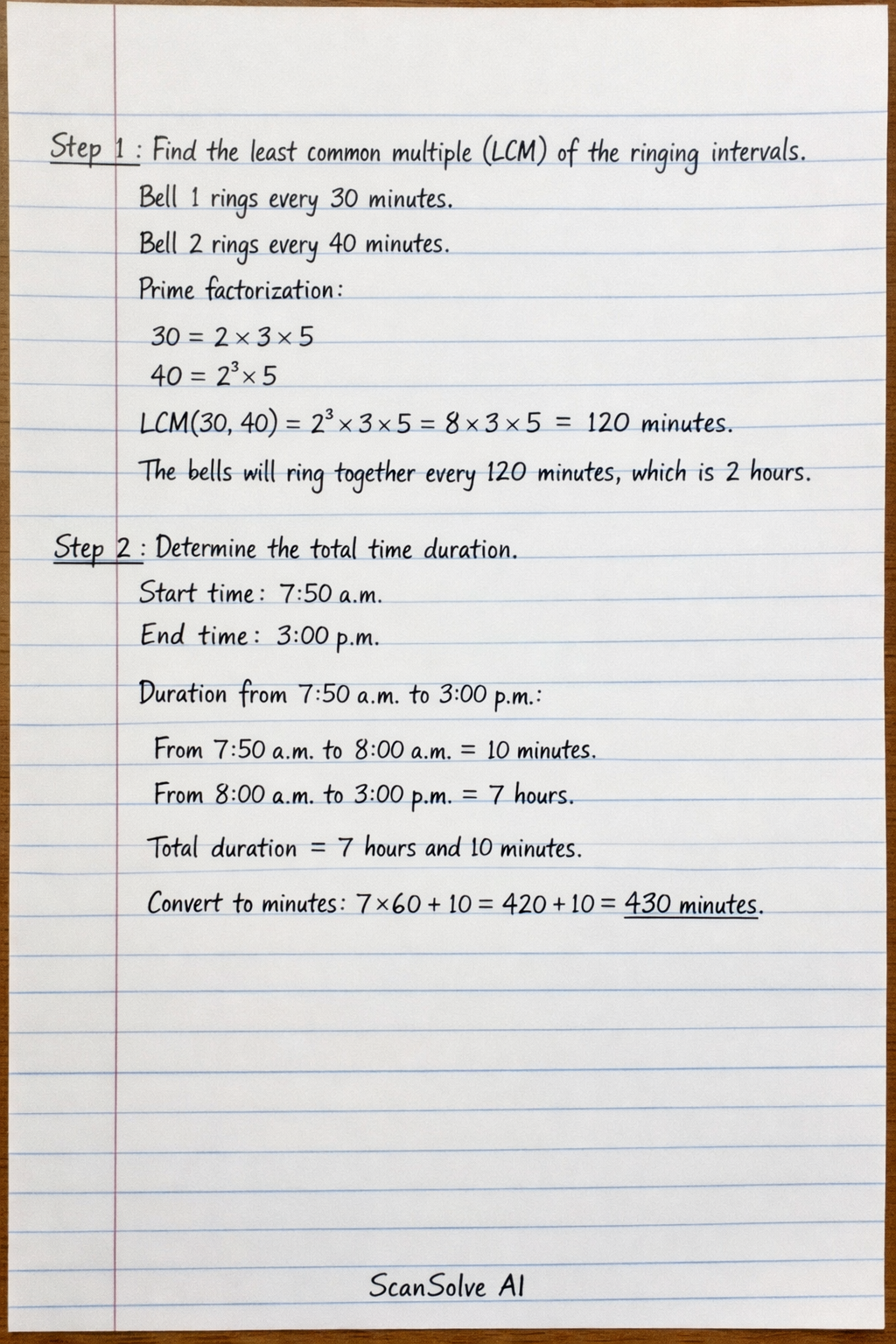
2. Lessons in Lake Primary and Kisumu Girls High Schools take 30 minutes and 40 minutes respectively. The two bells ring simultaneously at 7.50 a.m. How many times will they ring together again between 7.50 a.m. and 3 p.m.? Step 1: Find the least common multiple (LCM) of the ringing intervals. Bell 1 rings every 30 minutes. Bell 2 rings every 40 minutes. Prime factorization: 30 = 2 × 3 × 5 40 = 2^3 × 5 LCM(30, 40) = 2^3 × 3 × 5 = 8 × 3 × 5 = 120 minutes. The bells will ring together every 120 minutes, which is 2 hours. Step 2: Determine the total time duration. Start time: 7:50 a.m. End time: 3:00 p.m. Duration from 7:50 a.m. to 3:00 p.m.: From 7:50 a.m. to 8:00 a.m. = 10 minutes. From 8:00 a.m. to 3:00 p.m. = 7 hours. Total duration = 7 hours and 10 minutes. Convert to minutes: 7 × 60 + 10 = 420 + 10 = 430 minutes. Step 3: Calculate how many times the bells will ring together within this duration. The bells ring together every 120 minutes. Number of times = Total durationLCM Number of times = 430 minutes120 minutes/ring Number of times = 3.583... Since the bells must ring simultaneously, we only count the full intervals. This means they will ring together 3 more times after the initial 7:50 a.m. ring. The times they will ring together are: 1st time: 7:50 a.m. (initial ring) 2nd time: 7:50 a.m. + 2 hours = 9:50 a.m. 3rd time: 9:50 a.m. + 2 hours = 11:50 a.m. 4th time: 11:50 a.m. + 2 hours = 1:50 p.m. The next ring would be at 3:50 p.m., which is after 3:00 p.m. So, between 7:50 a.m. and 3:00 p.m., they will ring together 3 more times. The bells will ring together again between 7:50 a.m. and 3 p.m. 3 times.