
We read your photo as:
Find the length BC to the diagram below. A. |BC| = 3cm C. |BC| = 5cm B. |BC| = 4cm D. |BC| = 6cm
Mathematics
ScanSolve AI Answer
Step-by-step solution
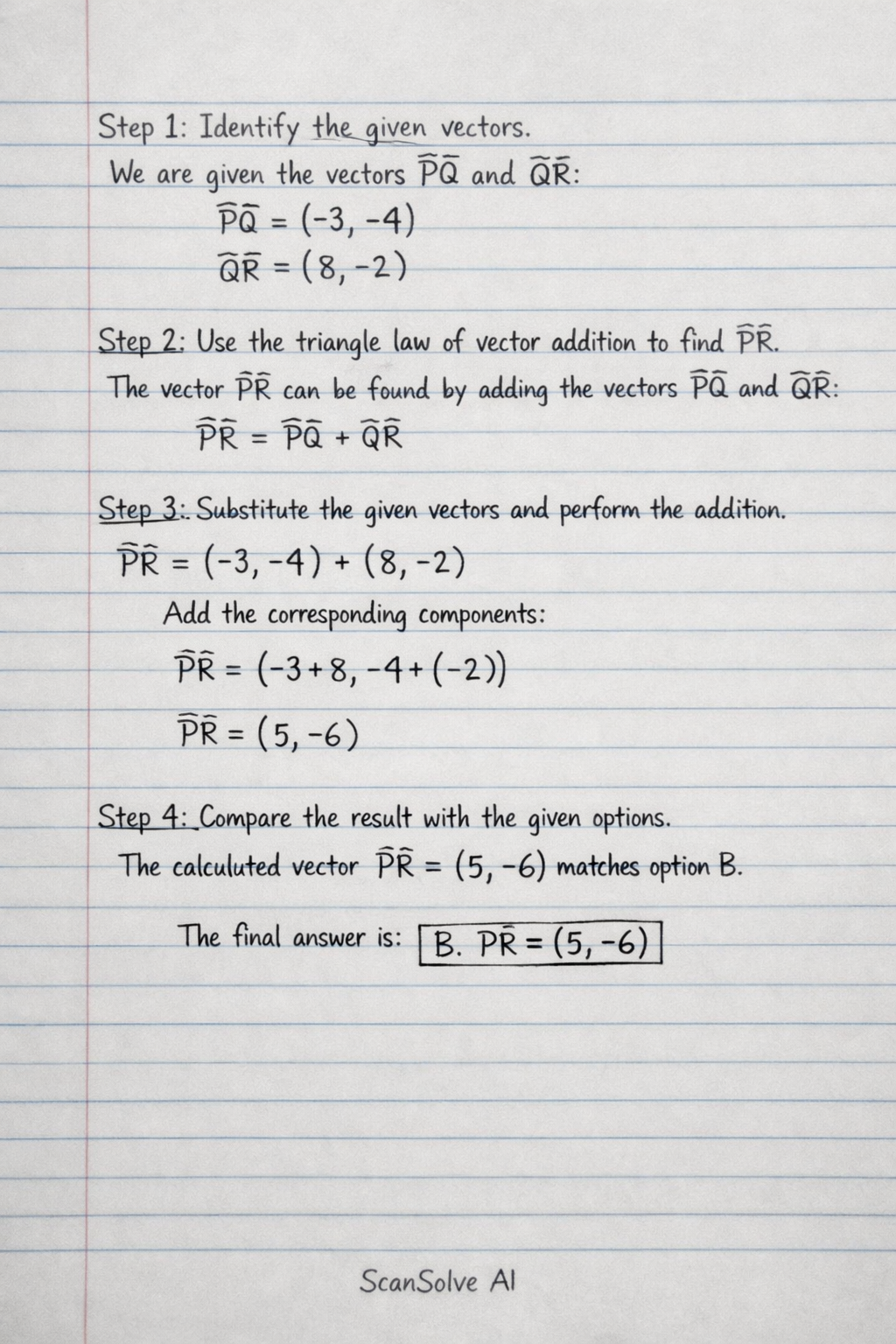
4 stepsIdentify the given vectors.
We are given the vectors and :
Use the triangle law of vector addition to find .
The vector can be found by adding the vectors and :
Substitute the given vectors and perform the addition.
Add the corresponding components:
Compare the result with the given options.
The calculated vector matches option B.
The final answer is .
Was this helpful?
Still stuck on this one?
Ask a follow-up, and the answer starts from this question.
Got a different question?Ask your own question
More Mathematics Questions
QFor the length of BC. From the diagram, ABC is a right-angled triangle with the right angle at B.QIn the diagram below DE//BC. DE = 2cm, BC = 3cm and AC = 2cm. Determine the value of x.QCalculate the distance BC.QGiven AB = 3 cm and BC = 4 cm, and ABC = 90^.QBased on the measurements provided in the figure: AB = 2.7 cm, BC = 1.5 cm, and the total length AD…
Handwritten Step-by-Step Solution
Get this as a handwritten image on WhatsApp — like a tutor wrote it for you.
Try on WhatsApp