
Write a lesson note for jss3 On a topic:probability
Mathematics
ScanSolve AI Answer
Step-by-step solution
5 stepsLesson Note: Probability
Topic: Introduction to Probability
Class: JSS 3
Time: 40 minutes
Learning Objectives:
By the end of this lesson, students will be able to:
- Define probability.
- Identify possible outcomes of an event.
- Calculate the probability of simple events.
Materials:
- Whiteboard or blackboard
- Markers or chalk
- Coins
- Dice
Lesson Procedure:
Introduction (5 minutes)
- Begin by asking students what they think "probability" means in everyday language.
- Guide them to understand that probability is about how likely something is to happen.
Defining Probability (5 minutes)
- Define probability as the measure of the likelihood of an event occurring.
- Explain that probability is usually expressed as a number between 0 and 1, inclusive.
- A probability of 0 means the event is impossible.
- A probability of 1 means the event is certain.
Outcomes and Events (10 minutes)
- Introduce the concept of an outcome: a single possible result of an experiment.
- Introduce the concept of an event: a set of one or more outcomes.
- Example 1 (Coin Toss):
- Experiment: Tossing a coin.
- Possible Outcomes: Heads (H), Tails (T).
- Event: Getting Heads.
- Example 2 (Dice Roll):
- Experiment: Rolling a standard six-sided die.
- Possible Outcomes: 1, 2, 3, 4, 5, 6.
- Event: Rolling an even number (outcomes: 2, 4, 6).
Calculating Simple Probability (15 minutes)
- Introduce the formula for calculating the probability of an event:
- Example 1 (Coin Toss):
- What is the probability of getting Heads when tossing a coin?
- Number of favorable outcomes (Heads) = 1
- Total number of possible outcomes (Heads, Tails) = 2
- Example 2 (Dice Roll):
- What is the probability of rolling a 4 on a die?
- Number of favorable outcomes (rolling a 4) = 1
- Total number of possible outcomes (1, 2, 3, 4, 5, 6) = 6
- Example 3 (Dice Roll):
- What is the probability of rolling an odd number on a die?
- Number of favorable outcomes (1, 3, 5) = 3
- Total number of possible outcomes = 6
Conclusion and Practice (5 minutes)
- Briefly recap the definition of probability and the formula.
- Ask students to state the probability of getting Tails on a coin toss.
Was this helpful?
Still stuck on this one?
Ask a follow-up, and the answer starts from this question.
Got a different question?Ask your own question
More Mathematics Questions
QSet 5 questions for jss3 on probaabilityQFull notes on probabilityQThe topic is probabilityQWrite the probability scale.
Browse by topic:Statistics
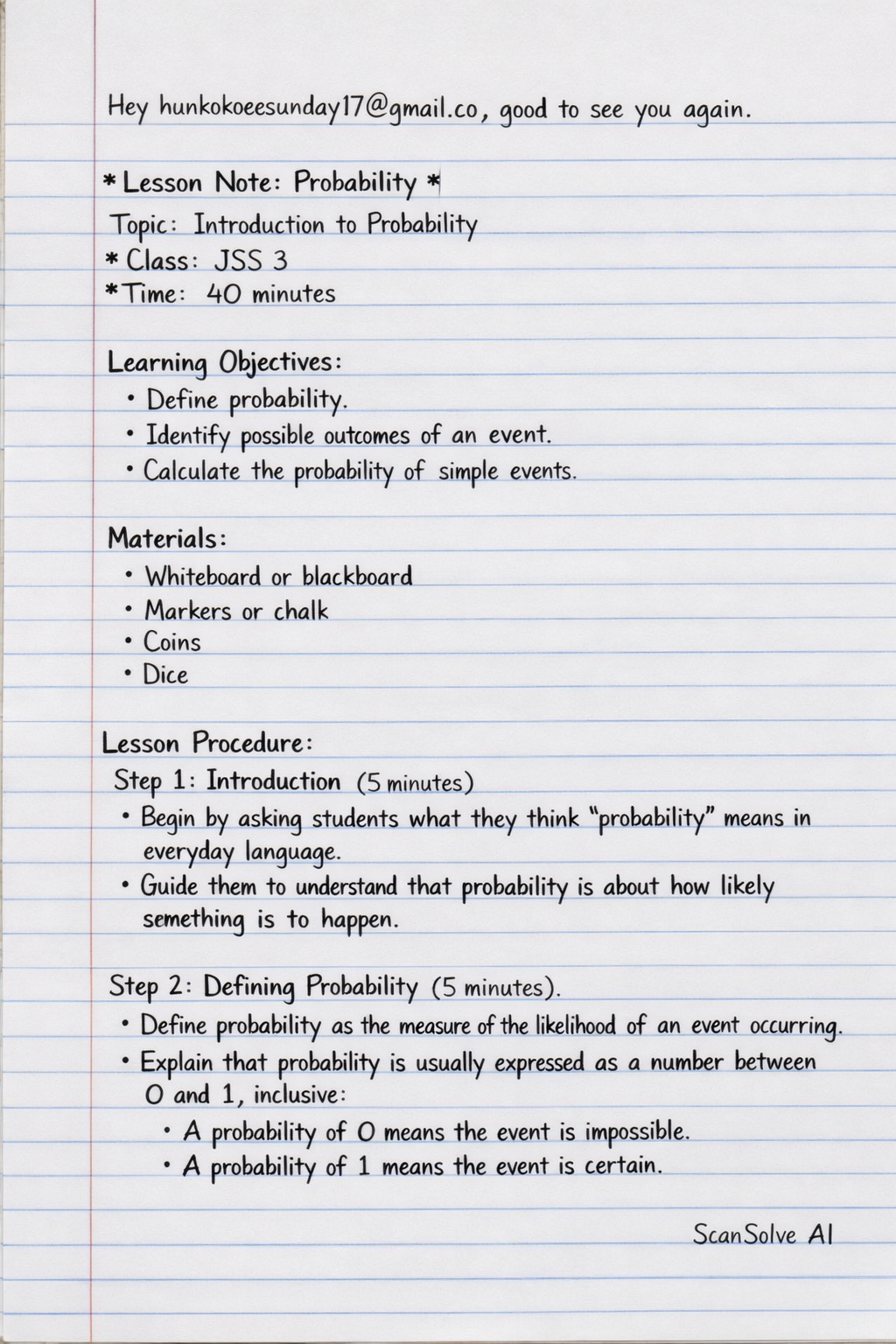
Handwritten Step-by-Step Solution
Get this as a handwritten image on WhatsApp — like a tutor wrote it for you.
Try on WhatsApp