
We read your photo as:
Let A be the set of patients who have Hypertension, B be the set of patients who have Diabetes, and C be the set of patients who have High Cholesterol. D is the set of patients older than 65 years. De
ScanSolve AI Answer
Step-by-step solution
10 stepsPart a(i)· 1 step
Step 1: Define .
represents the set of patients who have Hypertension or Diabetes (or both).
Identify the medical condition.
This group represents patients with at least one of Hypertension or Diabetes.
Part a(ii)· 2 steps
Step 1: Define the sets involved.
represents patients with Hypertension or Diabetes.
represents patients older than 65 years.
Describe .
represents patients who have Hypertension or Diabetes AND are older than 65 years.
Explain its relevance to public health planning.
In public health planning, this set represents elderly patients with at least one of Hypertension or Diabetes. This group is a high-risk population that may require targeted healthcare interventions and resource allocation.
Part a(iii)· 1 step
Step 1: Define .
is the complement of set .
Describe the patients in .
The patients in set are those who do not have Diabetes.
Part a(iv)· 2 steps
Step 1: Describe .
represents patients who have Hypertension but do not have High Cholesterol.
Describe .
represents patients who do not have High Cholesterol.
represents patients who have Hypertension AND do not have High Cholesterol.Identify the key difference.
The key difference is that and are two different notations for the exact same set of patients. They represent the same group.
Part a(v)· 1 step
Step 1: Identify the conditions.
Patients who have Diabetes are in set .
Patients who do not have High Cholesterol are in set .
Combine using set notation.
The set notation is or .
Part a(vi)· 1 step
Step 1: Define symmetric difference in words.
The symmetric difference represents the set of patients who have Hypertension or Diabetes, but not both.
Explain what represents.
represents the number of patients who have Hypertension or Diabetes, but not both.
Part a(vii)· 1 step
Step 1: Identify the conditions for "exactly one".
A patient has exactly one condition if they have A but not B and not C, OR B but not A and not C, OR C but not A and not B.
Express using set notation.
The set of patients is .
Part a(viii)· 1 step
Step 1: List the elements of set .
List all possible subsets of .
The power set is:
Still stuck on this one?
Ask a follow-up, and the answer starts from this question.
More Mathematics Questions
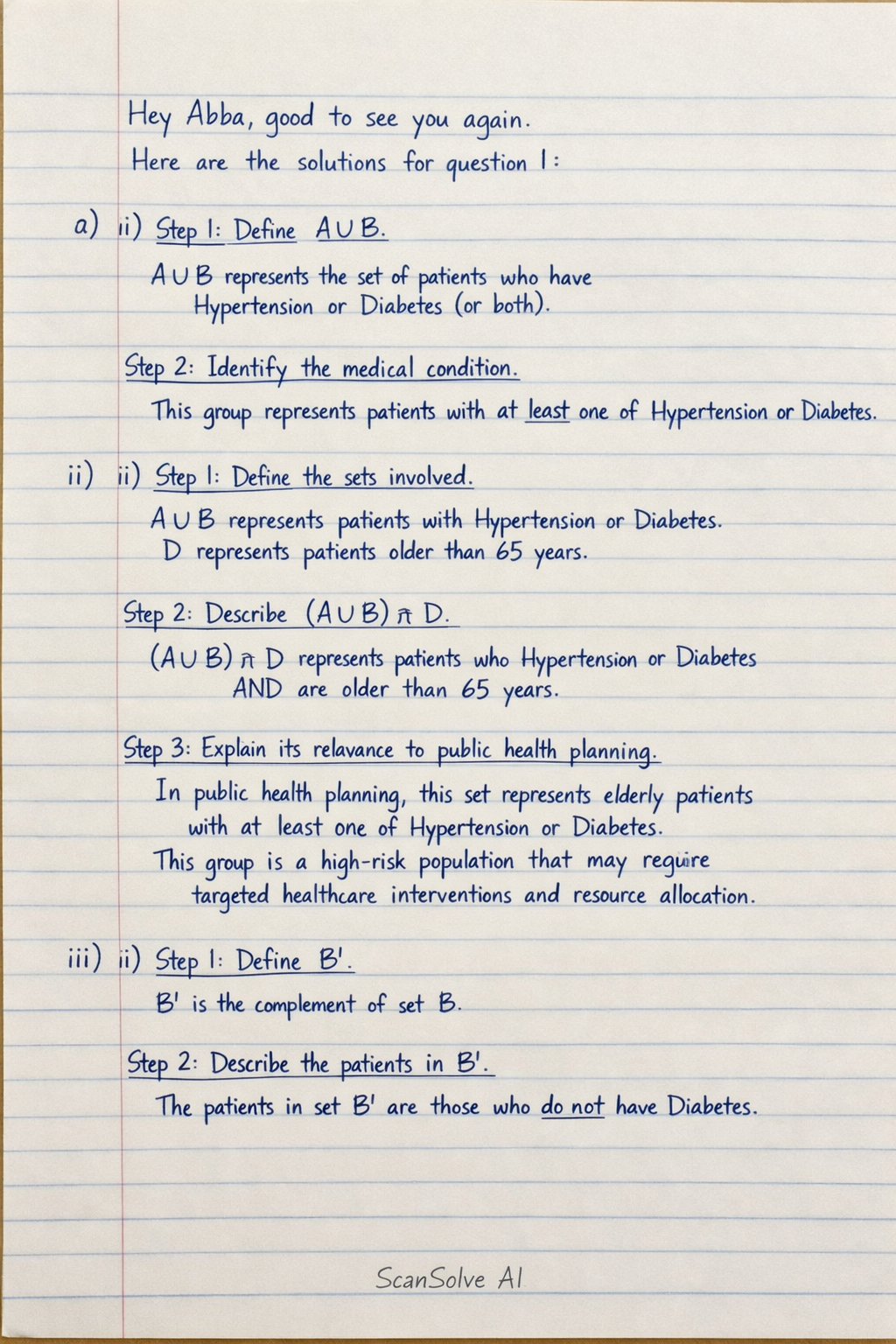
Handwritten Step-by-Step Solution
Get this as a handwritten image on WhatsApp — like a tutor wrote it for you.
Try on WhatsApp