We read your photo as:

Let f(x) = (4x)/(x-1). (i) Show that f is injective. (ii) Find the composite function f(f(x)) and determine its domain.

Mathematics

ScanSolve AI Answer

Graph of f(x) = (4x)/(x − 1)

Use the left and right arrow keys to trace the curve, up and down to jump between key points, and plus and minus to zoom.

Key points of f(x) = (4x)/(x − 1)
Pointxy
x-intercept00

Step-by-step solution

6 steps

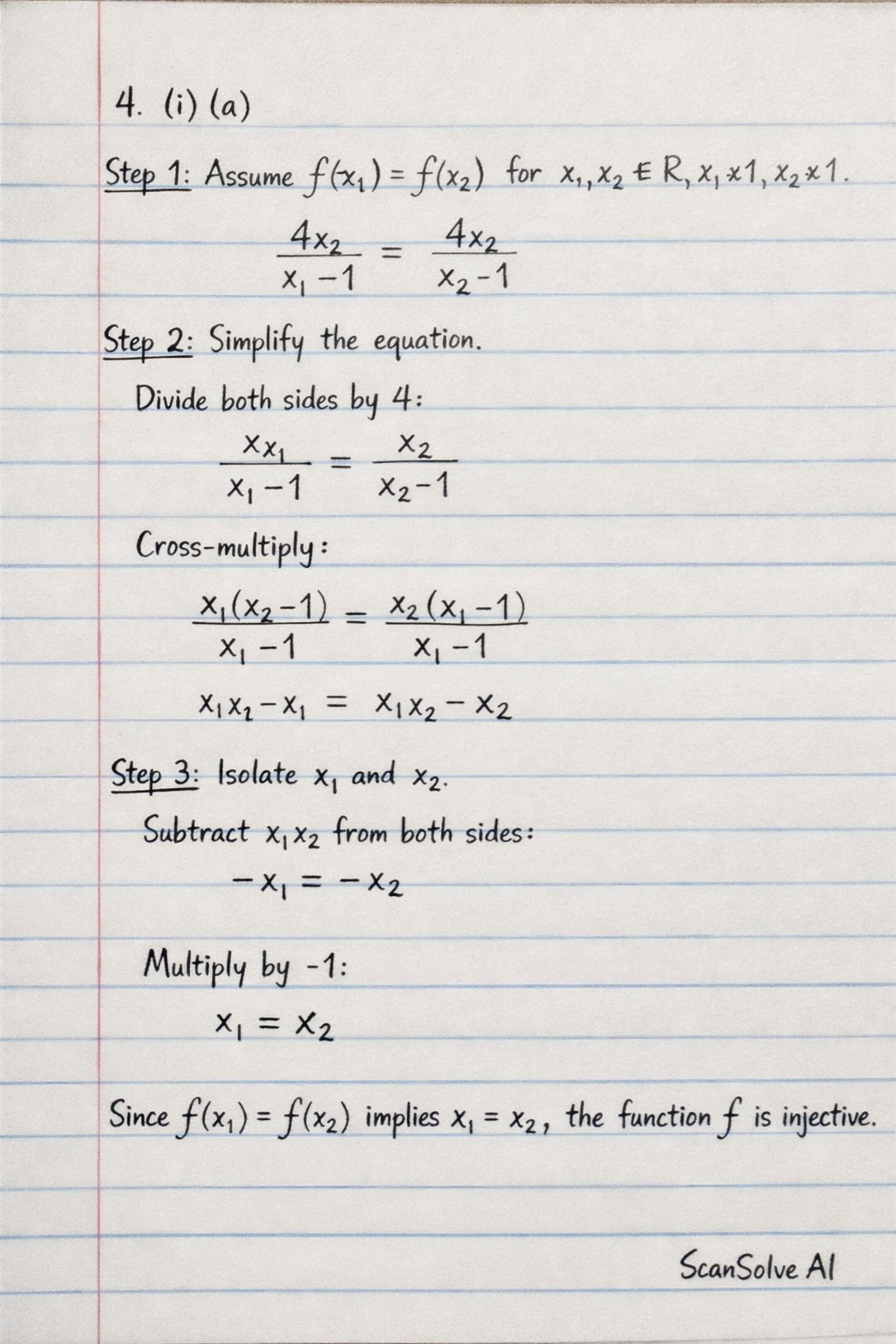
4. (i) (a)

  1. Assume f(x1)=f(x2)f(x_1) = f(x_2) for x1,x2∈R,x1≠1,x2≠1x_1, x_2 \in \mathbb{R}, x_1 \neq 1, x_2 \neq 1.

    4x1x1−1=4x2x2−1\frac{4x_1}{x_1-1} = \frac{4x_2}{x_2-1}
  2. Simplify the equation.

    Divide both sides by 4:

    x1x1−1=x2x2−1\frac{x_1}{x_1-1} = \frac{x_2}{x_2-1}

    Cross-multiply:

    x1(x2−1)=x2(x1−1)x_1(x_2-1) = x_2(x_1-1) x1x2−x1=x1x2−x2x_1x_2 - x_1 = x_1x_2 - x_2
  3. Isolate x1x_1 and x2x_2.

    Subtract x1x2x_1x_2 from both sides:

    −x1=−x2-x_1 = -x_2

    Multiply by -1:

    x1=x2x_1 = x_2

    Since f(x1)=f(x2)f(x_1) = f(x_2) implies x1=x2x_1 = x_2, the function ff is injective.

    4. (i) (b)

  4. Find the composite function (f∘f)(x)(f \circ f)(x).

    (f∘f)(x)=f(f(x))=f(4xx−1)(f \circ f)(x) = f(f(x)) = f\left(\frac{4x}{x-1}\right)

    Substitute 4xx−1\frac{4x}{x-1} into the function f(x)=4xx−1f(x) = \frac{4x}{x-1}:

    (f∘f)(x)=4(4xx−1)(4xx−1)−1(f \circ f)(x) = \frac{4\left(\frac{4x}{x-1}\right)}{\left(\frac{4x}{x-1}\right)-1}
  5. Simplify the expression.

    =16xx−14x−(x−1)x−1= \frac{\frac{16x}{x-1}}{\frac{4x - (x-1)}{x-1}} =16xx−14x−x+1x−1= \frac{\frac{16x}{x-1}}{\frac{4x - x + 1}{x-1}} =16xx−13x+1x−1= \frac{\frac{16x}{x-1}}{\frac{3x + 1}{x-1}} =16xx−1⋅x−13x+1= \frac{16x}{x-1} \cdot \frac{x-1}{3x+1} (f∘f)(x)=16x3x+1(f \circ f)(x) = \boxed{\frac{16x}{3x+1}}
  6. Determine the domain of (f∘f)(x)(f \circ f)(x).

    For (f∘f)(x)(f \circ f)(x) to be defined, two conditions must be met:

    1. xx must be in the domain of ff. This means x≠1x \neq 1.
    2. f(x)f(x) must be in the domain of ff. This means f(x)≠1f(x) \neq 1. 4xx−1≠1\frac{4x}{x-1} \neq 1 4x≠x−14x \neq x-1 3x≠−13x \neq -1 x≠−13x \neq -\frac{1}{3}

    Also, the denominator of the simplified (f∘f)(x)(f \circ f)(x) cannot be zero, so 3x+1≠0  ⟹  x≠−133x+1 \neq 0 \implies x \neq -\frac{1}{3}. Combining these conditions, the domain is x∈R,x≠1,x≠−13\boxed{x \in \mathbb{R}, x \neq 1, x \neq -\frac{1}{3}}.

    4. (ii) (a)
    The statement p∧qp \wedge q means "pp and qq".
    pp: The principal goes to the ministry.
    qq: The principal will meet the minister.
    Therefore, p∧qp \wedge q in ordinary English is:
    The principal goes to the ministry and will meet the minister.\boxed{\text{The principal goes to the ministry and will meet the minister.}}

Was this helpful?

Still stuck on this one?

Ask a follow-up, and the answer starts from this question.

Got a different question?Ask your own question
Handwritten step-by-step solution preview

Handwritten Step-by-Step Solution

Get this as a handwritten image on WhatsApp — like a tutor wrote it for you.

Try on WhatsApp