We read your photo as:

Let m be an odd integer. Show that the number (m4 + 4m2 + 11)/16 is an integer.

Mathematics

ScanSolve AI Answer

Step-by-step solution

16 steps

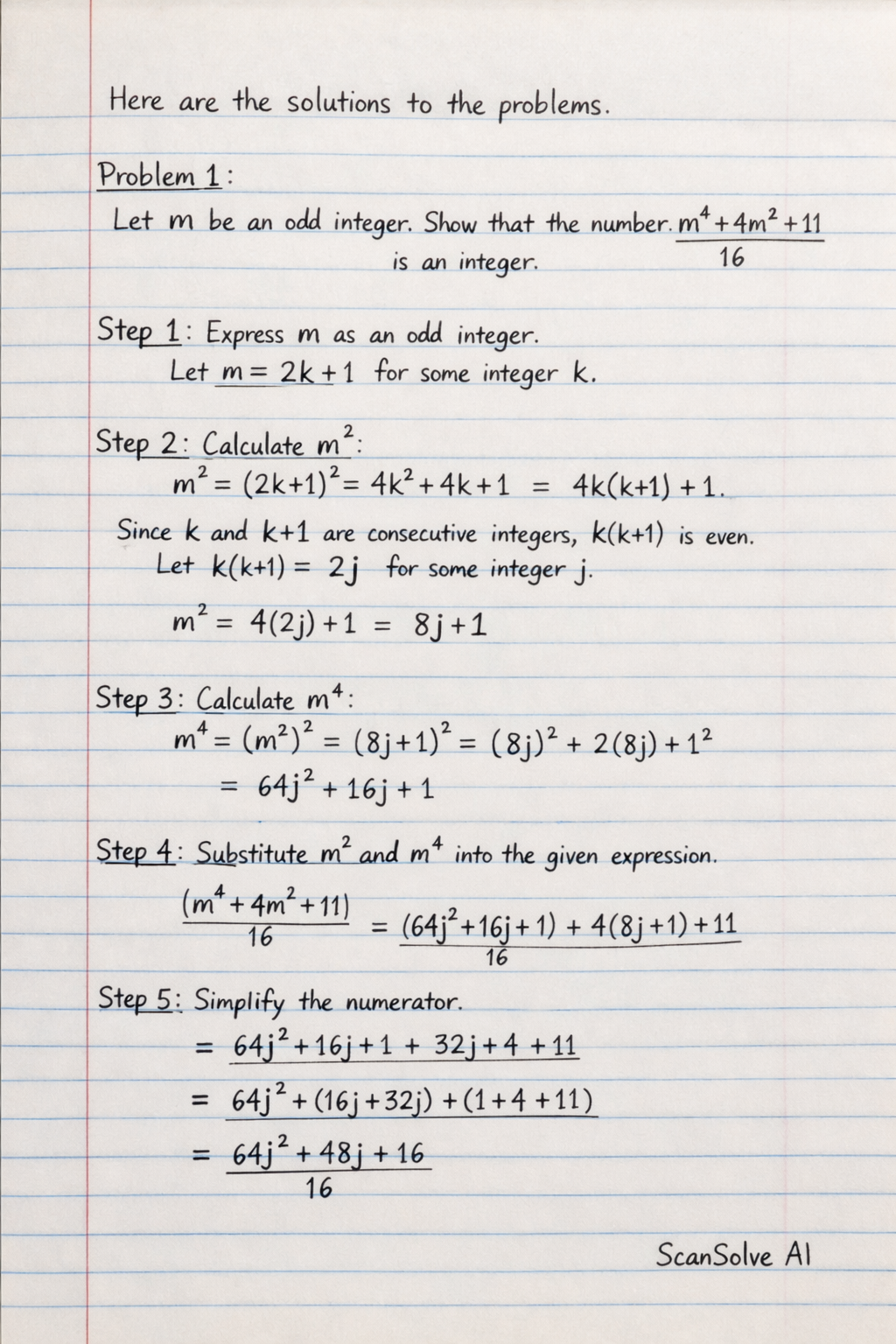
Here are the solutions to the problems.

:

Let mm be an odd integer. Show that the number m4+4m2+1116\frac{m^4 + 4m^2 + 11}{16} is an integer.

  1. Express mm as an odd integer.

    Let m=2k+1m = 2k+1 for some integer kk.

  2. Calculate m2m^2.

    m2=(2k+1)2=4k2+4k+1=4k(k+1)+1m^2 = (2k+1)^2 = 4k^2 + 4k + 1 = 4k(k+1) + 1

    Since kk and k+1k+1 are consecutive integers, their product k(k+1)k(k+1) is always an even number. Let k(k+1)=2jk(k+1) = 2j for some integer jj.

    m2=4(2j)+1=8j+1m^2 = 4(2j) + 1 = 8j + 1
  3. Calculate m4m^4.

    m4=(m2)2=(8j+1)2=(8j)2+2(8j)(1)+12=64j2+16j+1m^4 = (m^2)^2 = (8j+1)^2 = (8j)^2 + 2(8j)(1) + 1^2 = 64j^2 + 16j + 1
  4. Substitute m2m^2 and m4m^4 into the given expression.

    m4+4m2+1116=(64j2+16j+1)+4(8j+1)+1116\frac{m^4 + 4m^2 + 11}{16} = \frac{(64j^2 + 16j + 1) + 4(8j + 1) + 11}{16}
  5. Simplify the numerator.

    =64j2+16j+1+32j+4+1116= \frac{64j^2 + 16j + 1 + 32j + 4 + 11}{16} =64j2+(16j+32j)+(1+4+11)16= \frac{64j^2 + (16j + 32j) + (1 + 4 + 11)}{16} =64j2+48j+1616= \frac{64j^2 + 48j + 16}{16}
  6. Divide each term in the numerator by 16.

    =64j216+48j16+1616= \frac{64j^2}{16} + \frac{48j}{16} + \frac{16}{16} =4j2+3j+1= 4j^2 + 3j + 1

    Since jj is an integer, 4j24j^2, 3j3j, and 1 are all integers. The sum of integers is an integer.
    Therefore, the expression is an integer.

    The expression is an integer.\boxed{\text{The expression is an integer.}}

    :

    If a,b,a, b, and cc are positive real numbers, then show that: ba×cb×ac=1\sqrt{\frac{b}{a}} \times \sqrt{\frac{c}{b}} \times \sqrt{\frac{a}{c}} = 1

  7. Combine the terms under a single square root using the property x×y×z=xyz\sqrt{x} \times \sqrt{y} \times \sqrt{z} = \sqrt{xyz}.

    ba×cb×ac\sqrt{\frac{b}{a} \times \frac{c}{b} \times \frac{a}{c}}
  8. Multiply the fractions inside the square root.

    b⋅c⋅aa⋅b⋅c\sqrt{\frac{b \cdot c \cdot a}{a \cdot b \cdot c}}
  9. Cancel out common terms in the numerator and denominator.

    abcabc=1\sqrt{\frac{abc}{abc}} = \sqrt{1}
  10. Evaluate the square root.

    1=1\sqrt{1} = 1

    Thus, ba×cb×ac=1\sqrt{\frac{b}{a}} \times \sqrt{\frac{c}{b}} \times \sqrt{\frac{a}{c}} = 1.

    ba×cb×ac=1\boxed{\sqrt{\frac{b}{a}} \times \sqrt{\frac{c}{b}} \times \sqrt{\frac{a}{c}} = 1}

    :

    Suppose n=32\sqrt{n} = \frac{3}{2}, find −n-\sqrt{n}.

  11. Substitute the given value of n\sqrt{n} into the expression −n-\sqrt{n}.

    −n=−(32)-\sqrt{n} = -\left(\frac{3}{2}\right)
  12. Simplify the expression.

    −32-\frac{3}{2} −32\boxed{-\frac{3}{2}}

    :

    Let aa and bb be positive real numbers. Show that ab+ba≥2\frac{a}{b} + \frac{b}{a} \ge 2.

  13. Start with the known inequality that for any real numbers xx and yy, (x−y)2≥0(x-y)^2 \ge 0.

    Expand this inequality:

    x2−2xy+y2≥0x^2 - 2xy + y^2 \ge 0
  14. Rearrange the terms.

    x2+y2≥2xyx^2 + y^2 \ge 2xy
  15. Let x=ax = \sqrt{a} and y=by = \sqrt{b}.

    Substitute these into the inequality.

    (a)2+(b)2≥2ab(\sqrt{a})^2 + (\sqrt{b})^2 \ge 2\sqrt{a}\sqrt{b} a+b≥2aba + b \ge 2\sqrt{ab}

    This is the AM-GM inequality for aa and bb.

  16. Step 16

Was this helpful?

Still stuck on this one?

Ask a follow-up, and the answer starts from this question.

Got a different question?Ask your own question
Handwritten step-by-step solution preview

Handwritten Step-by-Step Solution

Get this as a handwritten image on WhatsApp — like a tutor wrote it for you.

Try on WhatsApp