
We read your photo as:
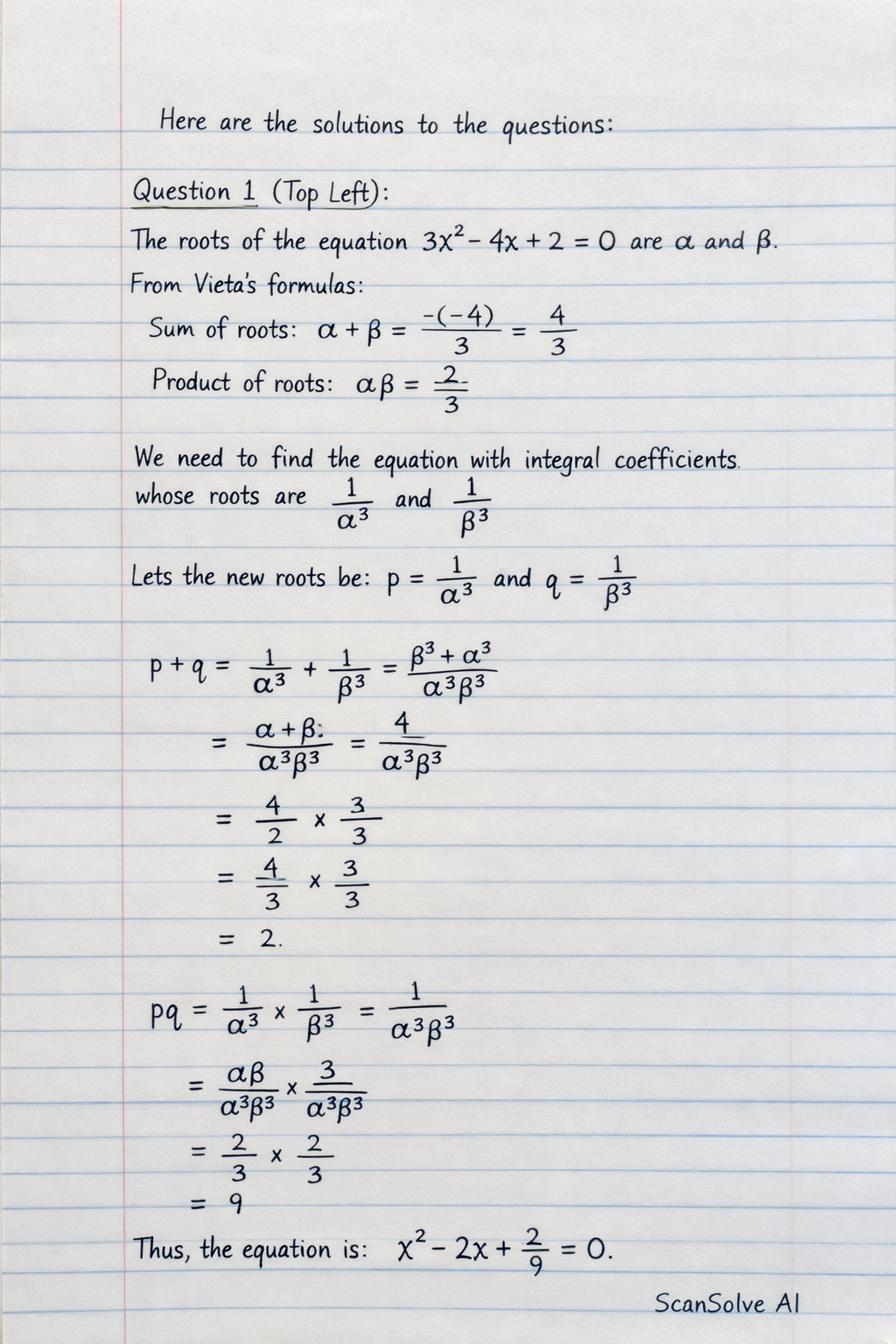
Let the roots of the equation 3x2 − 4x + 2 = 0 be alpha and beta. Find the equation with integral coefficients whose roots are (1)/(alpha3) and (1)/(beta3).
Mathematics
ScanSolve AI Answer
Here are the solutions to the questions:
Question 1 (Top Left):
The roots of the equation are and .
From Vieta's formulas:
Sum of roots:
Product of roots:
We need to find the equation with integral coefficients whose roots are and .
Let the new roots be and .
Was this helpful?
Still stuck on this one?
Ask a follow-up, and the answer starts from this question.
Got a different question?Ask your own question
More Mathematics Questions
QIf alpha and beta are the roots of the equation 3x2 - 2x − 1 = 0, find the equation whose roots are…QGiven the roots of the equation 3x2 - 4x + 2 = 0 are alpha and beta. Find the sum and product of the…QGiven that the roots of the equation 3x² − 4x + 2 = 0 are alpha and beta.QIf alpha and beta are the roots of 5x2 - 9x − 4 = 0, find the equation whose roots are (alpha2 - 3)…
Browse by topic:Calculus
Handwritten Step-by-Step Solution
Get this as a handwritten image on WhatsApp — like a tutor wrote it for you.
Try on WhatsApp