Evaluate the limit a = _x o 0 sqrt(1+1+x4)-sqrt(2)x4
|Mathematics
Evaluate the limit a = _x o 0 sqrt(1+1+x4)-sqrt(2)x4
ScanSolve AI Answer
Answer
32
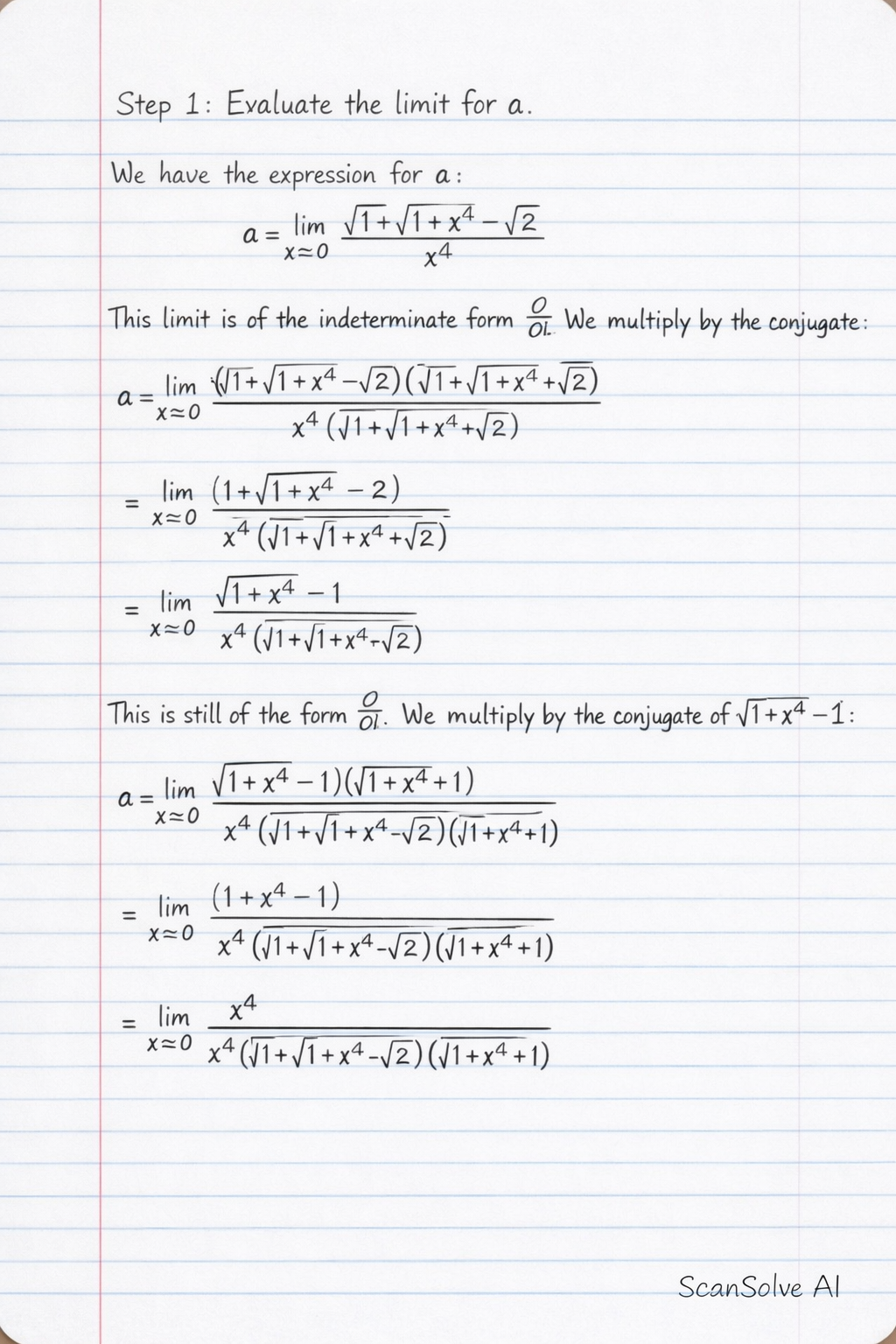
Step 1: Evaluate the limit for a.
We have the expression for a:
a=limx→0x41+1+x4−2
This limit is of the indeterminate form 00. We multiply the numerator and denominator by the conjugate of the numerator, which is 1+1+x4+2:
a=limx→0x4(1+1+x4+2)(1+1+x4−2)(1+1+x4+2)a=limx→0x4(1+1+x4+2)(1+1+x4)−2a=limx→0x4(1+1+x4+2)1+x4−1
This is still of the form 00. We multiply the numerator and denominator by the conjugate of 1+x4−1, which is 1+x4+1:
a=limx→0x4(1+1+x4+2)(1+x4+1)(1+x4−1)(1+x4+1)a=limx→0x4(1+1+x4+2)(1+x4+1)(1+x4)−1a=limx→0x4(1+1+x4+2)(1+x4+1)x4
Cancel x4 from the numerator and denominator (since x→0, x=0):
a=limx→0(1+1+x4+2)(1+x4+1)1
Now, substitute x=0:
a=(1+1+04+2)(1+04+1)1a=(1+1+2)(1+1)1a=(1+1+2)(1+1)1a=(2+2)(2)1a=(22)(2)1a=421
Rationalize the denominator:
a=421×22=82
Step 2: Evaluate the limit for b.
We have the expression for b:
b=limx→02−1+cosxsin2x
This limit is of the indeterminate form 00. We multiply the numerator and denominator by the conjugate of the denominator, which is 2+1+cosx:
b=limx→0(2−1+cosx)(2+1+cosx)sin2x(2+1+cosx)b=limx→02−(1+cosx)sin2x(2+1+cosx)b=limx→01−cosxsin2x(2+1+cosx)
Use the trigonometric identity sin2x=1−cos2x=(1−cosx)(1+cosx):
b=limx→01−cosx(1−cosx)(1+cosx)(2+1+cosx)
Cancel (1−cosx) from the numerator and denominator (since x→0, 1−cosx=0 for x near 0 but not equal to 0):
b=limx→0(1+cosx)(2+1+cosx)
Now, substitute x=0:
b=(1+cos0)(2+1+cos0)b=(1+1)(2+1+1)b=(2)(2+2)b=(2)(22)b=42
Step 3: Calculate the value of ab3.
Substitute the values of a and b we found:
ab3=(82)(42)3ab3=(82)(43⋅(2)3)ab3=(82)(64⋅22)ab3=(82)(1282)ab3=82⋅1282ab3=8128⋅(2)2ab3=8128⋅2ab3=8256ab3=32
The final answer is 32.
Was this helpful?
Need help with your own homework?
Get instant step-by-step solutions to any question. Free to start.
This mathematics problem involves applying core mathematical principles and formulas. Below you will find a complete step-by-step solution with detailed explanations for each step, helping you understand not just the answer but the method behind it.
ScanSolve AI Answer
Step 1: Evaluate the limit for a. We have the expression for a: a = _x 0 sqrt(1+1+x^4)-sqrt(2)x^4 This limit is of the indeterminate form (0)/(0). We multiply the numerator and denominator by the conjugate of the numerator, which is sqrt(1+1+x^4)+sqrt(2): a = _x 0 (sqrt(1+1+x^4)-sqrt(2))(sqrt(1+1+x^4)+sqrt(2))x^4(sqrt(1+1+x^4)+sqrt(2)) a = _x 0 (1+sqrt(1+x^4)) - 2x^4(sqrt(1+1+x^4)+sqrt(2)) a = _x 0 sqrt(1+x^4) - 1x^4(sqrt(1+1+x^4)+sqrt(2)) This is still of the form (0)/(0). We multiply the numerator and denominator by the conjugate of sqrt(1+x^4)-1, which is sqrt(1+x^4)+1: a = _x 0 (sqrt(1+x^4) - 1)(sqrt(1+x^4) + 1)x^4(sqrt(1+1+x^4)+sqrt(2))(sqrt(1+x^4)+1) a = _x 0 ((1+x^4) - 1)/(x^4(sqrt(1+1+x^4))+sqrt(2))(sqrt(1+x^4)+1) a = _x 0 (x^4)/(x^4(sqrt(1+1+x^4))+sqrt(2))(sqrt(1+x^4)+1) Cancel x^4 from the numerator and denominator (since x 0, x ≠ 0): a = _x 0 (1)/((sqrt(1+1+x^4))+sqrt(2))(sqrt(1+x^4)+1) Now, substitute x=0: a = (1)/((sqrt(1+1+0^4))+sqrt(2))(sqrt(1+0^4)+1) a = (1)/((sqrt(1+1))+sqrt(2))(sqrt(1)+1) a = (1)/((sqrt(1+1)+2))(1+1) a = (1)/((sqrt(2)+2))(2) a = (1)/((2sqrt(2))(2)) a = (1)/(4sqrt(2)) Rationalize the denominator: a = (1)/(4sqrt(2)) × sqrt(2)sqrt(2) = sqrt(2)8 Step 2: Evaluate the limit for b. We have the expression for b: b = _x 0 (^2 x)/(sqrt(2)-1+ x) This limit is of the indeterminate form (0)/(0). We multiply the numerator and denominator by the conjugate of the denominator, which is sqrt(2)+sqrt(1+ x): b = _x 0 ^2 x (sqrt(2)+sqrt(1+ x))(sqrt(2)-sqrt(1+ x))(sqrt(2)+sqrt(1+ x)) b = _x 0 ^2 x (sqrt(2)+sqrt(1+ x))2 - (1+ x) b = _x 0 ^2 x (sqrt(2)+sqrt(1+ x))1 - x Use the trigonometric identity ^2 x = 1 - ^2 x = (1- x)(1+ x): b = _x 0 (1- x)(1+ x) (sqrt(2)+sqrt(1+ x))1 - x Cancel (1- x) from the numerator and denominator (since x 0, 1- x ≠ 0 for x near 0 but not equal to 0): b = _x 0 (1+ x) (sqrt(2)+sqrt(1+ x)) Now, substitute x=0: b = (1+ 0) (sqrt(2)+sqrt(1+ 0)) b = (1+1) (sqrt(2)+sqrt(1+1)) b = (2) (sqrt(2)+sqrt(2)) b = (2) (2sqrt(2)) b = 4sqrt(2) Step 3: Calculate the value of ab^3. Substitute the values of a and b we found: ab^3 = (sqrt(2)8) (4sqrt(2))^3 ab^3 = (sqrt(2)8) (4^3 · (sqrt(2))^3) ab^3 = (sqrt(2)8) (64 · 2sqrt(2)) ab^3 = (sqrt(2)8) (128sqrt(2)) ab^3 = sqrt(2) · 128sqrt(2)8 ab^3 = 128 · (sqrt(2))^28 ab^3 = (128 · 2)/(8) ab^3 = (256)/(8) ab^3 = 32 The final answer is 32.