
We read your photo as:
Find the limit of the following functions as x approaches c: i) f(x) = x2, ii) f(x) = 1/x, iii) f(x) = sqrt(x)
ScanSolve AI Answer
Answer
2c
Step-by-step solution
15 stepsHere are the limits for each function:
Part i· 4 steps
For
Substitute and into the limit expression.
Factor the numerator using the difference of squares formula, .
Cancel out the term, since as .
Substitute into the simplified expression.
The limit is .
Part ii· 6 steps
For
Substitute and into the limit expression.
Combine the fractions in the numerator.
Rewrite the expression by multiplying the numerator by the reciprocal of the denominator.
Factor out from the numerator to match the term in the denominator.
Cancel out the term.
Substitute into the simplified expression.
The limit is .
Part iii· 5 steps
For
Substitute and into the limit expression.
Multiply the numerator and denominator by the conjugate of the numerator, .
Apply the difference of squares formula to the numerator.
Cancel out the term.
Substitute into the simplified expression.
The limit is .
Try one yourself
A new problem that tests the same skill.
Still stuck on this one?
Ask a follow-up, and the answer starts from this question.
More Mathematics Questions
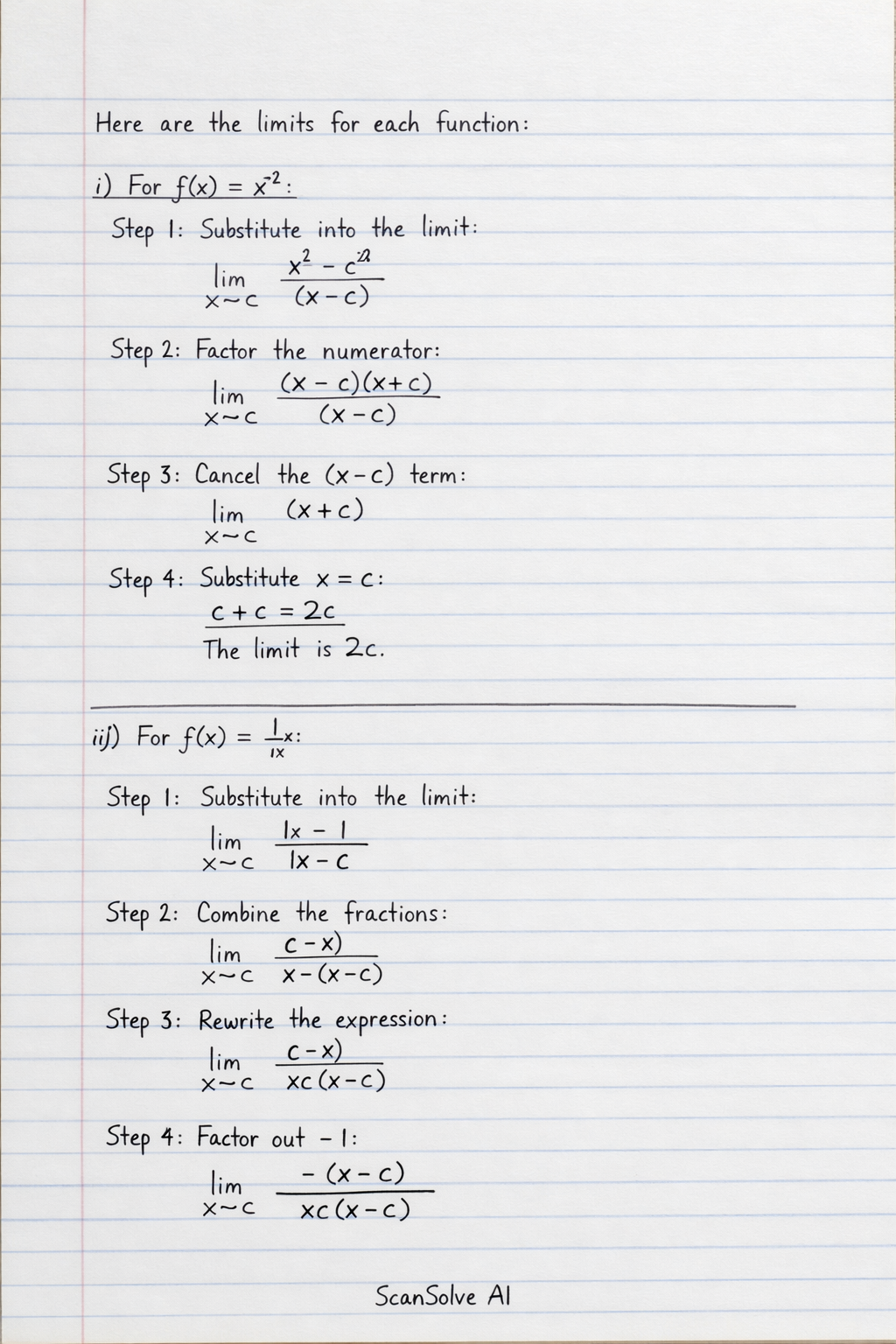
Handwritten Step-by-Step Solution
Get this as a handwritten image on WhatsApp — like a tutor wrote it for you.
Try on WhatsApp