
We read your photo as:
Evaluate the line integral integral_C (pi y) dy + yx2 dx, where C is the line segment from (0,2) to (1,4).
ScanSolve AI Answer
Answer
Step-by-step solution
4 stepsParameterize the line segment .
The line segment goes from to .
A parameterization for a line segment is given by:for .
Substitute the given points:
So, and for .
Find and in terms of .
Differentiate and with respect to :
Substitute , , , and into the integral.
The integral is .
Substitute , , , :Using the periodicity of the sine function, :
So, the first term becomes .
The second term is :
Now, substitute these into the integral, changing the limits of integration from to :
Evaluate the definite integral.
Integrate each term with respect to :
Now, evaluate the definite integral from to :
Since and :
To add these fractions, find a common denominator, which is 6:
The value of the line integral is .
Try one yourself
A new problem that tests the same skill.
Still stuck on this one?
Ask a follow-up, and the answer starts from this question.
More Mathematics Questions
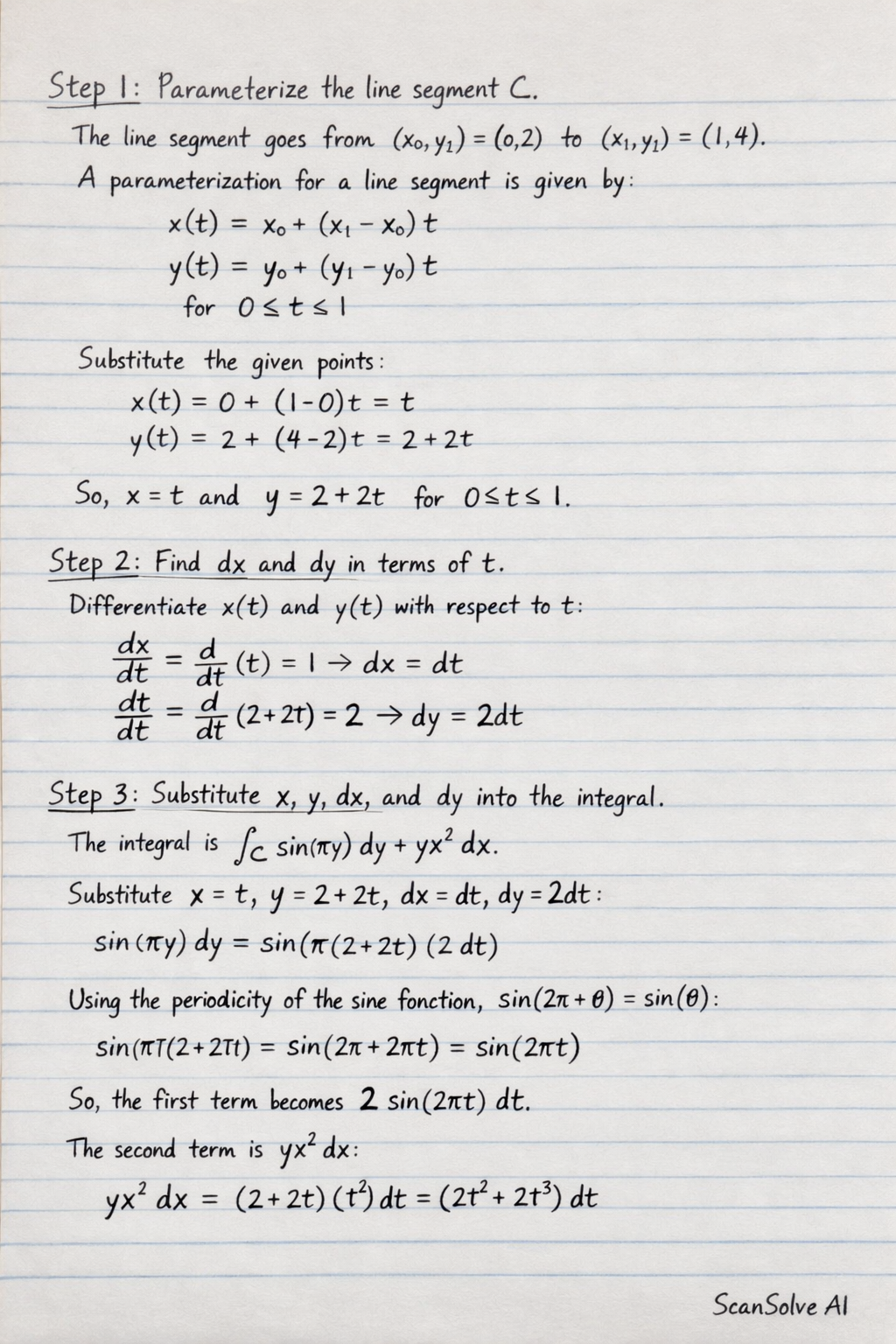
Handwritten Step-by-Step Solution
Get this as a handwritten image on WhatsApp — like a tutor wrote it for you.
Try on WhatsApp