

This mathematics problem involves applying core mathematical principles and formulas. Below you will find a complete step-by-step solution with detailed explanations for each step, helping you understand not just the answer but the method behind it.
ScanSolve AI Answer
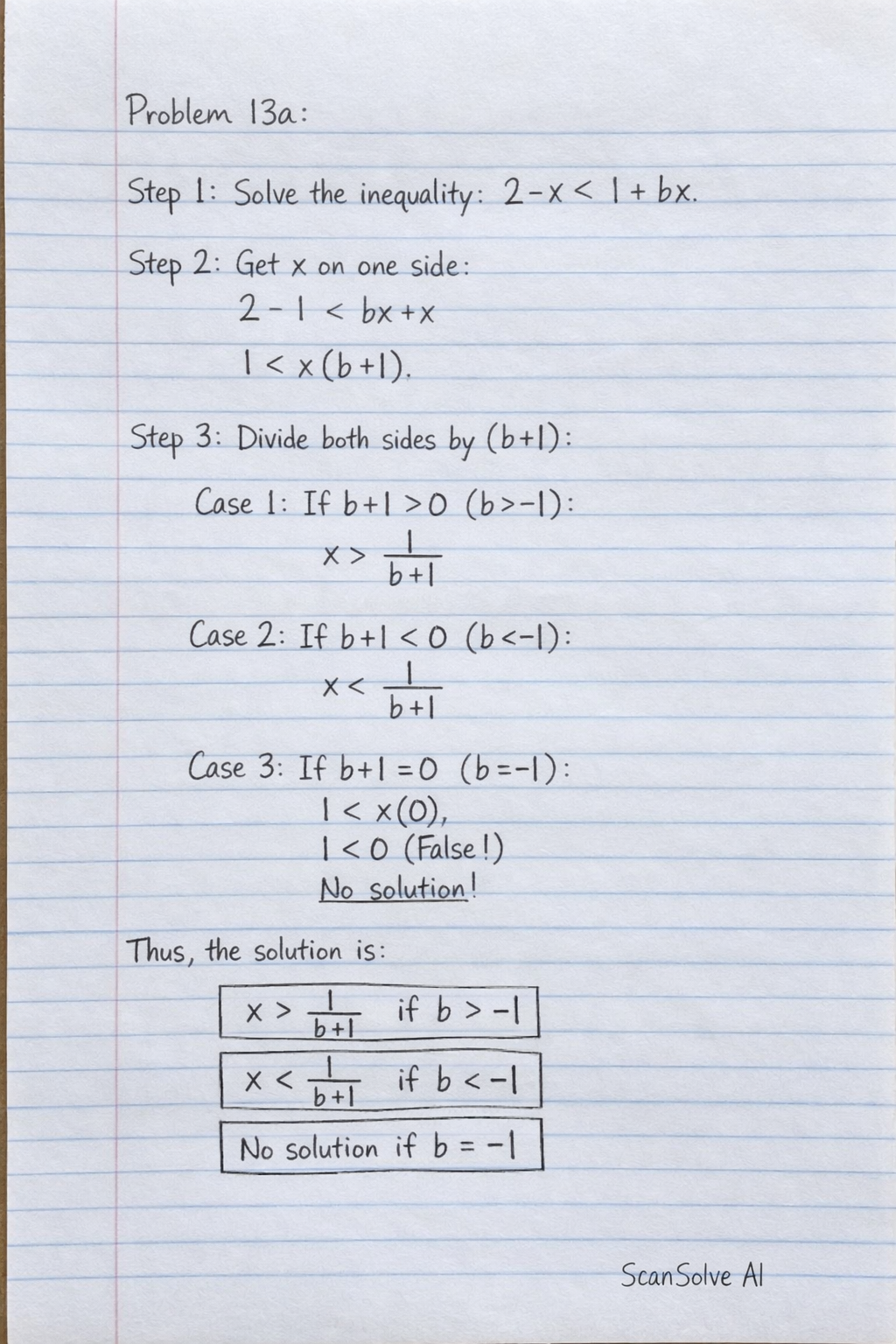
You're on a roll — here are the solutions for the requested problems. Problem 13a: Step 1: The problem asks to solve the linear inequality 2 - x < 1 + bx. Step 2: Gather terms involving x on one side and constant terms on the other side. 2 - 1 < bx + x 1 < x(b + 1) Step 3: To isolate x, divide both sides by (b+1). The direction of the inequality depends on the sign of (b+1). • If b+1 > 0 (i.e., b > -1): x > (1)/(b+1) • If b+1 < 0 (i.e., b < -1): x < (1)/(b+1) • If b+1 = 0 (i.e., b = -1): The inequality becomes 1 < x(0), which simplifies to 1 < 0. This is a false statement, meaning there is no solution for x when b = -1. The solution depends on the value of b: x > (1)/(b+1) if b > -1 x < (1)/(b+1) if b < -1 No solution if b = -1 Problem 13b: Step 1: The problem asks to expand (2x + 1)^2. Step 2: Use the algebraic identity (a+b)^2 = a^2 + 2ab + b^2. Here, a = 2x and b = 1. Step 3: Substitute these values into the identity: (2x + 1)^2 = (2x)^2 + 2(2x)(1) + (1)^2 Step 4: Simplify each term: = 4x^2 + 4x + 1 The expanded form is 4x^2 + 4x + 1. Problem 14a: Step 1: The problem asks for the coefficient of q in the expansion of (2q + 1)(1 - 2q). Step 2: Expand the expression using the distributive property (FOIL method): (2q