We read your photo as:

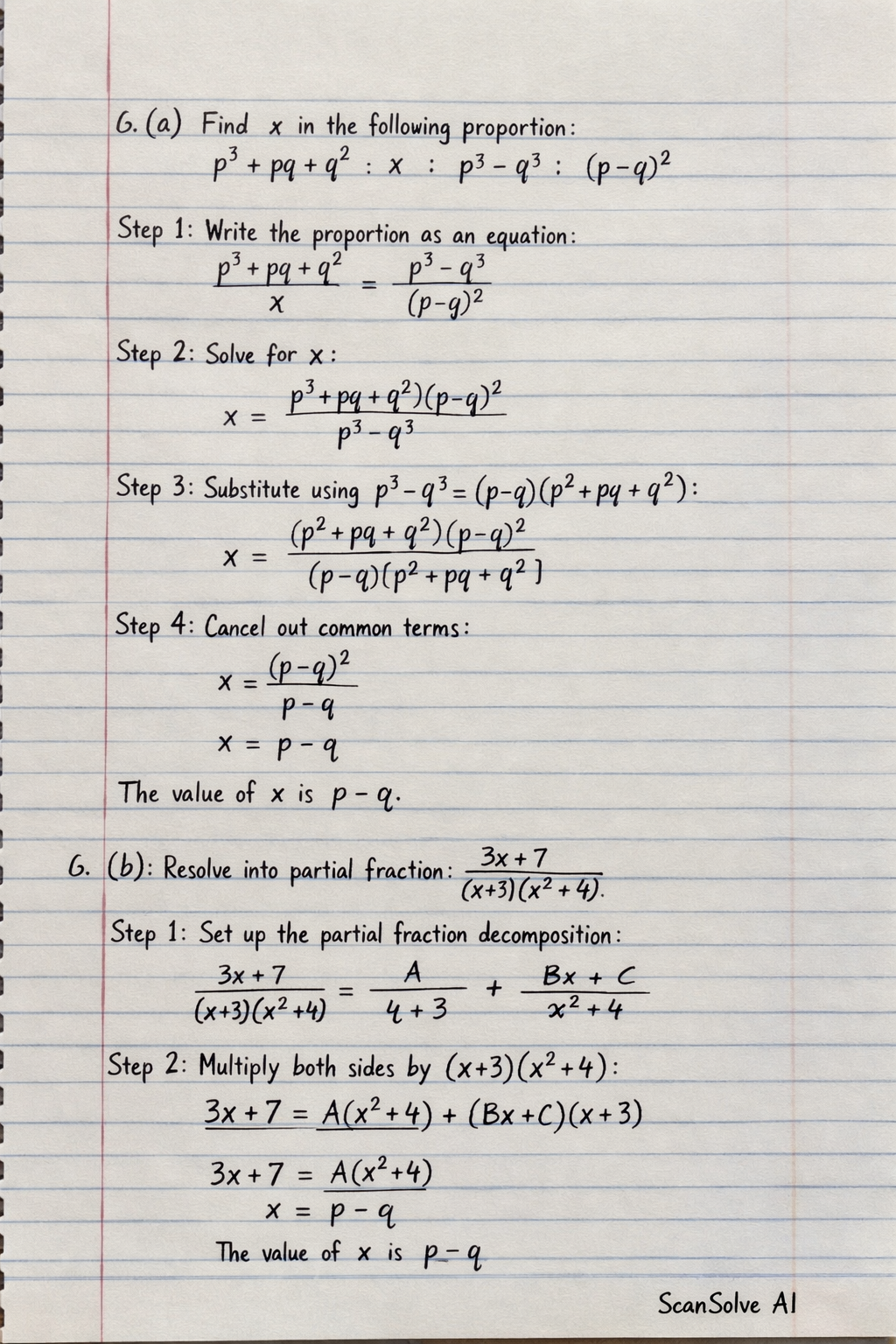
Solve the following problems: (a) Find x in the proportion p3 + pq + q2 : x :: p3 - q3 : (p-q)2. (b) Resolve into partial fraction: (3x+7)/((x+3)(x2+4)).

Mathematics

ScanSolve AI Answer

Step-by-step solution

8 steps

Here are the solutions to the questions:

6. (a) Find xx in the following proportion: p3+pq+q2:x::p3−q3:(p−q)2p^3 + pq + q^2 : x :: p^3 - q^3 : (p-q)^2

  1. Write the proportion as an equation.

    p3+pq+q2x=p3−q3(p−q)2\frac{p^3 + pq + q^2}{x} = \frac{p^3 - q^3}{(p-q)^2}
  2. Solve for xx.

    x=(p3+pq+q2)(p−q)2p3−q3x = \frac{(p^3 + pq + q^2)(p-q)^2}{p^3 - q^3}
  3. Use the difference of cubes formula, p3−q3=(p−q)(p2+pq+q2)p^3 - q^3 = (p-q)(p^2 + pq + q^2).

    Substitute this into the expression for xx.

    x=(p2+pq+q2)(p−q)2(p−q)(p2+pq+q2)x = \frac{(p^2 + pq + q^2)(p-q)^2}{(p-q)(p^2 + pq + q^2)}
  4. Cancel out common terms.

    x=(p−q)2p−qx = \frac{(p-q)^2}{p-q} x=p−qx = p-q

    The value of xx is p−q\boxed{p-q}.

    6. (b) Resolve into partial fraction: 3x+7(x+3)(x2+4)\frac{3x+7}{(x+3)(x^2+4)}

  5. Set up the partial fraction decomposition.

    Since (x2+4)(x^2+4) is an irreducible quadratic factor, its numerator will be a linear expression.

    3x+7(x+3)(x2+4)=Ax+3+Bx+Cx2+4\frac{3x+7}{(x+3)(x^2+4)} = \frac{A}{x+3} + \frac{Bx+C}{x^2+4}
  6. Multiply both sides by (x+3)(x2+4)(x+3)(x^2+4) to clear the denominators.

    3x+7=A(x2+4)+(Bx+C)(x+3)3x+7 = A(x^2+4) + (Bx+C)(x+3)
  7. Solve for AA, BB, and CC.

    To find AA, substitute x=−3x=-3:

    3(−3)+7=A((−3)2+4)+(B(−3)+C)(−3+3)3(-3)+7 = A((-3)^2+4) + (B(-3)+C)(-3+3) −9+7=A(9+4)+0-9+7 = A(9+4) + 0 −2=13A-2 = 13A A=−213A = -\frac{2}{13}

    Expand the equation:

    3x+7=Ax2+4A+Bx2+3Bx+Cx+3C3x+7 = Ax^2+4A + Bx^2+3Bx+Cx+3C 3x+7=(A+B)x2+(3B+C)x+(4A+3C)3x+7 = (A+B)x^2 + (3B+C)x + (4A+3C)

    Compare coefficients:
    Coefficient of x2x^2: 0=A+B0 = A+B
    Since A=−213A = -\frac{2}{13}, then 0=−213+B  ⟹  B=2130 = -\frac{2}{13} + B \implies B = \frac{2}{13}.

    Coefficient of xx: 3=3B+C3 = 3B+C
    Substitute B=213B = \frac{2}{13}:

    3=3(213)+C3 = 3\left(\frac{2}{13}\right) + C 3=613+C3 = \frac{6}{13} + C C=3−613=39−613=3313C = 3 - \frac{6}{13} = \frac{39-6}{13} = \frac{33}{13}

    (Alternatively, check constant term: 7=4A+3C7 = 4A+3C.
    7=4(−213)+3(3313)7 = 4(-\frac{2}{13}) + 3(\frac{33}{13})
    7=−813+99137 = -\frac{8}{13} + \frac{99}{13}
    7=91137 = \frac{91}{13}
    7=77 = 7. This confirms the values of AA, BB, and CC.)

  8. Substitute the values of AA, BB, and CC back into the decomposition.

    3x+7(x+3)(x2+4)=−213x+3+213x+3313x2+4\frac{3x+7}{(x+3)(x^2+4)} = \frac{-\frac{2}{13}}{x+3} + \frac{\frac{2}{13}x+\frac{33}{13}}{x^2+4} 3x+7(x+3)(x2+4)=−213(x+3)+2x+3313(x2+4)\frac{3x+7}{(x+3)(x^2+4)} = -\frac{2}{13(x+3)} + \frac{2x+33}{13(x^2+4)}

    The partial fraction decomposition is −213(x+3)+2x+3313(x2+4)\boxed{-\frac{2}{13(x+3)} + \frac{2x+33}{13(x^2+4)}}.

Was this helpful?

Still stuck on this one?

Ask a follow-up, and the answer starts from this question.

Got a different question?Ask your own question
Handwritten step-by-step solution preview

Handwritten Step-by-Step Solution

Get this as a handwritten image on WhatsApp — like a tutor wrote it for you.

Try on WhatsApp