
We read your photo as:
Locate the point on the curve corresponding to 12 minutes on the time (x-axis).
ScanSolve AI Answer
Step-by-step solution
3 stepsPart i· 3 steps
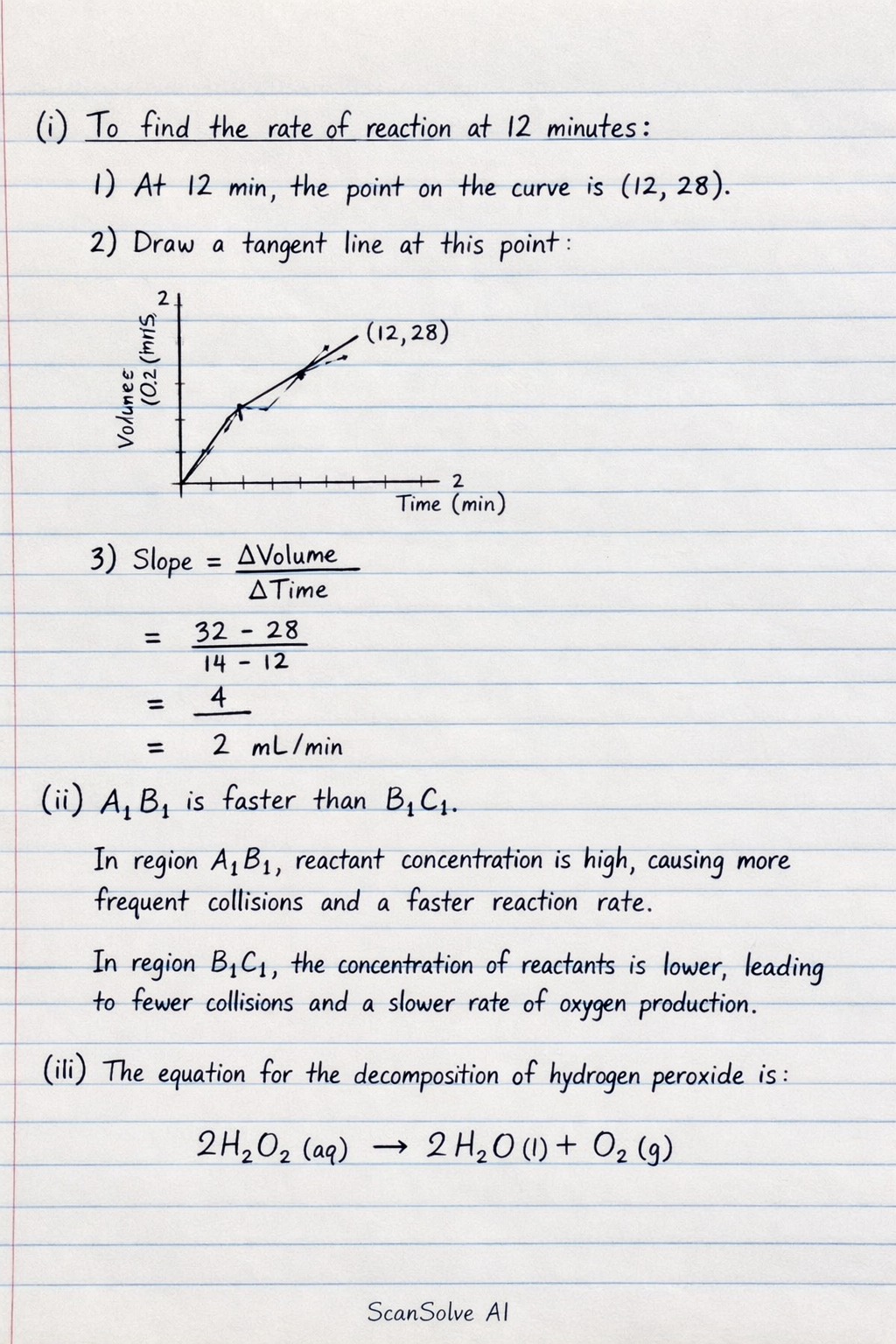
To determine the rate of reaction at 12 minutes
Locate the point on the curve corresponding to 12 minutes on the time (x-axis).
Draw a tangent to the curve at this specific point.
Calculate the gradient (slope) of this tangent.
The gradient, , represents the rate of reaction at 12 minutes.
Part ii
The production of oxygen in region is faster than in region .
Explanation: In region , the concentration of reactants is higher, leading to a greater frequency of effective collisions between reactant particles and thus a faster rate of reaction. As the reaction proceeds into region , the concentration of reactants decreases, resulting in fewer effective collisions and a slower rate of oxygen production.
Part iii
The equation for the decomposition of hydrogen peroxide is
Part c
i) A major source of nitrogen gas in the Haber process is *air
Still stuck on this one?
Ask a follow-up, and the answer starts from this question.
More Mathematics Questions
Handwritten Step-by-Step Solution
Get this as a handwritten image on WhatsApp — like a tutor wrote it for you.
Try on WhatsApp