
We read your photo as:
Look at the drawings below and explain them.
Mathematics
ScanSolve AI Answer
Here are the explanations for the problems shown in the image.
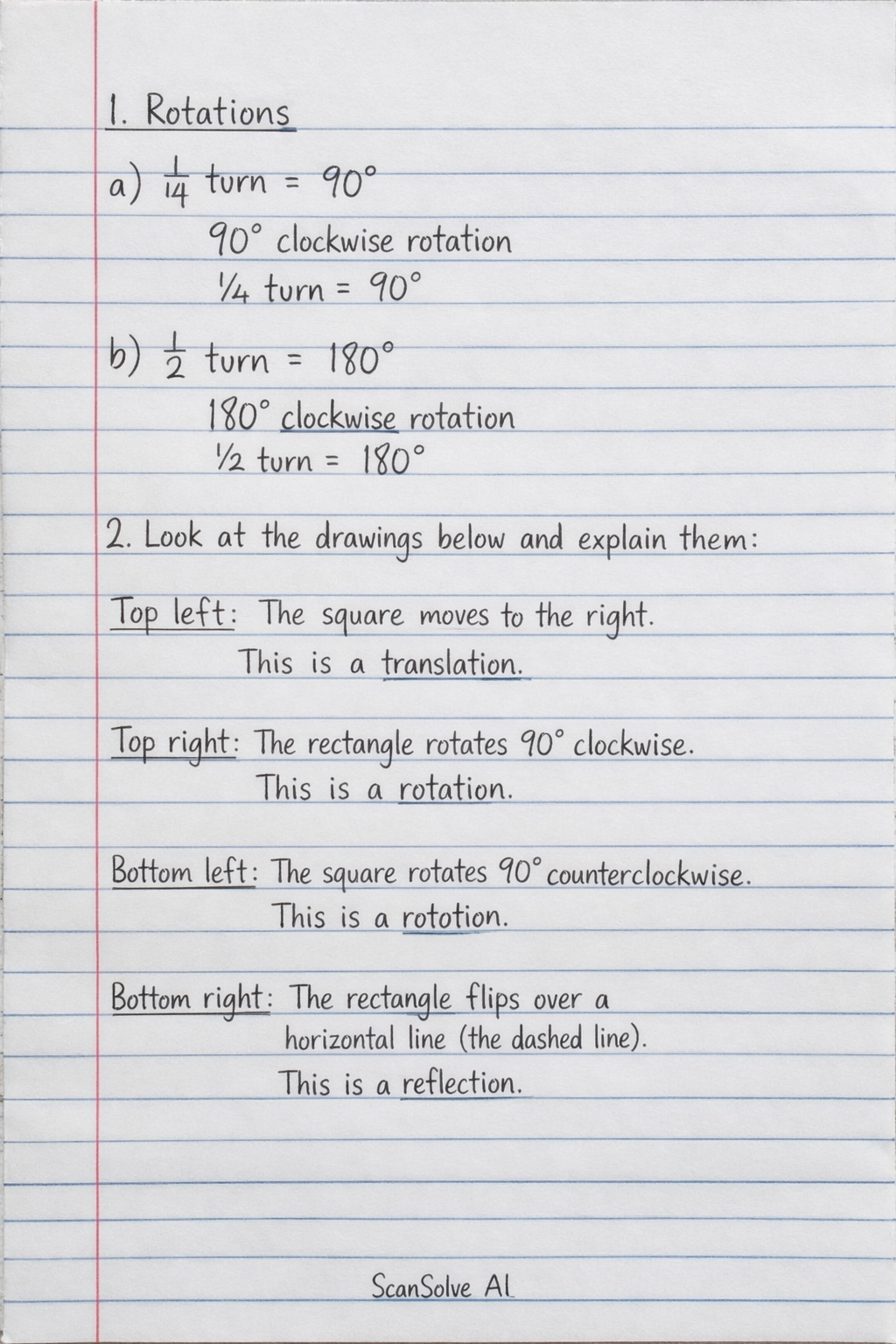
1. Rotations
- a) turn = : This shows a shape rotated by clockwise around its center. A quarter turn is equivalent to a rotation.
- b) turn = : This shows the same shape rotated by clockwise around its center. A half turn is equivalent to a rotation.
2. Look at the drawings below and explain them.
- Top left: The square is moved horizontally to the right without changing its orientation. This transformation is called a translation.
- Top right: The rectangle is turned around a fixed point (the small circle with an arrow). It has been rotated clockwise. This transformation is called a rotation.
- Bottom left: The square is turned around a fixed point. It has been rotated counter-clockwise. This transformation is also a rotation.
- Bottom right: The rectangle is flipped over a horizontal line (the dashed line). This transformation is called a reflection.
3. Complete the table below by rotating each shape and draw the rotated shape.
Since I cannot draw, I will describe the orientation of the rotated shapes. Assume rotations are clockwise unless specified.
-
Row 1 (Bowtie/Hourglass shape):
- Original: Two triangles joined at a point, one pointing up, one pointing down.
- rotation: The shape will appear rotated . The top triangle will now point to the right, and the bottom triangle will point to the left.
- rotation: The shape will look identical to the original, as it has rotational symmetry.
- rotation: The shape will appear rotated clockwise (or counter-clockwise). The top triangle will now point to the left, and the bottom triangle will point to the right.
-
Row 2 (Horizontal rectangle with a dot on the top-left corner):
- Original: A horizontal rectangle with a dot at its top-left vertex.
- rotation: The rectangle will become vertical. The dot will be at the top-right vertex of the new vertical rectangle.
- rotation: The rectangle will be horizontal again. The dot will be at the bottom-right vertex.
- rotation: The rectangle will be vertical again. The dot will be at the bottom-left vertex of the new vertical rectangle.
-
Row 3 (Upright triangle with a dot on the bottom-left vertex):
- Original: An equilateral or isosceles triangle pointing upwards, with a dot at its bottom-left vertex.
- rotation: The triangle will point to the right. The dot will be at the top vertex of the triangle.
- rotation: The triangle will point downwards (upside-down). The dot will be at the top-right vertex.
- rotation: The triangle will point to the left. The dot will be at the bottom vertex of the triangle.
Was this helpful?
Still stuck on this one?
Ask a follow-up, and the answer starts from this question.
Got a different question?Ask your own question
More Mathematics Questions
QLook at the diagrams and explain them in your own wordsQStudy the diagrams below and answer the questions that follow.QStudy the diagrams and answer the questions.QDemonstrate how Interpreting of drawing is correctQThe diagrams below are of two methods used in making magnets. Study them and use them to answer the…
Handwritten Step-by-Step Solution
Get this as a handwritten image on WhatsApp — like a tutor wrote it for you.
Try on WhatsApp