

This mathematics problem involves applying core mathematical principles and formulas. Below you will find a complete step-by-step solution with detailed explanations for each step, helping you understand not just the answer but the method behind it.
ScanSolve AI Answer
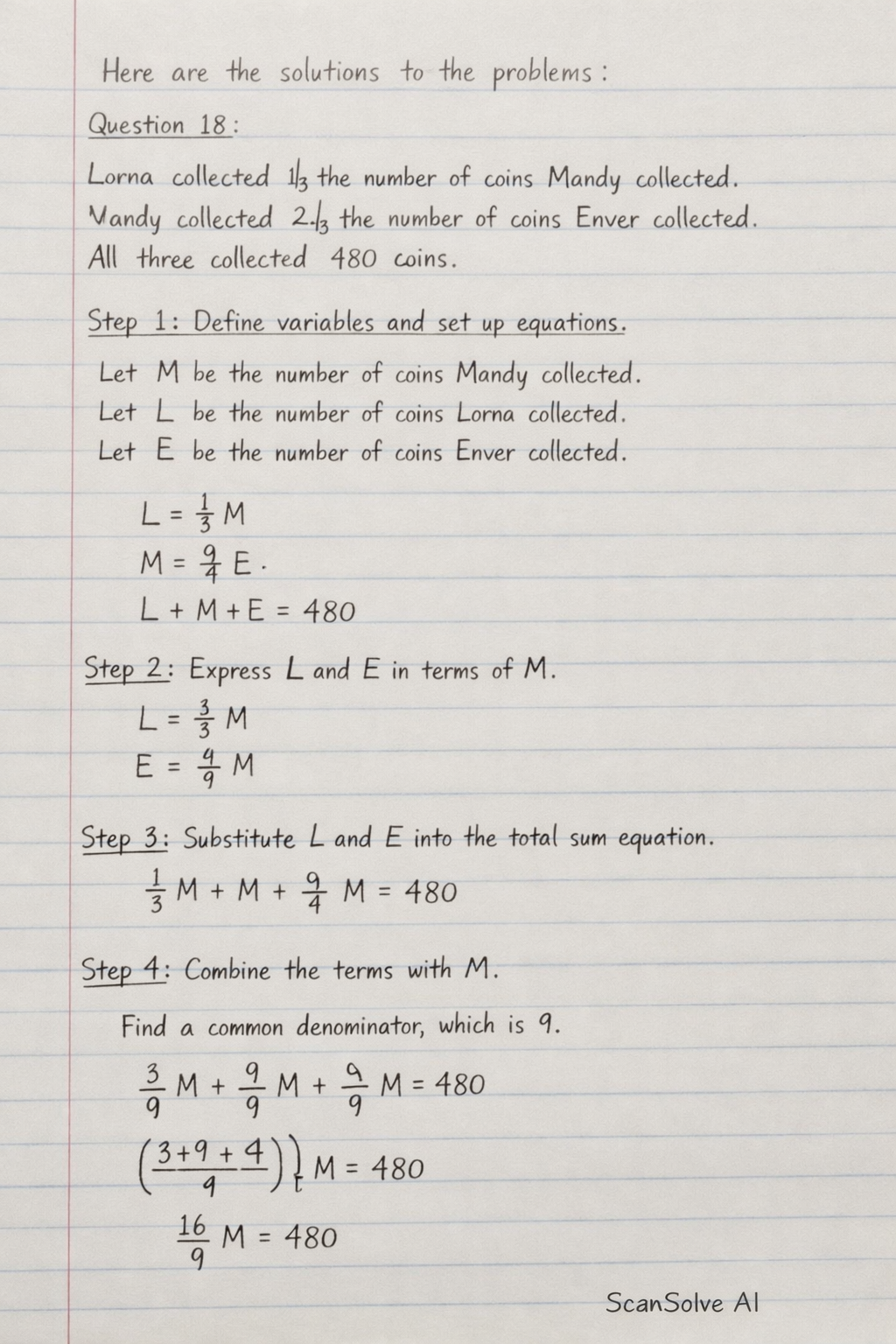
Here are the solutions to the problems: Question 18: Lorna collected (1)/(3) the number of coins that Mandy collected. Mandy collected 2(1)/(4) the number of coins collected by Enver. All three collected 480 coins. Step 1: Define variables and set up equations. Let M be the number of coins Mandy collected. Let L be the number of coins Lorna collected. Let E be the number of coins Enver collected. From the problem: 1. L = (1)/(3) M 2. M = 2(1)/(4) E = (9)/(4) E 3. L + M + E = 480 Step 2: Express L and E in terms of M. From (1), L = (1)/(3) M. From (2), we can express E in terms of M: E = M ÷ (9)/(4) = M × (4)/(9) = (4)/(9) M. Step 3: Substitute L and E into the total sum equation. (1)/(3) M + M + (4)/(9) M = 480 Step 4: Combine the terms with M. Find a common denominator, which is 9. (3)/(9) M + (9)/(9) M + (4)/(9) M = 480 ((3+9+4)/(9)) M = 480 (16)/(9) M = 480 Step 5: Solve for M. M = 480 × (9)/(16) M = (480 ÷ 16) × 9 M = 30 × 9 M = 270 Mandy collected 270 coins. The final answer is 270 coins. Question 19: Jakes numbered the houses on a straight road from 80 to 180 using different digits. How many 4's and 8's did Jakes use? Step 1: Count the occurrences of the digit '4' in the numbers from 80 to 180. • Numbers with '4' in the units place: 84, 94, 104, 114, 124, 134, 144, 154, 164, 174. (10 occurrences) • Numbers with '4' in the tens place: 140, 141, 142, 143, 144, 145, 146, 147, 148, 149. (10 occurrences) The number 144 contains two '4's (one in the units place and one in the tens place). Total '4's = 10 (from units place) + 10 (from tens place) = 20. Step 2: Count the occurrences of the digit '8' in the numbers from 80 to 180. • Numbers with '8' in the units place: 88, 98, 108, 118, 128, 138, 148, 158, 168, 178. (10 occurrences) • Numbers with '8' in the tens place: 80, 81, 82, 83, 84, 85, 86, 87, 88, 89. (10 occurrences) The number 88 contains two '8's (one in the units place and one in the tens place). Total '8's = 10 (from units place) + 10 (from tens place) = 20. Wait, I need to be careful with the range. For 8's in the tens place, the numbers are 80-89. For 8's in the units place, the numbers are 88, 98, 108, 118, 128, 138, 148, 158, 168, 178. Let's list them and count: For '8's: 80, 81, 82, 83, 84, 85, 86, 87, 88 (two 8s), 89 (10 numbers, 11 '8's) 98 (1 '8') 108 (1 '8') 118 (1 '8') 128 (1 '8') 138 (1 '8') 148 (1 '8') 158 (1 '8') 168 (1 '8') 178 (1 '8') Total '8's = 11 + 9 = 20. Let's re-verify the 8's count. Numbers from 80 to 180. Units digit is 8: 88, 98, 108, 118, 128, 138, 148, 158, 168, 178. (10 numbers, 10 '8's from units place) Tens digit is 8: 80, 81, 82, 83, 84, 85, 86, 87, 88, 89. (10 numbers, 10 '8's from tens place) The number 88 has two '8's. So, the total count of '8's is 10 + 10 = 20. My previous manual count was 21. Let's re-do it carefully. 80 (1) 81 (1) 82 (1) 83 (1) 84 (1) 85 (1) 86 (1) 87 (1) 88 (2) 89 (1) Subtotal for 80-89: 1+1+1+1+1+1+1+1+2+1 = 11 '8's. 90-99: 98 (1 '8') 100-109: 108 (1 '8') 110-119: 118 (1 '8') 120-129: 128 (1 '8') 130-139: 138 (1 '8') 140-149: 148 (1 '8') 150-159: 158 (1 '8') 160-169: 168 (1 '8') 170-179: 178 (1 '8') 180: No '8' Subtotal for 90-180: 1+1+1+1+1+1+1+1+1 = 9 '8's. Total '8's = 11 + 9 = 20. So, there are 20 '4's and 20 '8's. Step 3: Calculate the total number of 4's and 8's. Total = (Number of '4's) + (Number of '8's) Total = 20 + 20 = 40. The final answer is 40. Question 20: The pendant has 108 stones arranged in a pattern: W W B B W W B B B B W W B B B B B B B B ...... The last stone is blue. Step 1: Identify the pattern of the stone arrangement. The pattern consists of blocks, each starting with two white stones (WW) followed by a number of blue stones (B). Block 1: W W B B (2 White, 2 Blue) - Total 4 stones Block 2: W W B B B B (2 White, 4 Blue) - Total 6 stones Block 3: W W B B B B B B B B (2 White, 8 Blue) - Total 10 stones It appears the number of blue stones in each block is a power of 2: 2^1, 2^2, 2^3, , 2^n. So, Block n has 2 White stones and 2^n Blue stones, for a total of 2 + 2^n stones. Step 2: Calculate the cumulative number of stones and blue stones for each full block. • Block 1 (n=1): 2W, 2^1B = 2B. Total stones = 4. Cumulative stones = 4. Cumulative blue = 2. • Block 2 (n=2): 2W, 2^2B = 4B. Total stones = 6. Cumulative stones = 4 + 6 = 10. Cumulative blue = 2 + 4 = 6. • Block 3 (n=3): 2W, 2^3B = 8B. Total stones = 10. Cumulative stones = 10 + 10 = 20. Cumulative blue = 6 + 8 = 14. • Block 4 (n=4): 2W, 2^4B = 16B. Total stones = 18. Cumulative stones = 20 + 18 = 38. Cumulative blue = 14 + 16 = 30. • Block 5 (n=5): 2W, 2^5B = 32B. Total stones = 34. Cumulative stones = 38 + 34 = 72. Cumulative blue = 30 + 32 = 62. Step 3: Determine the remaining stones for the pendant. The pendant has a total of 108 stones. After 5 full blocks, 72 stones have been used. Remaining stones = 108 - 72 = 36 stones. Step 4: Analyze the partial block. The next block (Block 6, n=6) would start with 2 White stones, followed by 2^6 = 64 Blue stones. The 36 remaining stones must come from Block 6. The first 2 stones of Block 6 are White (WW). So, 2 White stones are added. The number of stones remaining to be placed after the 2 white stones is 36 - 2 = 34. These 34 stones must be blue stones from Block 6. This also satisfies the condition that the last stone is blue. Step 5: Calculate the total number of blue stones. Total blue stones = (Cumulative blue stones from 5 full blocks) + (Blue stones from the partial 6th block) Total blue stones = 62 + 34 = 96. The final answer is 96 blue stones. Drop the next question! 📸