
We read your photo as:
M varies jointly as N and inversely as the square root of R. If M = 35 when N = 7 and R = 9, find the equation connecting M, N and R. Find R when M = 42 and N = 15. Find the percentage change in M whe
ScanSolve AI Answer
Answers
3 partsStep-by-step solution
11 stepsHere are the solutions to the problem:
Part i· 4 steps
Find the equation connecting M, N and R.
Write the proportionality relationship.
M varies jointly as N, so .
M varies inversely as the square root of R, so .
Combining these, we get:Introduce the constant of proportionality, .
Use the given values (, , ) to find .
Multiply both sides by 3:
Divide by 7:
Substitute the value of back into the equation.
The equation connecting M, N, and R is .
Part ii
Find R when M = 42 and N = 15.
Use the equation from Part (i).
Substitute the given values (, ).
Solve for .
Simplify the fraction:
Square both sides to find R.
The value of R is .
Part iii
Find the percentage change in M when N is increased by 25% and R reduced by 36%.
Express the new values of N and R in terms of their original values.
Let the original values be and . The original M is .
N is increased by 25%, so the new N, , is:R is reduced by 36%, so the new R, , is:
Calculate the new value of M, .
Substitute and :
Rearrange the terms to relate to :
Since :
Calculate the fraction:
So, .
Calculate the percentage change in M.
Percentage change
Percentage change
Percentage change
Percentage change
Percentage change
The percentage change in M is an increase of .
Try one yourself
A new problem that tests the same skill.
Still stuck on this one?
Ask a follow-up, and the answer starts from this question.
More Mathematics Questions
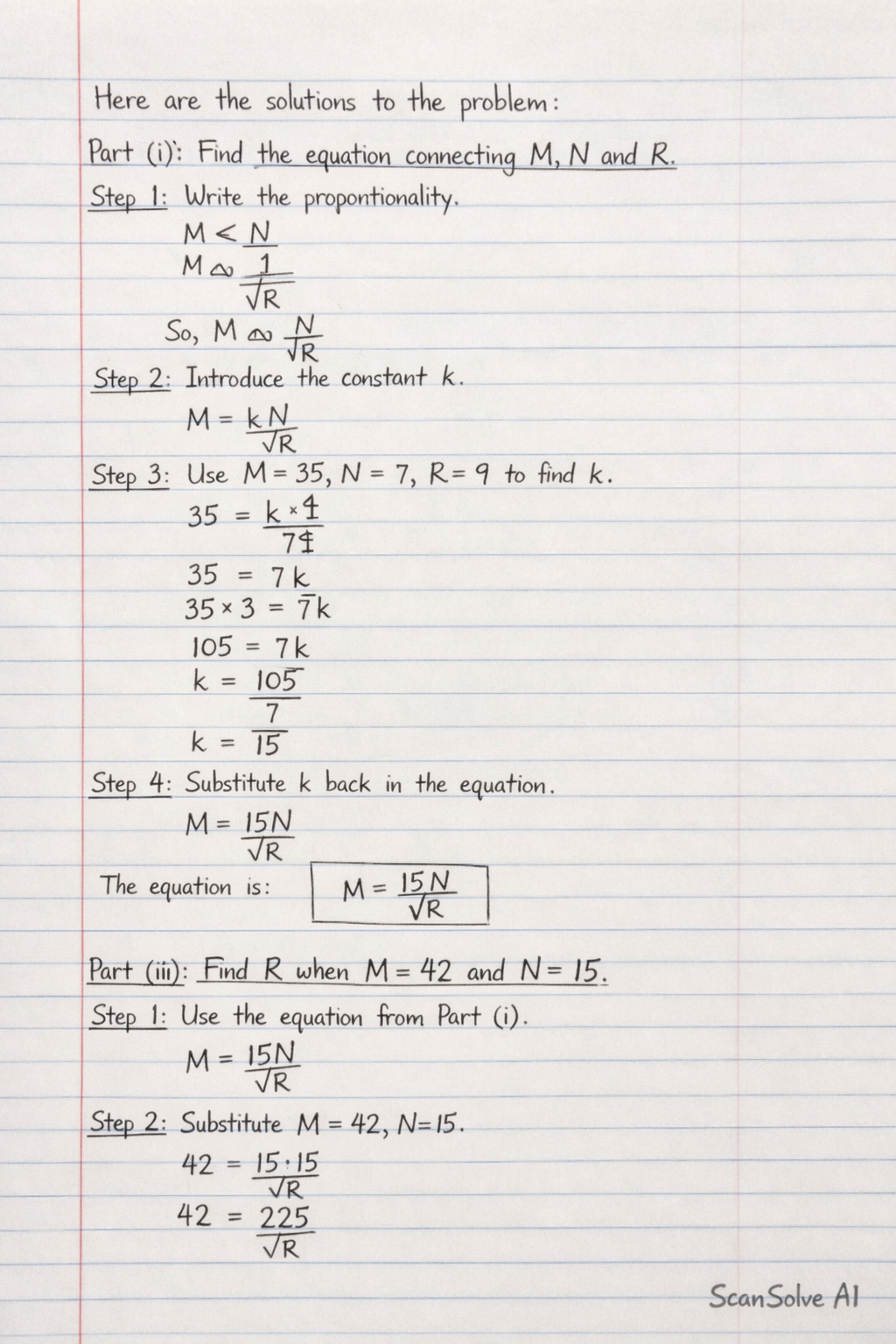
Handwritten Step-by-Step Solution
Get this as a handwritten image on WhatsApp — like a tutor wrote it for you.
Try on WhatsApp