

This mathematics problem involves applying core mathematical principles and formulas. Below you will find a complete step-by-step solution with detailed explanations for each step, helping you understand not just the answer but the method behind it.
ScanSolve AI Answer
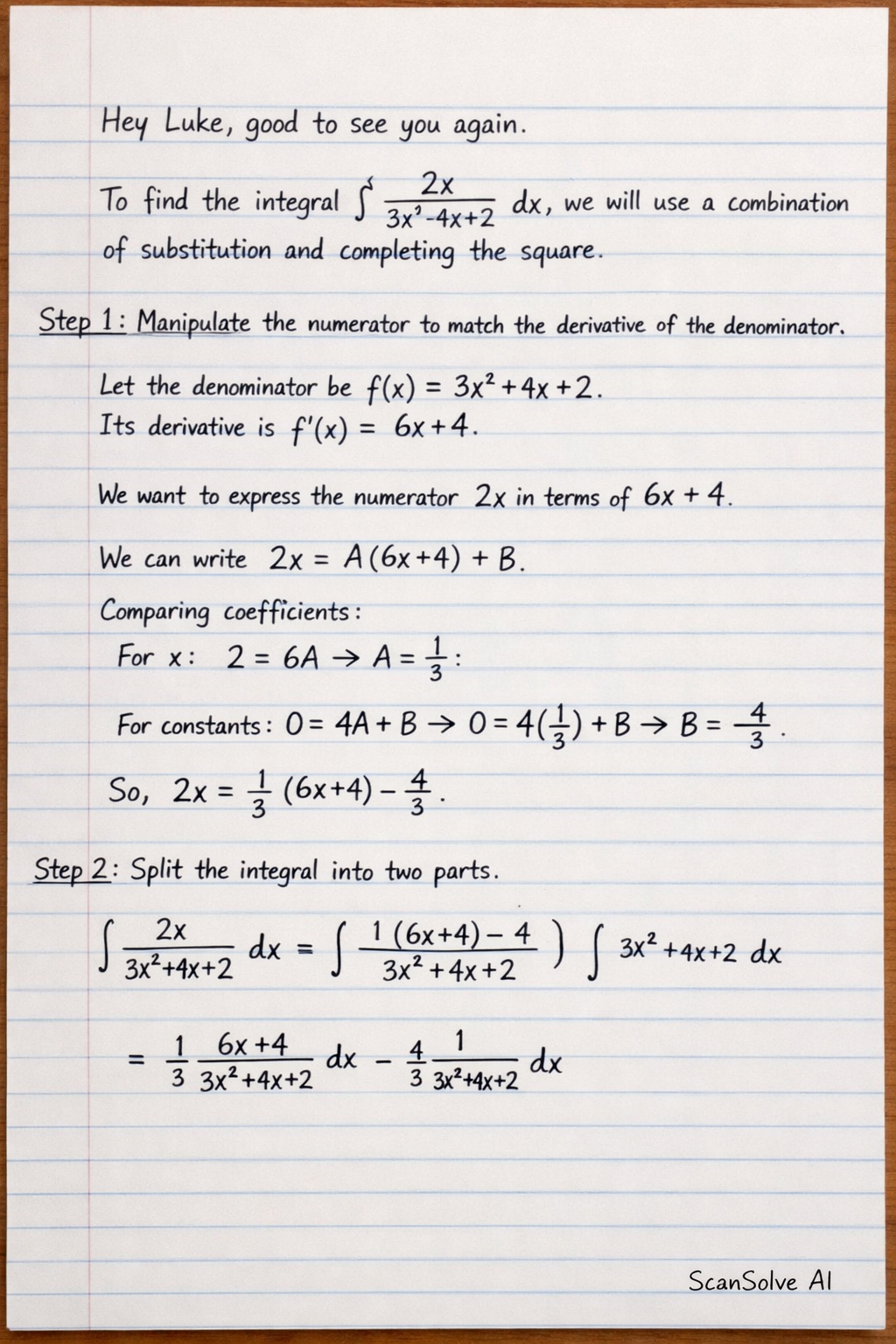
Hey Luke, good to see you again. To find the integral (2x)/(3x^2+4x+2) dx, we will use a combination of substitution and completing the square. Step 1: Manipulate the numerator to match the derivative of the denominator. Let the denominator be f(x) = 3x^2+4x+2. Its derivative is f'(x) = 6x+4. We want to express the numerator 2x in terms of 6x+4. We can write 2x = A(6x+4) + B. Comparing coefficients: For x: 2 = 6A A = (1)/(3). For constants: 0 = 4A + B 0 = 4((1)/(3)) + B B = -(4)/(3). So, 2x = (1)/(3)(6x+4) - (4)/(3). Step 2: Split the integral into two parts. (2x)/(3x^2+4x+2) dx = (1)/(3)(6x+4) - (4)/(3)3x^2+4x+2 dx = (1)/(3) (6x+4)/(3x^2+4x+2) dx - (4)/(3) (1)/(3x^2+4x+2) dx Step 3: Evaluate the first integral. For the first integral, let u = 3x^2+4x+2. Then du = (6x+4) dx. (1)/(3) (du)/(u) = (1)/(3) |u| + C_1 = (1)/(3) (3x^2+4x+2) + C_1 (Note: 3x^2+4x+2 is always positive because its discriminant 4^2 - 4(3)(2) = 16-24 = -8 < 0 and the leading coefficient is positive.) Step 4: Evaluate the second integral by completing the square in the denominator. For the second integral, consider the denominator 3x^2+4x+2. 3x^2+4x+2 = 3(x^2 + (4)/(3)x + (2)/(3)) Complete the square for x^2 + (4)/(3)x: x^2 + (4)/(3)x + ((4)/(3 · 2))^2 - ((4)/(3 · 2))^2 + (2)/(3) = (x + (2)/(3))^2 - (4)/(9) + (2)/(3) = (x + (2)/(3))^2 - (4)/(9) + (6)/(9) = (x + (2)/(3))^2 + (2)/(9) So, 3x^2+4x+2 = 3[(x + (2)/(3))^2 + (2)/(9)]. The second integral becomes: -(4)/(3) (1)/(3[(x + 2)3)^2 + (2)/(9)] dx = -(4)/(9) (1)/((x + 2)3)^2 + (sqrt(2)3)^2 dx Step 5: Apply the arctan integration formula. This integral is of the form (1)/(u^2+a^2) du = (1)/(a) ((u)/(a)) + C. Here, u = x + (2)/(3) (so du = dx) and a = sqrt(2)3. -(4)/(9) [ (1)/(sqrt(2))3 ((x + 2)/(3)sqrt(2)3) ] + C_2 = -(4)/(9) [ (3)/(sqrt(2)) ((3x+2)/(3)sqrt(2)3) ] + C_2 = -(4)/(3sqrt(2)) ((3x+2)/(sqrt(2))) + C_2 Rationalize the denominator: -4sqrt(2)3 · 2 ((3x+2)/(sqrt(2))) + C_2 = -2sqrt(2)3 ((3x+2)/(sqrt(2))) + C_2 Step 6: Combine the results from both integrals. (2x)/(3x^2+4x+2) dx = (1)/(3) (3x^2+4x+2) - 2sqrt(2)3 ((3x+2)/(sqrt(2))) + C The final answer is (1)/(3) (3x^2+4x+2) - 2sqrt(2)3 ((3x+2)/(sqrt(2))) + C. Drop the next question.