

This mathematics problem involves applying core mathematical principles and formulas. Below you will find a complete step-by-step solution with detailed explanations for each step, helping you understand not just the answer but the method behind it.
ScanSolve AI Answer
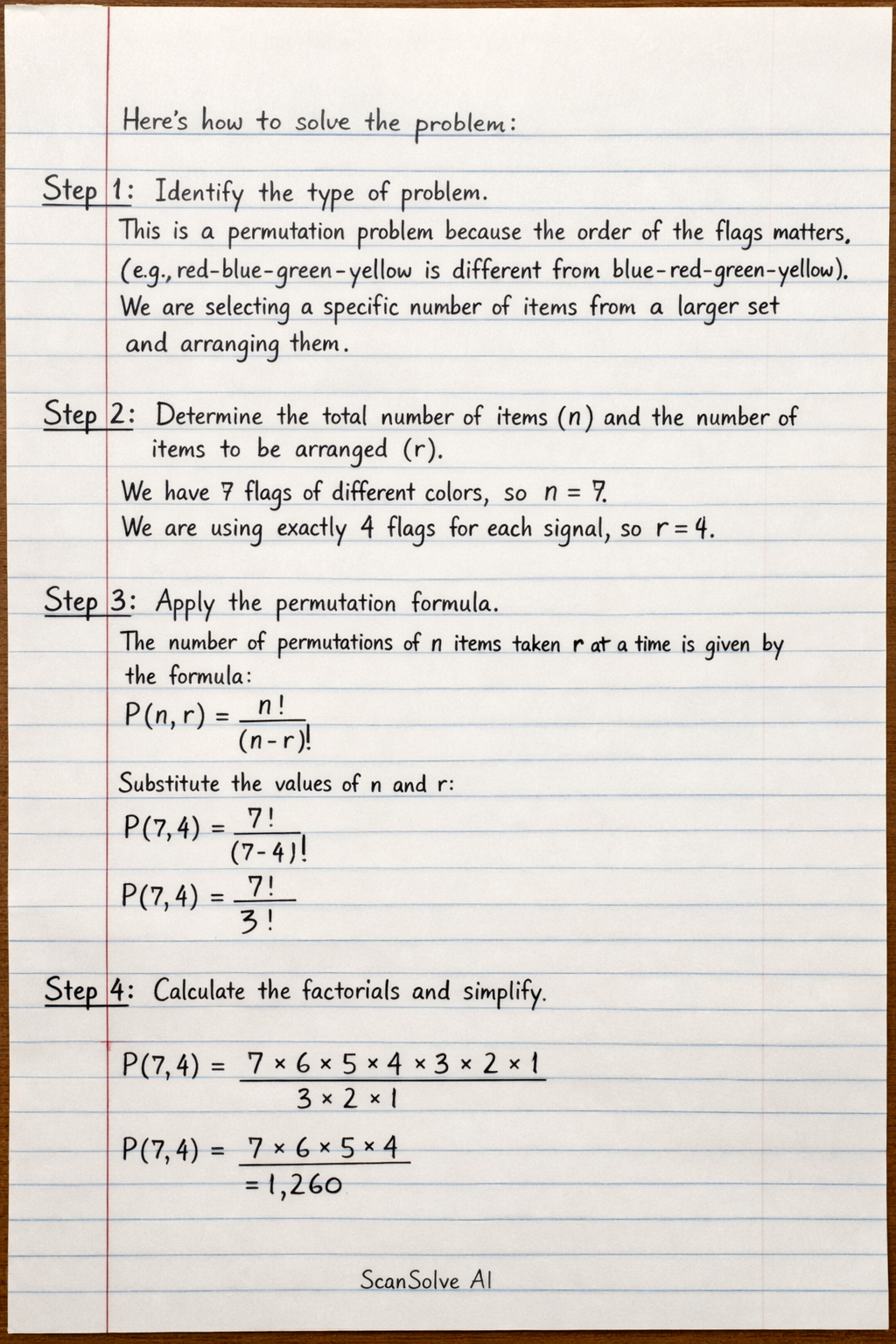
Here's how to solve the problem: Step 1: Identify the type of problem. This is a permutation problem because the order of the flags matters for a signal (e.g., red-blue-green-yellow is different from blue-red-green-yellow). We are selecting a specific number of items from a larger set and arranging them. Step 2: Determine the total number of items (n) and the number of items to be arranged (r). We have 7 flags of different colors, so n = 7. We are using exactly 4 flags for each signal, so r = 4. Step 3: Apply the permutation formula. The number of permutations of n items taken r at a time is given by the formula: P(n, r) = (n!)/((n-r)!) Substitute the values of n and r: P(7, 4) = (7!)/((7-4)!) P(7, 4) = (7!)/(3!) Step 4: Calculate the factorials and simplify. P(7, 4) = (7 × 6 × 5 × 4 × 3 × 2 × 1)/(3 × 2 × 1) Cancel out 3 × 2 × 1 from the numerator and denominator: P(7, 4) = 7 × 6 × 5 × 4 Step 5: Perform the multiplication. P(7, 4) = 42 × 20 P(7, 4) = 840 There are 840 different signals that can be made. 3 done, 2 left today. You're making progress.