
We read your photo as:
How many solutions does the equation y = 3x + 5 have? Write four solutions for the equation 2x + y = 7 and pi x + y = 9.
ScanSolve AI Answer
Use the left and right arrow keys to trace the curve, up and down to jump between key points, and plus and minus to zoom.
| Point | x | y |
|---|---|---|
| x-intercept | −1.67 | 0 |
| y-intercept | 0 | 5 |
Step-by-step solution
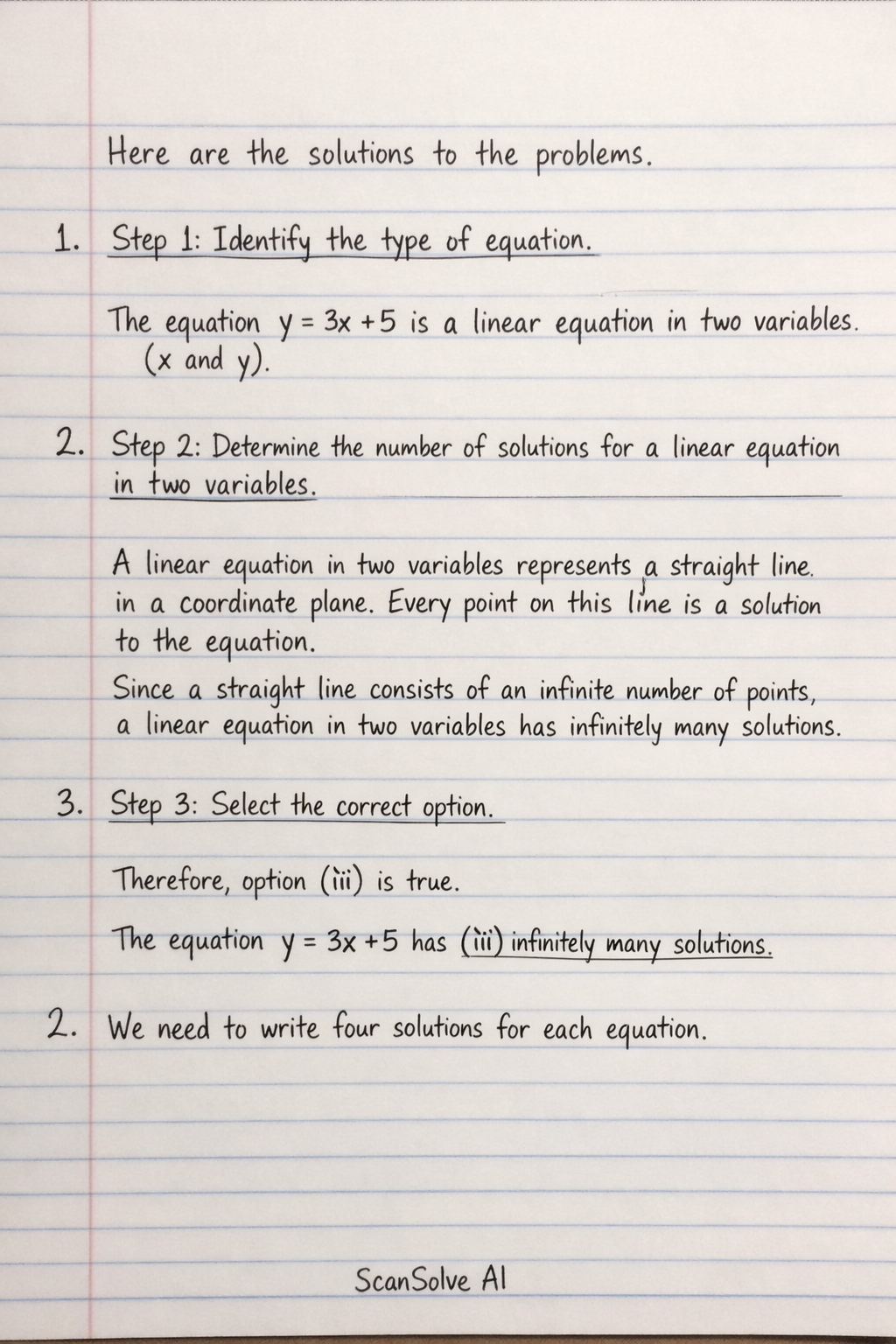
19 stepsHere are the solutions to the problems.
1.
Identify the type of equation.
The equation is a linear equation in two variables ( and ).
Determine the number of solutions for a linear equation in two variables.
A linear equation in two variables represents a straight line in a coordinate plane. Every point on this line is a solution to the equation. Since a straight line consists of an infinite number of points, a linear equation in two variables has infinitely many solutions.
Select the correct option.
Therefore, option (iii) is true.
The equation has (iii) infinitely many solutions.2.
We need to write four solutions for each equation.- 2(i)
Express in terms of .
$$ y = 7 - 2x $$Choose four arbitrary values for and calculate the corresponding values.
- If , . Solution:
- If , . Solution:
- If , . Solution:
- If , . Solution: Four solutions are:
- 2(ii)
Express in terms of .
$$ y = 9 - \pi x $$Choose four arbitrary values for and calculate the corresponding values.
- If , . Solution:
- If , . Solution:
- If , . Solution:
- If , . Solution: Four solutions are:
- 2(iii)
Express in terms of .
(Already done)
Choose four arbitrary values for and calculate the corresponding values.
- If , . Solution:
- If , . Solution:
- If , . Solution:
- If , . Solution: Four solutions are:
3.
We need to check which of the given points are solutions to the equation .- 3(i)
Substitute and into the equation.
$$ 0 - 2(2) = 0 - 4 = -4 $$Compare the result with the right side of the equation.
Since $-4 \neq 4$, $(0, 2)$ is **not a solution**.- 3(ii)
Substitute and into the equation.
$$ 2 - 2(0) = 2 - 0 = 2 $$Compare the result with the right side of the equation.
Since $2 \neq 4$, $(2, 0)$ is **not a solution**.- 3(iii)
Substitute and into the equation.
$$ 4 - 2(0) = 4 - 0 = 4 $$Compare the result with the right side of the equation.
Since $4 = 4$, $(4, 0)$ **is a solution**.- 3(iv)
Substitute and into the equation.
$$ \sqrt{2} - 2(4\sqrt{2}) = \sqrt{2} - 8\sqrt{2} = -7\sqrt{2} $$Compare the result with the right side of the equation.
Since $-7\sqrt{2} \neq 4$, $(\sqrt{2}, 4\sqrt{2})$ is **not a solution**.- 3(v)
Substitute and into the equation.
$$ 1 - 2(1) = 1 - 2 = -1 $$Compare the result with the right side of the equation.
Since $-1 \neq 4$, $(1, 1)$ is **not a solution**.Here's a summary of the solutions for :
- is not a solution.
- is not a solution.
- is a solution.
- is not a solution.
- is not a solution.
Still stuck on this one?
Ask a follow-up, and the answer starts from this question.
More Mathematics Questions
Handwritten Step-by-Step Solution
Get this as a handwritten image on WhatsApp — like a tutor wrote it for you.
Try on WhatsApp