

This mathematics problem involves applying core mathematical principles and formulas. Below you will find a complete step-by-step solution with detailed explanations for each step, helping you understand not just the answer but the method behind it.
ScanSolve AI Answer
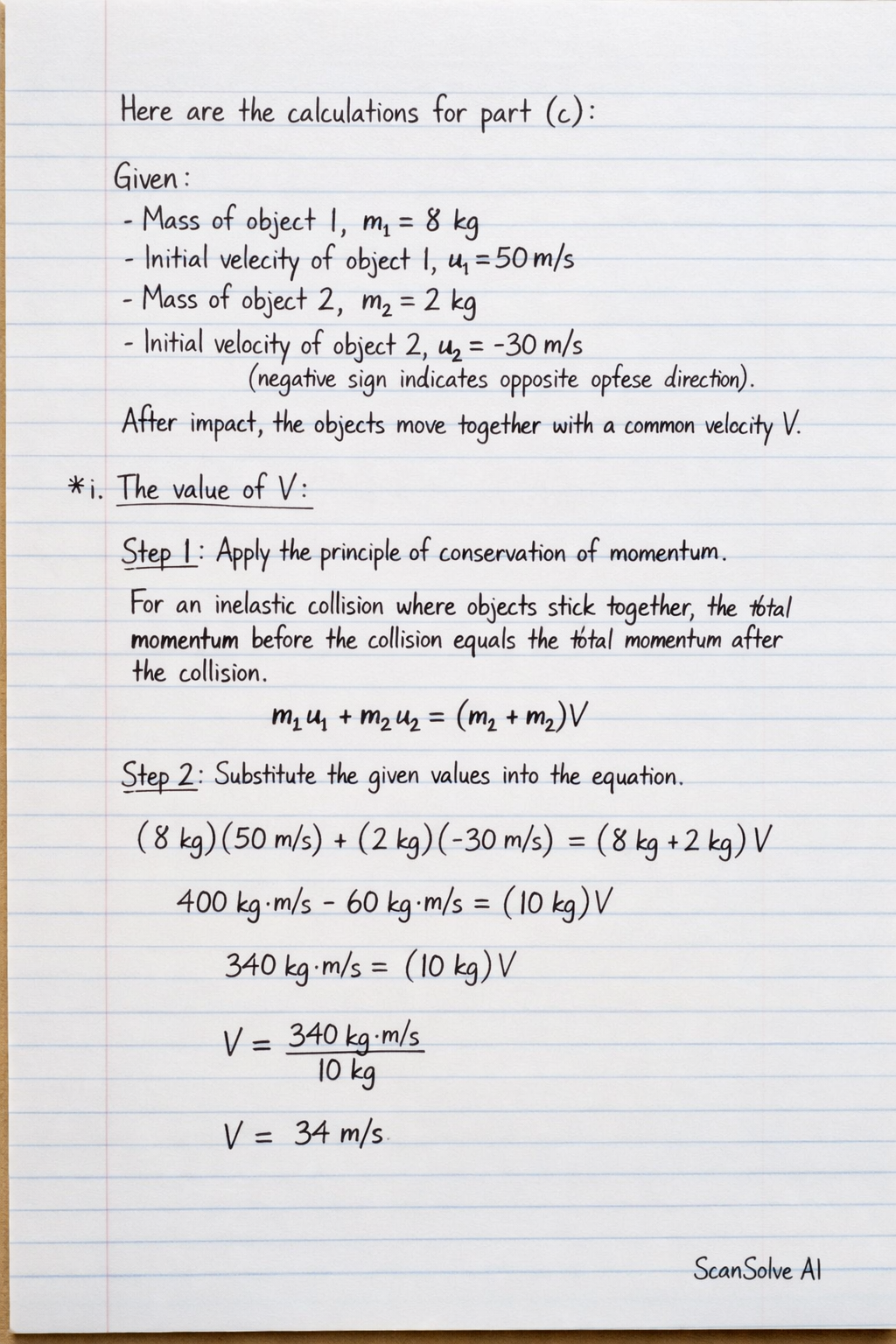
Here are the calculations for part (c): Given: Mass of object 1, m_1 = 8 \, kg Initial velocity of object 1, u_1 = 50 \, m/s Mass of object 2, m_2 = 2 \, kg Initial velocity of object 2, u_2 = -30 \, m/s (negative sign indicates opposite direction) After impact, the objects move together with a common velocity V. i. The value of V: Step 1: Apply the principle of conservation of momentum. For an inelastic collision where objects stick together, the total momentum before the collision equals the total momentum after the collision. m_1 u_1 + m_2 u_2 = (m_1 + m_2)V Step 2: Substitute the given values into the equation. (8 \, kg)(50 \, m/s) + (2 \, kg)(-30 \, m/s) = (8 \, kg + 2 \, kg)V 400 \, kg · m/s - 60 \, kg · m/s = (10 \, kg)V 340 \, kg · m/s = (10 \, kg)V Step 3: Solve for V. V = 340 \, kg · m/s10 \, kg V = 34 \, m/s The common velocity after impact is 34 m/s. ii. The loss in kinetic energy in the process: Step 1: Calculate the total initial kinetic energy (KE_initial). KE_initial = (1)/(2)m_1 u_1^2 + (1)/(2)m_2 u_2^2 KE_initial = (1)/(2)(8 \, kg)(50 \, m/s)^2 + (1)/(2)(2 \, kg)(-30 \, m/s)^2 KE_initial = (1)/(2)(8)(2500) + (1)/(2)(2)(900) KE_initial = 4(2500) + 1(900) KE_initial = 10000 \, J + 900 \, J KE_initial = 10900 \, J Step 2: Calculate the total final kinetic energy (KE_final). KE_final = (1)/(2)(m_1 + m_2)V^2 KE_final = (1)/(2)(8 \, kg + 2 \, kg)(34 \, m/s)^2 KE_final = (1)/(2)(10 \, kg)(1156 \, m^2/s^2) KE_final = 5(1156) KE_final = 5780 \, J Step 3: Calculate the loss in kinetic energy. Loss in KE = KE_initial - KE_final Loss in KE = 10900 \, J - 5780 \, J Loss in KE = 5120 \, J The loss in kinetic energy is 5120 J.