
We read your photo as:
Miss Claire started a job in 2001 on a salary of Kshs. 40,000 per year. Her salary increases by 3% annually. Calculate her salary in 2022 and 2030. Also find her total earnings from 2001 to 2030 inclu
ScanSolve AI Answer
Answers
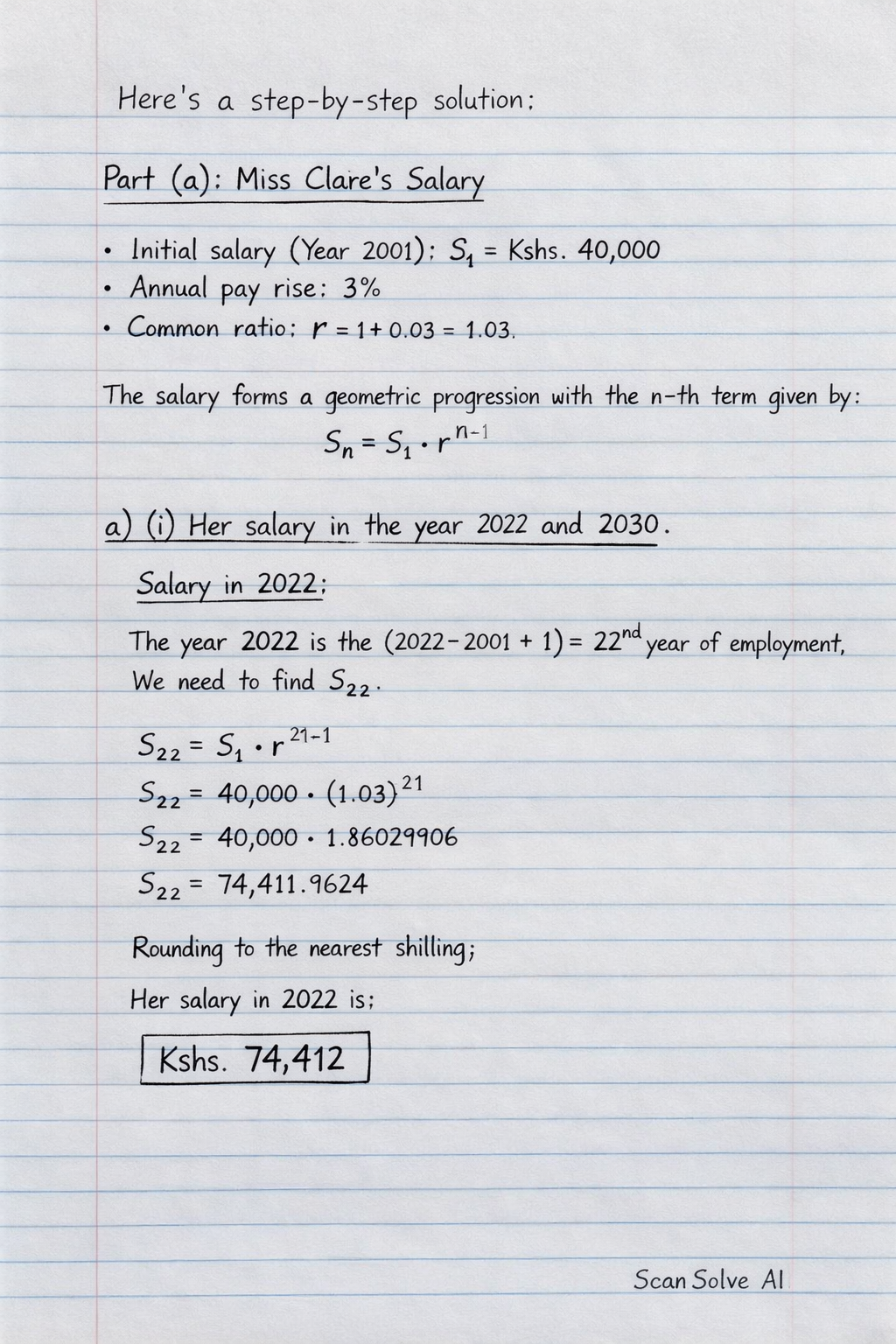
2 partsHere's a step-by-step solution:
Part (a): Miss Claire's Salary
-
Initial salary (Year 2001):
-
Annual pay rise: 3%
-
Common ratio:
-
The salary forms a geometric progression with the -th term given by .
-
a) (i) Her salary in the year 2022 and 2030.
-
Salary in 2022: The year 2022 is the year of employment. We need to find .
Rounding to the nearest shilling: Her salary in 2022 is .
-
Salary in 2030: The year 2030 is the year of employment. We need to find .
Rounding to the nearest shilling: Her salary in 2030 is .
-
-
a) (ii) Her total earnings in employment for the year 2001 to 2030, inclusive. This is the sum of a geometric series for terms. The formula for the sum of the first terms is .
First, calculate :
Now substitute this value:
Rounding to the nearest shilling: Her total earnings are .
Part (b): Geometric Sequence
-
The first four even numbers less than ten: These are 2, 4, 6, 8.
-
The first three consecutive terms of a geometric sequence are:
- 1st term = 1st even number = 2
- 2nd term = 2nd even number = 4
- 3rd term = 4th even number = 8
-
So, the geometric sequence is 2, 4, 8, ...
-
Determine the term of the sequence.
- The first term is .
- The common ratio is found by dividing a term by its preceding term:
- The formula for the term of a geometric sequence is .
- Substitute and :
- Using the rule of exponents :
The term of the sequence is .
Try one yourself
A new problem that tests the same skill.
Still stuck on this one?
Ask a follow-up, and the answer starts from this question.
More Mathematics Questions
Handwritten Step-by-Step Solution
Get this as a handwritten image on WhatsApp — like a tutor wrote it for you.
Try on WhatsApp