
We read your photo as:
Find the missing number in the following puzzle using the diagonal sum pattern: [39, ?, 25, 13]
Mathematics
ScanSolve AI Answer
Answer
Step-by-step solution
3 stepsTo find the missing number in this type of puzzle, we often look for a pattern between the numbers on the diagonals. A common pattern is that the sum of the numbers on one diagonal equals the sum of the numbers on the other diagonal.
Identify the numbers on the first diagonal.
The numbers on the diagonal from top-left to bottom-right are 39 and 13.
Calculate their sum:Identify the numbers on the second diagonal.
The numbers on the diagonal from bottom-left to top-right are 25 and the missing number (let's call it ).
Their sum is:Equate the sums of the two diagonals to find the missing number.
Subtract 25 from both sides:
The missing number is .
Was this helpful?
Try one yourself
A new problem that tests the same skill.
Still stuck on this one?
Ask a follow-up, and the answer starts from this question.
Got a different question?Ask your own question
More Mathematics Questions
QFind the missing number in the grid: [[7, 4, 5], [8, 7, 6], [3, 3, ?], [29, 19, 31]]QSolve the following number puzzle based on the pattern derived from the provided example.QFind the missing number in the given pattern.QWhat is the missing number in the grid: [[16, 9, 4], [25, 16, 9], [36, 25, ?]]?QIdentify the pattern and fill in the missing numbers in the four given figures.
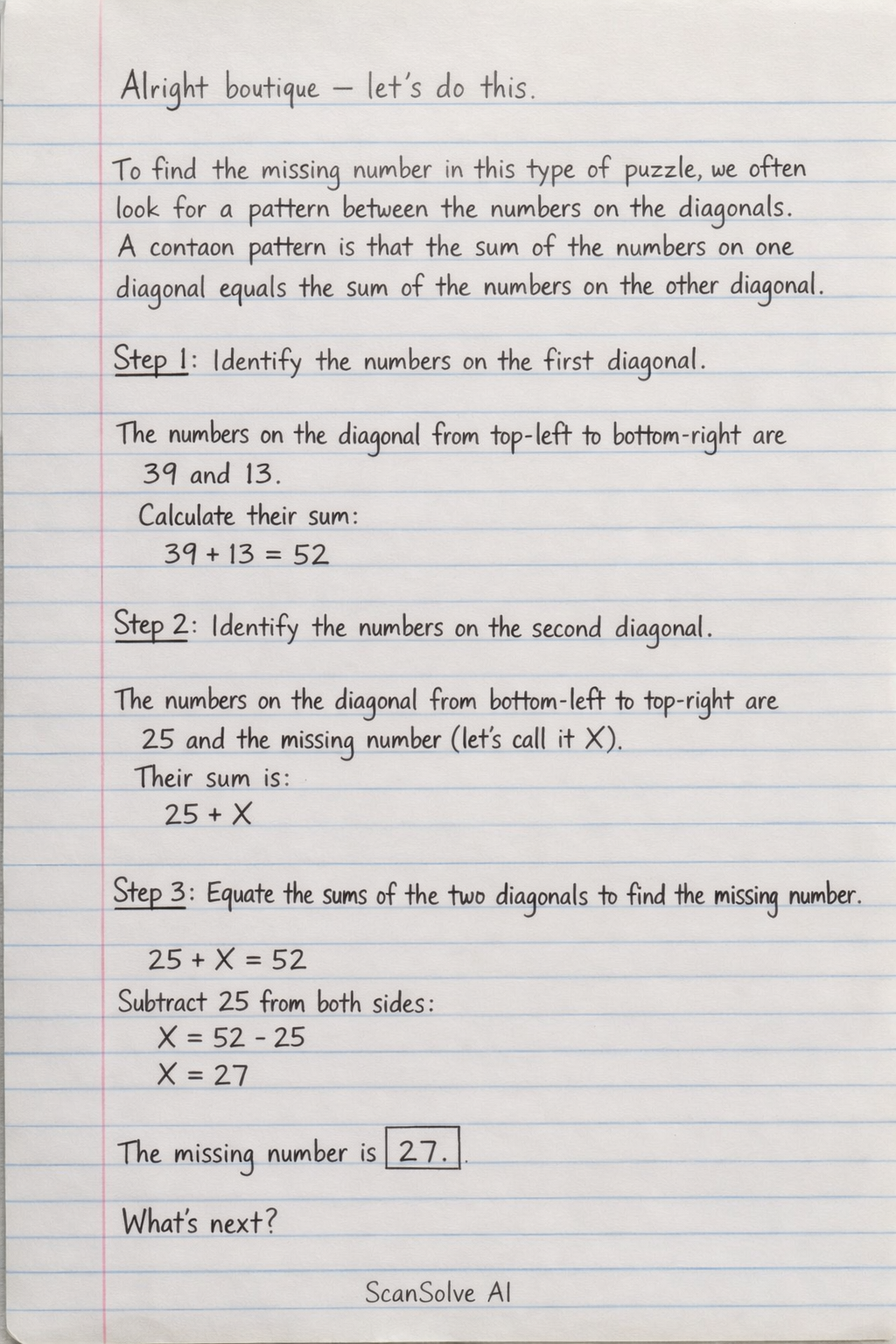
Handwritten Step-by-Step Solution
Get this as a handwritten image on WhatsApp — like a tutor wrote it for you.
Try on WhatsApp