

This mathematics problem involves applying core mathematical principles and formulas. Below you will find a complete step-by-step solution with detailed explanations for each step, helping you understand not just the answer but the method behind it.
ScanSolve AI Answer
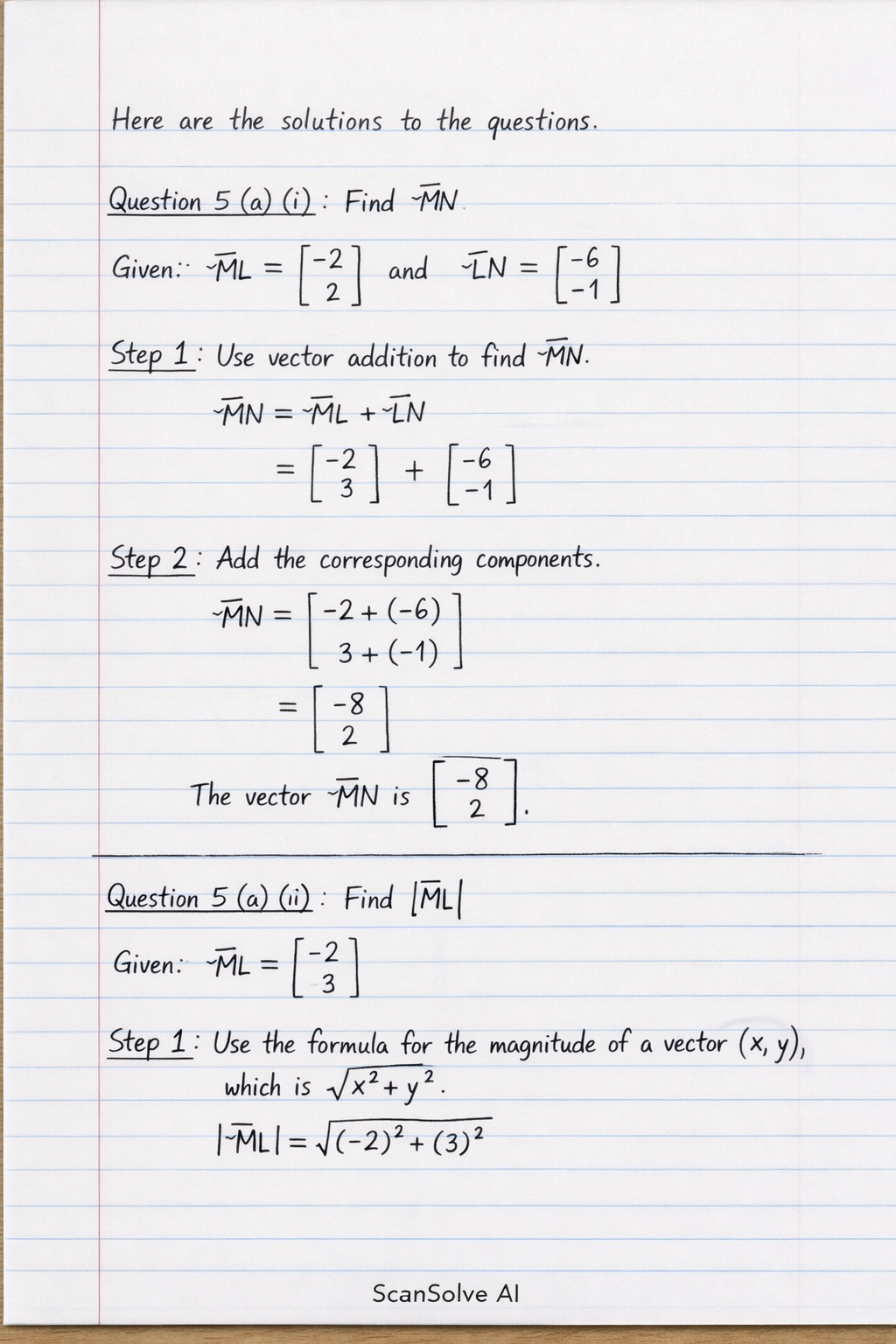
Here are the solutions to the questions. Question 5 (a) (i): Find MN Given: ML = -2 \\ 3 and LN = -6 \\ -1 . Step 1: Use vector addition to find MN. MN = ML + LN MN = -2 \\ 3 + -6 \\ -1 Step 2: Add the corresponding components. MN = -2 + (-6) \\ 3 + (-1) MN = -8 \\ 2 The vector MN is -8 \\ 2 . Question 5 (a) (ii): Find |ML| Given: ML = -2 \\ 3 . Step 1: Use the formula for the magnitude of a vector x \\ y , which is sqrt(x^2 + y^2). |ML| = sqrt((-2)^2 + (3)^2) Step 2: Calculate the squares and sum them. |ML| = sqrt(4 + 9) |ML| = sqrt(13) The magnitude of ML is sqrt(13) units. Question 5 (b) (i): Express TS in terms of a and/or b Given: PT = a, PS = b. Step 1: Express TS using the path TP + PS. Since PT = a, then TP = -a. TS = TP + PS TS = -a + b The vector TS is b - a. Question 5 (b) (ii): Express TR in terms of a and/or b Given: PT = a, PS = b. PS is divided into 3 equal parts at Q and R. Step 1: Express TR using the path TP + PR. We know TP = -a. Since PS is divided into 3 equal parts at Q and R, PR = (2)/(3)PS. PR = (2)/(3)b Step 2: Substitute the expressions for TP and PR into the equation for TR. TR = -a + (2)/(3)b The vector TR is (2)/(3)b - a. Question 5 (c): Using the information in (b), show that PT = 2QU Given: PT = a, PS = b. PS is divided into 3 equal parts at Q and R. U is the midpoint of TR. Step 1: Express QU in terms of a and b. QU = QR + RU From part (b), QR = (1)/(3)PS = (1)/(3)b. Since U is the midpoint of TR, RU = (1)/(2)RT. From part (b)(ii), TR = (2)/(3)b - a. So, RT = -TR = -((2)/(3)b - a) = a - (2)/(3)b. RU = (1)/(2)(a - (2)/(3)b) = (1)/(2)a - (1)/(3)b Step 2: Substitute QR and RU into the expression for QU. QU = (1)/(3)b + ((1)/(2)a - (1)/(3)b) QU = (1)/(2)a Step 3: Compare 2QU with PT. 2QU = 2((1)/(2)a) = a We are given PT = a. Therefore, PT = 2QU. (Shown) Question 6 (a) (i): Find g(-6)-3 Given: g(x) = x^2 + 1. Step 1: Calculate g(-6). g(-6) = (-6)^2 + 1 g(-6) = 36 + 1 g(-6) = 37 Step 2: Subtract 3 from g(-6). g(-6) - 3 = 37 - 3 g(-6) - 3 = 34 The value is 34. Question 6 (a) (ii): Find h^-1g(x), in its simplest form. Given: h(x) = 2x - 5 and g(x) = x^2 + 1. Step 1: Find the inverse function h^-1(x). Let y = h(x). y = 2x - 5 Swap x and y: x = 2y - 5 Solve for y: x + 5 = 2y y = (x + 5)/(2) So, h^-1(x) = (x + 5)/(2). Step 2: Substitute g(x) into h^-1(x). h^-1g(x) = h^-1(x^2 + 1) h^-1g(x) = ((x^2 + 1) + 5)/(2) h^-1g(x) = (x^2 + 6)/(2) The expression for h^-1g(x) is (x^2 + 6)/(2). Question 6 (b): 2g(x) - h(x) can be expressed in the form px^2 + qx + 7. Find the value of p and q. Given: h(x) = 2x - 5 and g(x) = x^2 + 1. Step 1: Substitute g(x) and h(x) into the expression 2g(x) - h(x). 2g(x) - h(x) = 2(x^2 + 1) - (2x - 5) Step 2: Expand and simplify the expression. 2g(x) - h(x) = 2x^2 + 2 - 2x + 5 2g(x) - h(x) = 2x^2 - 2x + 7 Step 3: Compare the simplified expression with px^2 + qx + 7 to find p and q. By comparing 2x^2 - 2x + 7 with px^2 + qx + 7: p = 2 q = -2 The values are p = 2 and q = -2. Question 6 (c): Find the value of x for which xh(x) - 2g(x) = -12 Given: h(x) = 2x - 5 and g(x) = x^2 + 1. Step 1: Substitute h(x) and g(x) into the given equation. x(2x - 5) - 2(x^2 + 1) = -12 Step 2: Expand and simplify the equation. 2x^2 - 5x - (2x^2 + 2) = -12 2x^2 - 5x - 2x^2 - 2 = -12 -5x - 2 = -12 Step 3: Solve for x. -5x = -12 + 2 -5x = -10 x = (-10)/(-5) x = 2 The value of x is 2. Send me the next one 📸