
We read your photo as:
Multiply matrix B by matrix C where B = [-2 6] and C = [3; 4].
ScanSolve AI Answer
Answer
Step-by-step solution
4 stepsIdentify the given matrices.
The matrices are given as:
Determine the dimensions of the matrices.
Matrix B has 1 row and 2 columns, so its dimension is .
Matrix C has 2 rows and 1 column, so its dimension is .Check if matrix multiplication BC is possible.
For matrix multiplication BC to be defined, the number of columns in B must be equal to the number of rows in C.
Number of columns in B = 2.
Number of rows in C = 2.
Since , the multiplication is possible, and the resulting matrix BC will have dimensions .Perform the matrix multiplication.
To find the product BC, we multiply the elements of the row of B by the corresponding elements of the column of C and sum them.
The final answer is .
Try one yourself
A new problem that tests the same skill.
Still stuck on this one?
Ask a follow-up, and the answer starts from this question.
More Mathematics Questions
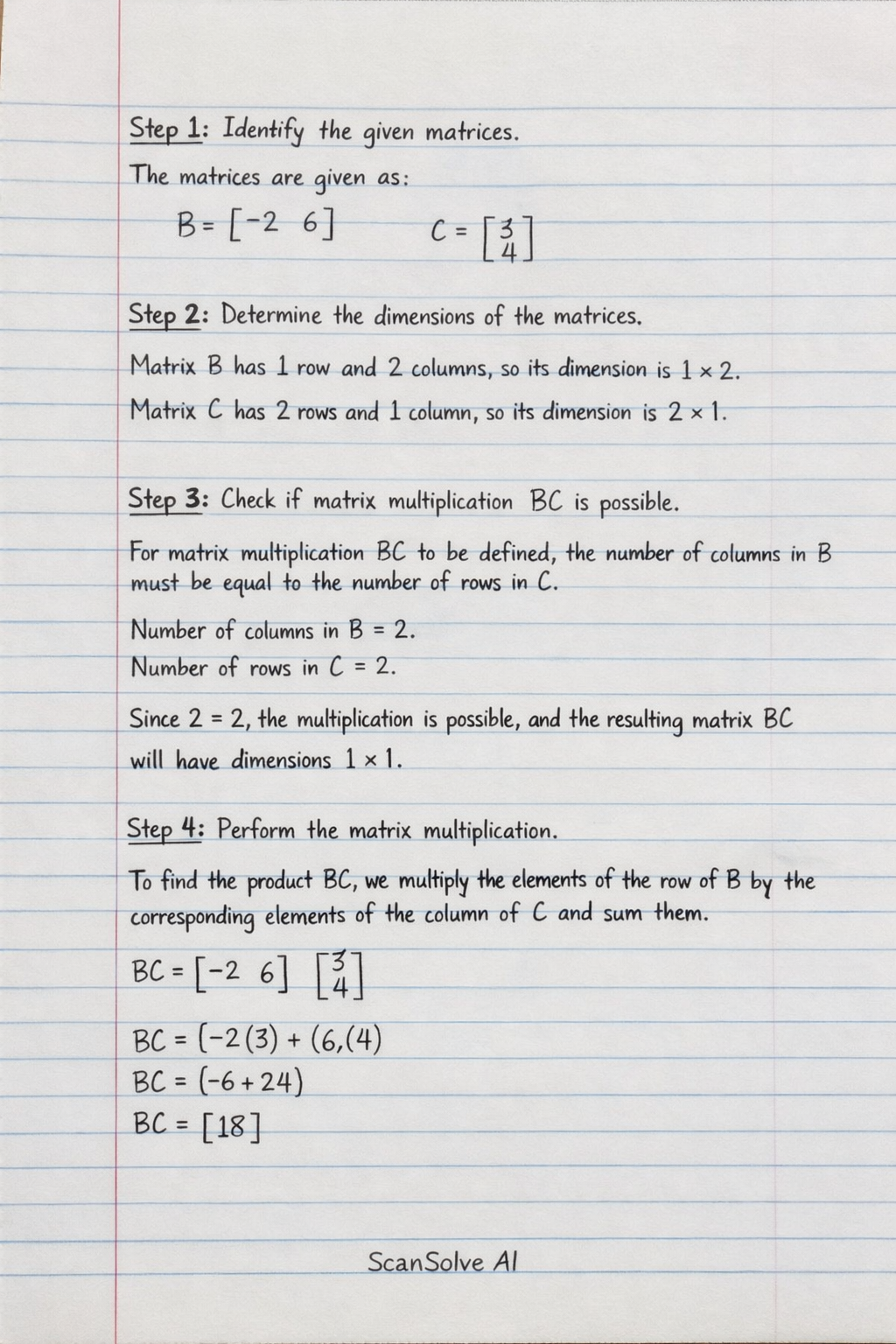
Handwritten Step-by-Step Solution
Get this as a handwritten image on WhatsApp — like a tutor wrote it for you.
Try on WhatsApp