This mathematics problem involves applying core mathematical principles and formulas. Below you will find a complete step-by-step solution with detailed explanations for each step, helping you understand not just the answer but the method behind it.
ScanSolve AI Answer
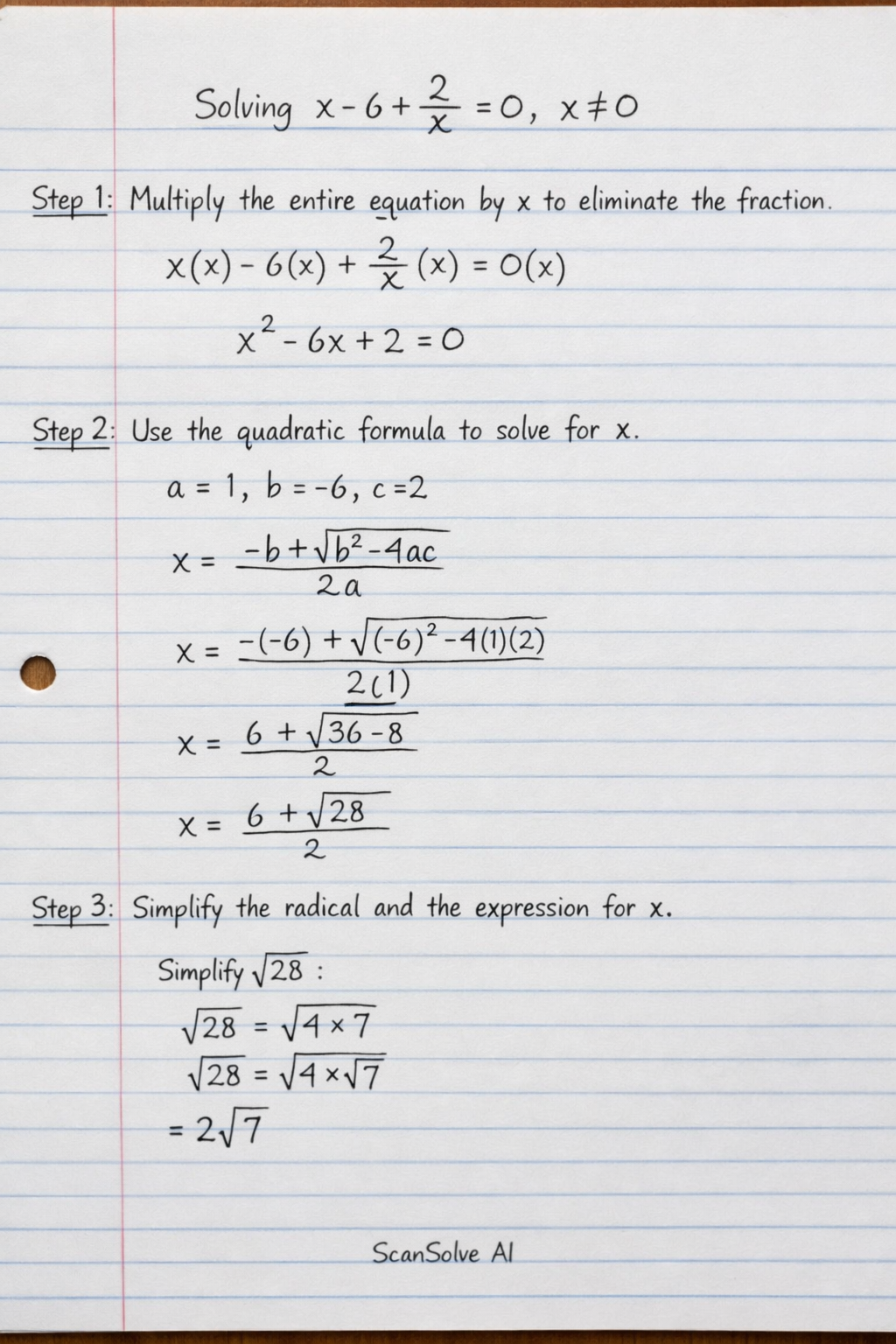
To solve the equation $x - 6 + \frac{2}{x} = 0$, with the condition $x \neq 0$:
Step 1: Multiply the entire equation by $x$ to eliminate the fraction.
Since $x \neq 0$, we can multiply both sides by $x$ without changing the validity of the equation.
$$ x \cdot (x) - 6 \cdot (x) + \frac{2}{x} \cdot (x) = 0 \cdot (x) $$
$$ x^2 - 6x + 2 = 0 $$
Step 2: Use the quadratic formula to solve for $x$.
The equation is in the standard quadratic form $ax^2 + bx + c = 0$, where $a=1$, $b=-6$, and $c=2$.
The quadratic formula is $x = \frac{-b \pm \sqrt{b^2 - 4ac}}{2a}$.
Substitute the values of $a$, $b$, and $c$ into the formula:
$$ x = \frac{-(-6) \pm \sqrt{(-6)^2 - 4(1)(2)}}{2(1)} $$
$$ x = \frac{6 \pm \sqrt{36 - 8}}{2} $$
$$ x = \frac{6 \pm \sqrt{28}}{2} $$
Step 3: Simplify the radical and the expression for $x$.
Simplify $\sqrt{28}$:
$$ \sqrt{28} = \sqrt{4 \times 7} = \sqrt{4} \times \sqrt{7} = 2\sqrt{7} $$
Substitute this back into the expression for $x$:
$$ x = \frac{6 \pm 2\sqrt{7}}{2} $$
Factor out 2 from the numerator:
$$ x = \frac{2(3 \pm \sqrt{7})}{2} $$
Cancel out the common factor of 2:
$$ x = 3 \pm \sqrt{7} $$
Step 4: Verify the solutions against the condition $x \neq 0$.
The two solutions are $x_1 = 3 + \sqrt{7}$ and $x_2 = 3 - \sqrt{7}$.
Since $\sqrt{7}$ is approximately $2.646$, neither $3 + \sqrt{7}$ nor $3 - \sqrt{7}$ is equal to zero.
Both solutions are valid.
The final answers are $\boxed{x = 3 + \sqrt{7}, 3 - \sqrt{7}}$.
Multiply the entire equation by x to eliminate the fraction.
|Mathematics
Multiply the entire equation by x to eliminate the fraction.
ScanSolve AI Answer
To solve the equation x−6+x2=0, with the condition x=0:
Step 1: Multiply the entire equation by x to eliminate the fraction.
Since x=0, we can multiply both sides by x without changing the validity of the equation.
x⋅(x)−6⋅(x)+x2⋅(x)=0⋅(x)x2−6x+2=0
Step 2: Use the quadratic formula to solve for x.
The equation is in the standard quadratic form ax2+bx+c=0, where a=1, b=−6, and c=2.
The quadratic formula is x=2a−b±b2−4ac.
Substitute the values of a, b, and c into the formula:
x=2(1)−(−6)±(−6)2−4(1)(2)x=26±36−8x=26±28
Step 3: Simplify the radical and the expression for x.
Simplify 28:
28=4×7=4×7=27
Substitute this back into the expression for x:
x=26±27
Factor out 2 from the numerator:
x=22(3±7)
Cancel out the common factor of 2:
x=3±7
Step 4: Verify the solutions against the condition x=0.
The two solutions are x1=3+7 and x2=3−7.
Since 7 is approximately 2.646, neither 3+7 nor 3−7 is equal to zero.
Both solutions are valid.
The final answers are x=3+7,3−7.
Need help with your own homework?
Get instant step-by-step solutions to any question. Free to start.