We read your photo as:

Name 4 problem solving strategies and solve problems 2.2.1 to 2.2.4.

Mathematics

ScanSolve AI Answer

Step-by-step solution

2 steps
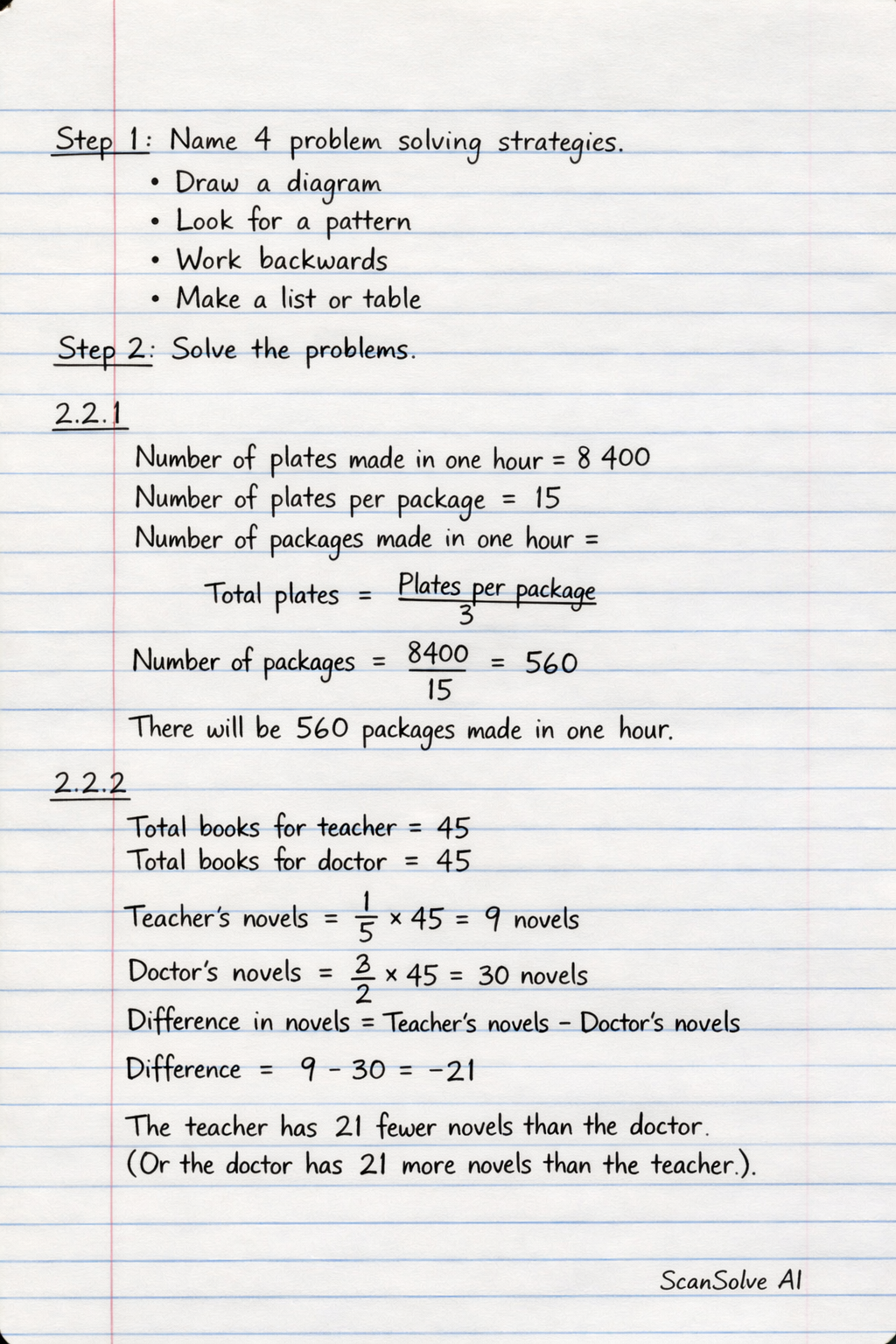
  1. Name 4 problem solving strategies.

    • Draw a diagram
    • Look for a pattern
    • Work backwards
    • Make a list or table
  2. Solve the problems.

    2.2.1
    Number of plates made in one hour = 8 400
    Number of plates per package = 15
    Number of packages made in one hour = Total platesPlates per package\frac{\text{Total plates}}{\text{Plates per package}}

    Number of packages=840015=560\text{Number of packages} = \frac{8400}{15} = 560

    There will be 560 packages made in one hour.

    2.2.2
    Total books for teacher = 45
    Total books for doctor = 45
    Teacher's novels = 15×45=9\frac{1}{5} \times 45 = 9 novels
    Doctor's novels = 23×45=30\frac{2}{3} \times 45 = 30 novels
    Difference in novels = Teacher's novels - Doctor's novels

    Difference=9−30=−21\text{Difference} = 9 - 30 = -21

    The teacher has 21 fewer novels than the doctor. (Or the doctor has 21 more novels than the teacher).

    2.2.3
    Original bill amount = R350,60
    VAT rate = 15%
    VAT amount = 15%×R350,6015\% \times \text{R}350,60

    VAT amount=0.15×350.60=R52.59\text{VAT amount} = 0.15 \times 350.60 = \text{R}52.59

    Total bill amount = Original bill amount + VAT amount

    Total bill amount=350.60+52.59=R403.19\text{Total bill amount} = 350.60 + 52.59 = \text{R}403.19

    The total amount of the bill will be R403,19.

    2.2.4
    Cost of one 2-litre bottle = R18,40
    Number of bottles bought = 10
    Total cost of bottles = 10×R18,40=R184,0010 \times \text{R}18,40 = \text{R}184,00

    Volume of one bottle = 2 litres = 2000 ml
    Total volume of cold drinks = 10×2000 ml=20000 ml10 \times 2000 \text{ ml} = 20000 \text{ ml}
    Volume per glass = 200 ml
    Number of glasses = Total volumeVolume per glass\frac{\text{Total volume}}{\text{Volume per glass}}

    Number of glasses=20000 ml200 ml=100 glasses\text{Number of glasses} = \frac{20000 \text{ ml}}{200 \text{ ml}} = 100 \text{ glasses}

    Selling price per glass = R5
    Total revenue from selling glasses = 100×R5=R500,00100 \times \text{R}5 = \text{R}500,00

    Profit = Total revenue - Total cost

    Profit=500.00−184.00=R316.00\text{Profit} = 500.00 - 184.00 = \text{R}316.00

    Your profit is R316,00.

    2.2.5
    Original taxi ticket cost = R45,00
    Increase percentage = 20%
    Increase amount = 20%×R45,0020\% \times \text{R}45,00

    Increase amount=0.20×45.00=R9.00\text{Increase amount} = 0.20 \times 45.00 = \text{R}9.00

    New cost after increase = Original cost + Increase amount

    New cost=45.00+9.00=R54.00\text{New cost} = 45.00 + 9.00 = \text{R}54.00

    The taxi ticket will cost R54,00 after the increase.

    2.2.6
    Total amount of partnership = R200 000
    A owns 35\frac{3}{5}
    B owns 25\frac{2}{5}

    Amount owned by A = 35×R200000\frac{3}{5} \times \text{R}200 000

    Amount for A=35×200000=R120000\text{Amount for A} = \frac{3}{5} \times 200000 = \text{R}120000

    Amount owned by B = 25×R200000\frac{2}{5} \times \text{R}200 000

    Amount for B=25×200000=R80000\text{Amount for B} = \frac{2}{5} \times 200000 = \text{R}80000

    A owns R120 000 and B owns R80 000.

    2.2.7
    Total amount invested = R30 000 (assuming R3 0000 means R30 000)
    Ratio for income to capital growth = 3:5
    Total parts in ratio = 3+5=83 + 5 = 8

    Amount invested for income = 38×R30000\frac{3}{8} \times \text{R}30 000

    Amount for income=38×30000=R11250\text{Amount for income} = \frac{3}{8} \times 30000 = \text{R}11250

    Amount invested for capital growth = 58×R30000\frac{5}{8} \times \text{R}30 000

    Amount for capital growth=58×30000=R18750\text{Amount for capital growth} = \frac{5}{8} \times 30000 = \text{R}18750

    R11 250 is invested for income and R18 750 is invested for capital growth.

    2.2.8
    Cans per box = 12
    Number of boxes = 9
    Total cans = Cans per box ×\times Number of boxes

    Total cans=12×9=108\text{Total cans} = 12 \times 9 = 108

    There will be 108 cans in 9 boxes.

Was this helpful?

Still stuck on this one?

Ask a follow-up, and the answer starts from this question.

Got a different question?Ask your own question
Handwritten step-by-step solution preview

Handwritten Step-by-Step Solution

Get this as a handwritten image on WhatsApp — like a tutor wrote it for you.

Try on WhatsApp