
We read your photo as:
NATIONAL COMMON ENTRANCE EXAMINATION MATHEMATICS QUESTIONS 1990 TIME ALLOWED : 60 MINUTES
ScanSolve AI Answer
Answer
Step-by-step solution
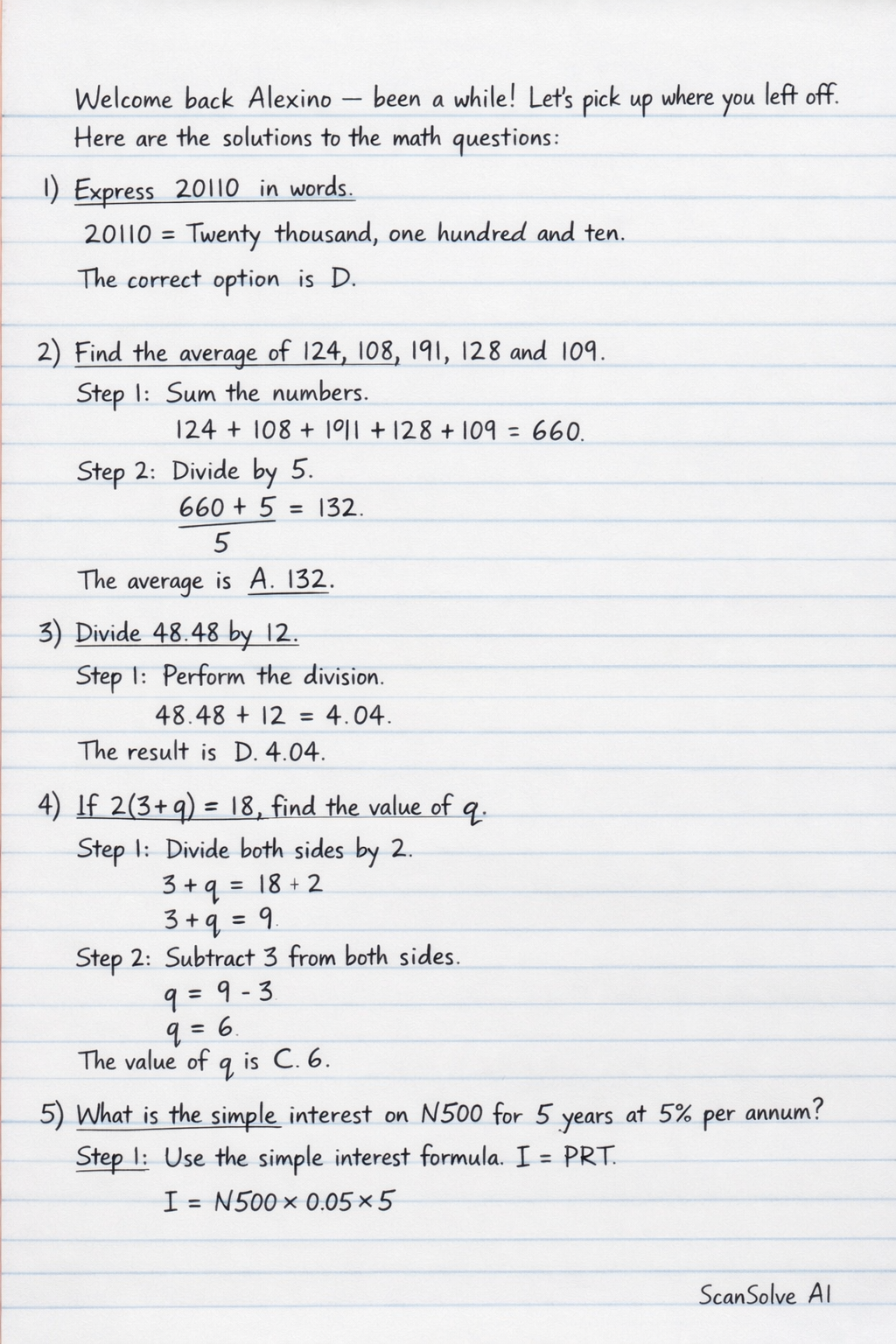
41 stepsHere are the solutions to the math questions:
1. Express 20110 in words.
The number 20110 is read as twenty thousand, one hundred and ten.
The correct option is D.
2. Find the average of 124, 108, 191, 128 and 109.
Sum the given numbers.
Divide the sum by the count of numbers (which is 5).
The average is A. 132.
3. Divide 48.48 by 12.
Perform the division.
The result is D. 4.04.
4. If , find the value of .
Divide both sides by 2.
Subtract 3 from both sides.
The value of is C. 6.
5. What is the simple interest on N500 for 5 years at the rate of 5% per annum?
Use the simple interest formula , where is the principal, is the rate, and is the time.
Calculate the interest.
The simple interest is A. N125.
6. If 500 oranges were shared among Taiwo, Kehinde and Musa in the ratio 3:3:4 respectively. What is Musa's share?
Find the total ratio parts.
Calculate Musa's share.
Musa's ratio is 4.
Musa's share is C. 200.
7. What is the value of ?
Calculate the powers.
Multiply the results.
The value is A. 504.
8. Jide's mother went to the market to buy some articles. She bought 3 dozen of cups and gross of plates. How many articles did she buy altogether?
Convert dozens to individual items.
1 dozen = 12 items.
Convert gross to individual items.
1 gross = 12 dozen = 144 items.
Add the number of cups and plates.
She bought E. 252 articles altogether.
9. Simplify .
Convert mixed numbers to improper fractions.
Find a common denominator, which is 21.
Add the fractions.
Convert the improper fraction back to a mixed number (optional, but useful for checking options).
None of the options match or . Let's recheck the options provided in the image. The options are A. , B. , C. , D. , E. . It seems there might be a typo in the question or options. However, if we assume the question meant to simplify or a different operation, the current calculation for addition is .
Let's re-examine the image for question 9. It looks like .
The calculation is correct. The answer is . Since this is not among the options, I cannot select one.10. What is the sum of 0.349, 5.246, 3.2 and 8.41?
Align the decimal points and add the numbers.
The sum is D. 17.205.
11. A student scored 80% in an Arithmetic test. If the total mark is 240, how many marks did he obtain?
Calculate 80% of the total mark.
Perform the multiplication.
The student obtained E. 192 marks.
12. Find the perimeter of the diagram above.
Identify all side lengths from the diagram.
The diagram shows a shape with sides: 3 cm, 3 cm, 4 cm, 5 cm, and an unknown top side.
The top side can be found by subtracting the smaller horizontal segment from the larger one. The total bottom length is 5 cm. The top horizontal segment is which is if the vertical lines are aligned.
Let's re-evaluate the shape. It's a house-like shape.
The sides are:
Left vertical: 3 cm
Top left diagonal: 3 cm
Top right diagonal: 3 cm
Right vertical: 4 cm
Bottom horizontal: 5 cmThe perimeter is the sum of all outer side lengths.
Sum the lengths.
The perimeter is D. 18cm.
13. What is the total length of 3km, 464km, 8km, 550m and 900m in kilometres?
Convert all lengths to kilometers.
Add all lengths in kilometers.
Let's recheck the options. The options are A. 11.814km, B. 11.914km, C. 11.924km, D. 12.914km, C. 12.814km.
It seems there might be a typo in the question, as the sum of 3km, 464km, and 8km alone is 475km, which is much larger than any of the options.
Assuming the question meant 3km, 464m, 8km, 550m, and 900m.
Let's try that interpretation:Sum the lengths in kilometers.
This matches option D. So, the "464km" in the question was likely a typo and should have been "464m".
The total length is D. 12.914km.
14. A book which cost N24.00 was sold for N30.00. What was the percentage gain?
Calculate the gain.
Calculate the percentage gain using the formula .
The percentage gain was B. 25%.
15. Increase 600 by 8%.
Calculate 8% of 600.
Add the increase to the original number.
None of the options (A. 50, B. 450, C. 550, D. 605, E. 650) match 648. There might be a typo in the options or the question. If the question meant "What is 8% of 600?", the answer would be 48. If it meant "Increase 600 to 8% of its original value", it would be 48. But "Increase 600 by 8%" means .
Let's assume there's a typo and one of the options is correct for a different calculation. For example, if it was "Increase 600 by 50", the answer would be 650 (Option E). Or if it was "Increase 600 by 5", the answer would be 605 (Option D).
Given the options, it's possible the question intended to ask for an increase of 50, making the answer 650. However, based on the question "Increase 600 by 8%", the correct answer is 648. Since 648 is not an option, I cannot select one.16. Express 0.02 as a percentage.
Multiply the decimal by 100%.
The correct option is C. 2%.
17. If 3 oranges cost 2k, what will be the cost of 54 oranges?
Find the cost of one orange.
Calculate the cost of 54 oranges.
The cost of 54 oranges will be B. 36k.
18. Express as a ratio of whole numbers.
Convert mixed numbers to improper fractions.
Write the ratio with improper fractions.
Multiply both sides of the ratio by the common denominator (2) to eliminate fractions.
The ratio is C. 11:5.
The graph above shows the fish caught by a fisherman in some months of a certain year. Use it to answer questions 19-21.
19. Which month was his best fishing period?
Examine the bar graph to find the month with the highest bar (most fish caught).
- April: 20 kg
- May: 10 kg
- June: 40 kg
- July: 30 kg
- August: 5 kg
Identify the month with the highest value.
June has the highest catch at 40 kg.
His best fishing period was C. June.
20. How many kg of fish was caught in the April and May?
Read the fish caught for April from the graph.
April: 20 kg
Read the fish caught for May from the graph.
May: 10 kg
Add the amounts for April and May.
The total fish caught in April and May was C. 30kg.
Try one yourself
A new problem that tests the same skill.
Still stuck on this one?
Ask a follow-up, and the answer starts from this question.
More Mathematics Questions
Handwritten Step-by-Step Solution
Get this as a handwritten image on WhatsApp — like a tutor wrote it for you.
Try on WhatsApp