
We read your photo as:
Find the next three terms in the given sequences and calculate the sum of the arithmetic series.
ScanSolve AI Answer
Step-by-step solution
10 stepsIdentify the pattern.
The sequence is . Each term is obtained by multiplying the previous term by 3. This is a geometric progression with a common ratio of 3.
Calculate the next three terms.
The term after 27 is .
The term after 81 is .
The term after 243 is .The completed sequence is .
Identify the pattern.
The sequence is . Let's find the differences between consecutive terms:
The differences are increasing by 1 each time (). This means the next differences will be .Calculate the next three terms.
The term after 10 is .
The term after 15 is .
The term after 21 is .The next three terms are .
Identify the series.
The series is . This is a sum of consecutive odd numbers.
Determine the number of terms.
The -th odd number is given by the formula . To find the number of terms, we set the last term equal to :
There are 20 terms in the series.
Calculate the sum.
The sum of the first odd numbers is given by the formula .
Since , the sum is:The sum is .
Identify the series.
The series is . This is the sum of the first 100 natural numbers.
Apply the formula for the sum of the first natural numbers.
The formula for the sum of the first natural numbers is .
In this case, .Calculate the sum.
The sum is .
Still stuck on this one?
Ask a follow-up, and the answer starts from this question.
More Mathematics Questions
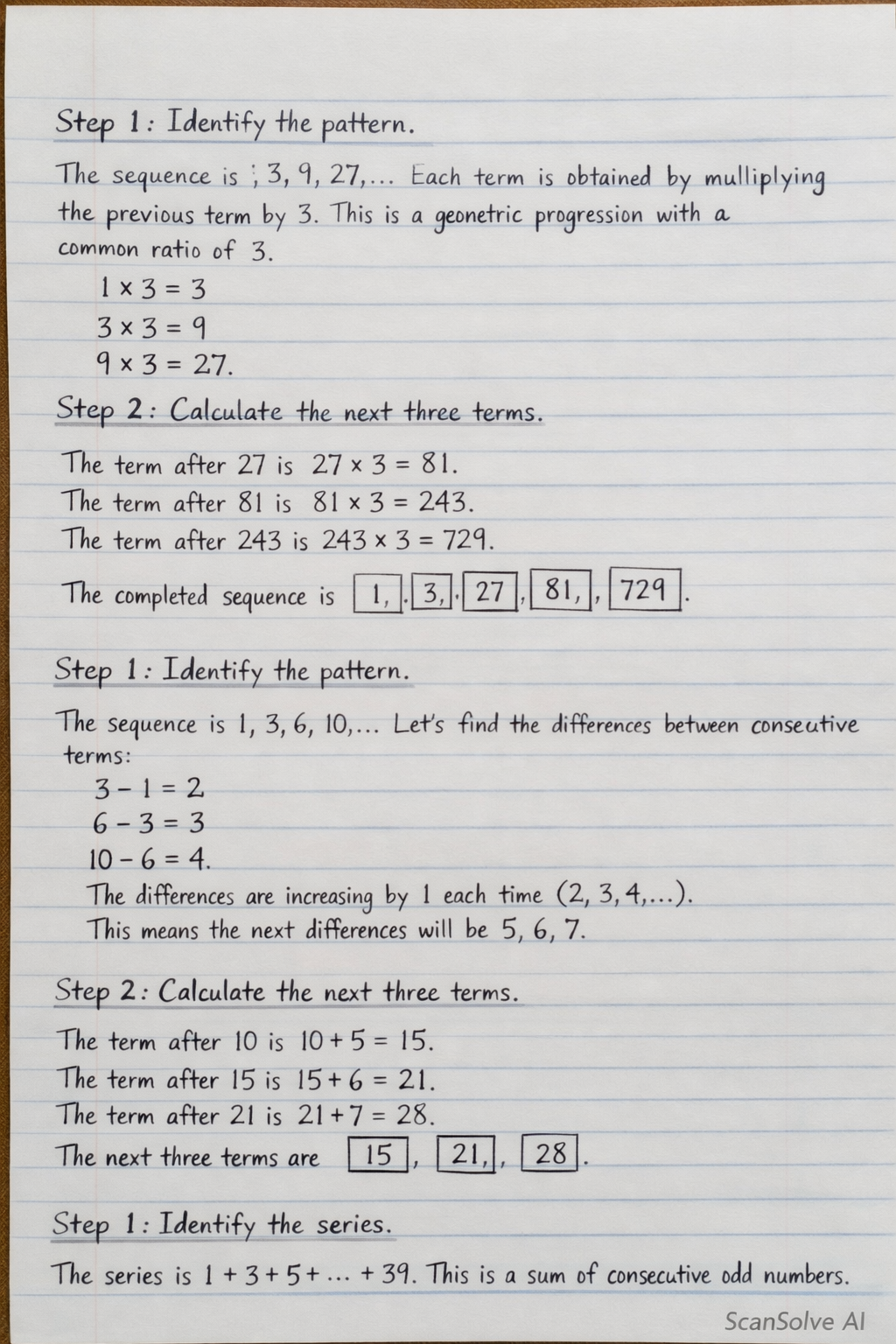
Handwritten Step-by-Step Solution
Get this as a handwritten image on WhatsApp — like a tutor wrote it for you.
Try on WhatsApp