

This mathematics problem involves applying core mathematical principles and formulas. Below you will find a complete step-by-step solution with detailed explanations for each step, helping you understand not just the answer but the method behind it.
ScanSolve AI Answer
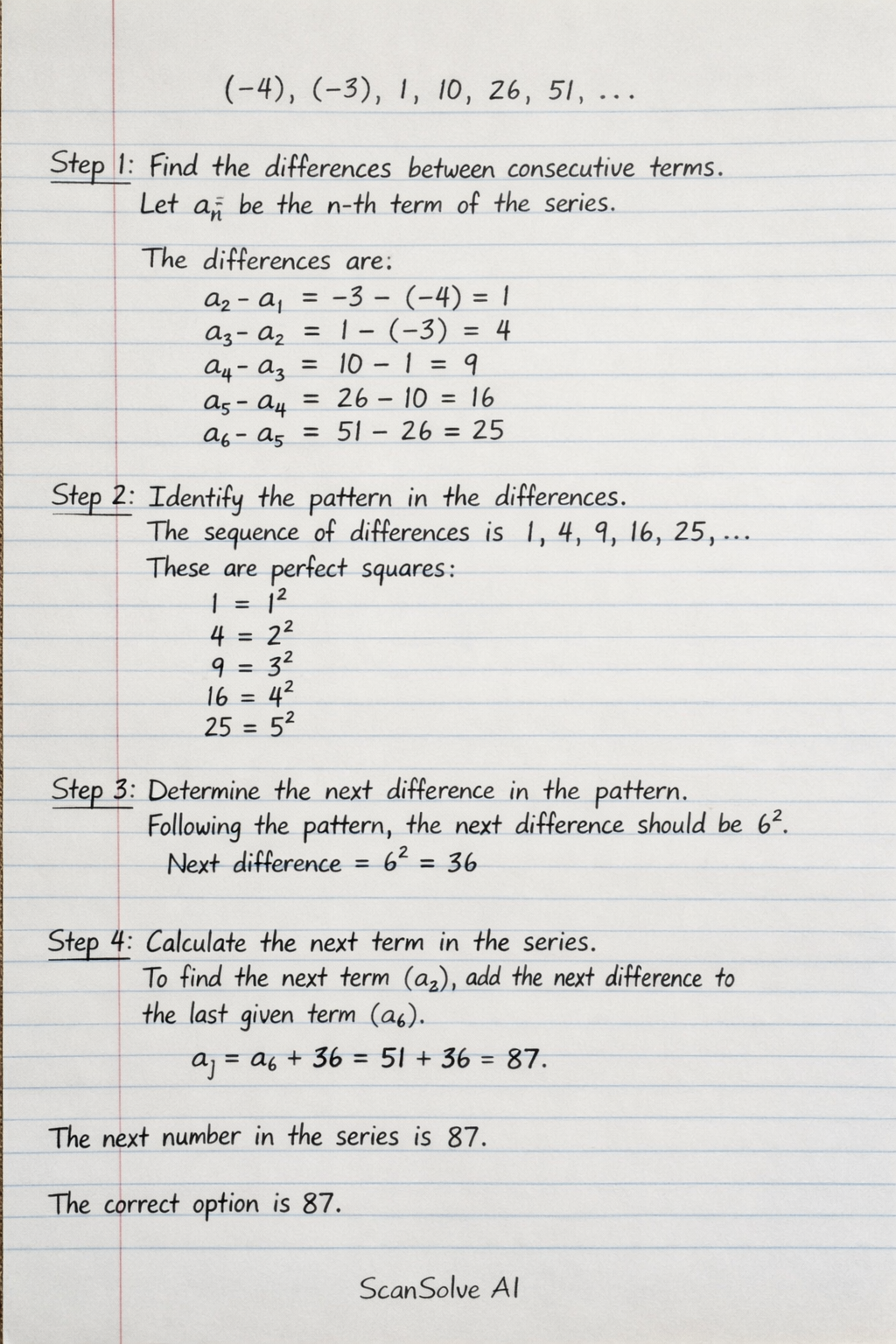
The given series is: (-4), (-3), 1, 10, 26, 51, Step 1: Find the differences between consecutive terms. Let a_n be the n-th term of the series. The differences are: a_2 - a_1 = -3 - (-4) = 1 a_3 - a_2 = 1 - (-3) = 4 a_4 - a_3 = 10 - 1 = 9 a_5 - a_4 = 26 - 10 = 16 a_6 - a_5 = 51 - 26 = 25 Step 2: Identify the pattern in the differences. The sequence of differences is 1, 4, 9, 16, 25, . These are perfect squares: 1 = 1^2 4 = 2^2 9 = 3^2 16 = 4^2 25 = 5^2 Step 3: Determine the next difference in the pattern. Following the pattern, the next difference should be 6^2. Next difference = 6^2 = 36. Step 4: Calculate the next term in the series. To find the next term (a_7), add the next difference to the last given term (a_6). a_7 = a_6 + 36 = 51 + 36 = 87. The next number in the series is 87. The correct option is 87. Send me the next one 📸