Explain the meaning and importance of Number and Algebra; identify key concepts, how they are taught, and how they apply to real-life situations; and develop teaching strategies.

Mathematics
Explain the meaning and importance of Number and Algebra; identify key concepts, how they are taught, and how they apply to real-life situations; and develop teaching strategies.

ScanSolve AI Answer

Answer

5discount,so5 discount, so 25 - 5=5 = 20.

Here's how Number and Algebra concepts can be applied to real-life situations:

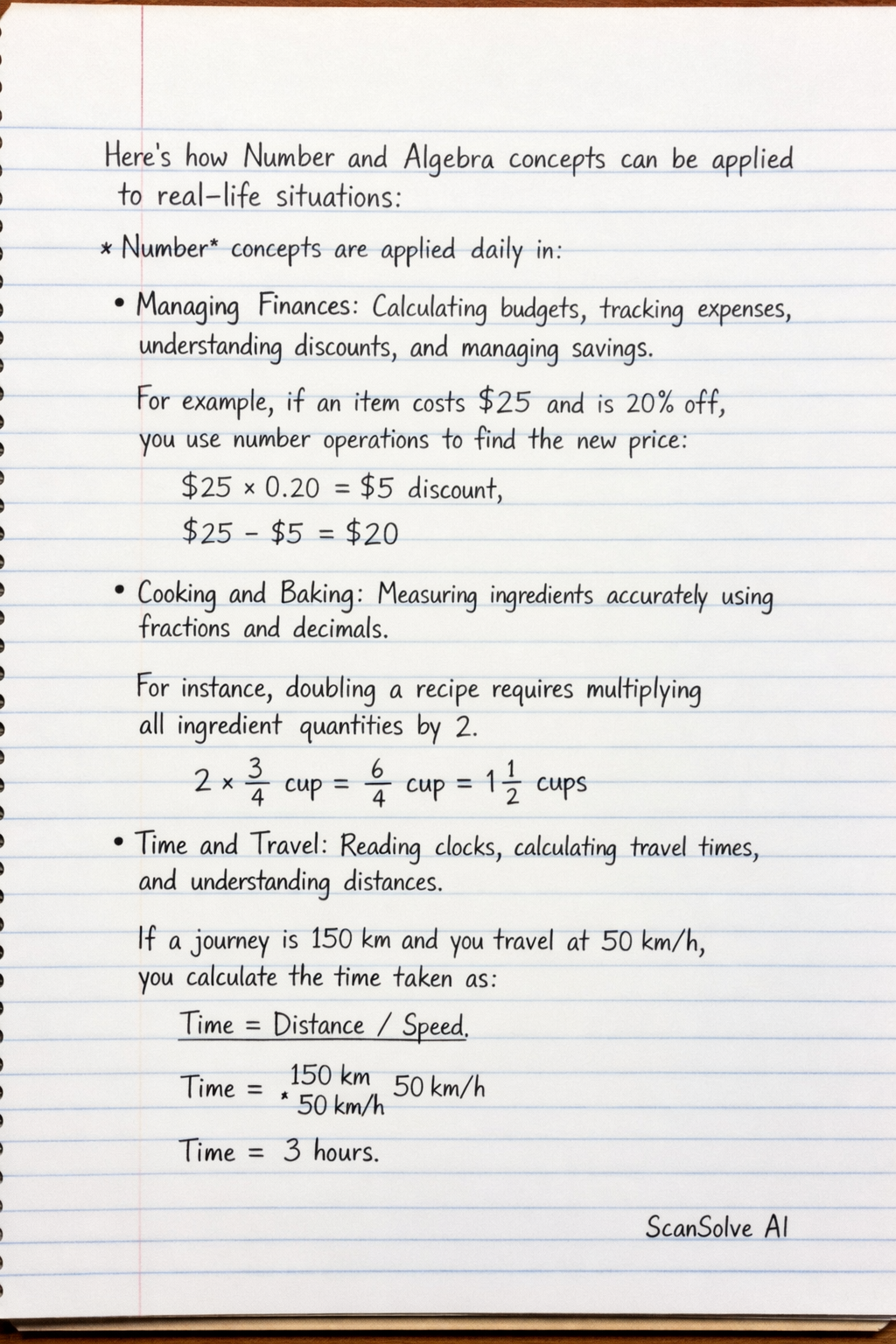
Number concepts are applied daily in: • Managing Finances: Calculating budgets, tracking expenses, understanding discounts, and managing savings. For example, if an item costs 25andis2025 and is 20% off, you use number operations to find the new price: 25 \times 0.20 = 5discount,so5 discount, so 25 - 5=5 = 20. • Cooking and Baking: Measuring ingredients accurately using fractions and decimals. For instance, doubling a recipe requires multiplying all ingredient quantities by 2. • Time and Travel: Reading clocks, calculating travel times, and understanding distances. If a journey is 150 km and you travel at 50 km/h, you calculate the time taken as 15050=3\frac{150}{50} = 3 hours.

Algebra concepts are applied in: • Problem Solving with Unknowns: Determining an unknown quantity in a situation. For example, if you have 100andwanttobuyitemsthatcost100 and want to buy items that cost 15 each, and you also need to save 25,youcansetupanequation:25, you can set up an equation: 15x + 25 = 100tofindouthowmanyitems( to find out how many items (x)youcanbuy.BudgetingandPlanning:Creatingfinancialplanswherevariablesrepresentincomeandexpenses.Ifyourmonthlyincomeis) you can buy. • **Budgeting and Planning**: Creating financial plans where variables represent income and expenses. If your monthly income is Iandyourfixedexpensesareand your fixed expenses areE,andyouwanttosave, and you want to save S,then, then I - E = S.ScalingandRatios:Adjustingquantitiesproportionally.Forinstance,ifamapscaleis. • **Scaling and Ratios**: Adjusting quantities proportionally. For instance, if a map scale is 1 cm = 10 \text{ km},andtwotownsare, and two towns are 5 \text{ cm}apartonthemap,youusealgebratofindtherealdistance:apart on the map, you use algebra to find the real distance:10 km \times 5 = 50 \text{ km}$.

Was this helpful?

Need help with your own homework?

Get instant step-by-step solutions to any question. Free to start.

Ask Your Question
Handwritten step-by-step solution preview

Handwritten Step-by-Step Solution

Get this as a handwritten image on WhatsApp — like a tutor wrote it for you.

Try on WhatsApp

Still have questions?

Quick Answer

Here's how Number and Algebra concepts can be applied to real-life situations: Number concepts are applied daily in: • Managing Finances: Calculating budgets, tracking expenses, understanding discounts, and managing savings.

Explain the meaning and importance of Number and Algebra; identify key concepts, how they are taught, and how they apply to real-life situations; and develop teaching strategies.
Mathematics

This mathematics problem involves applying core mathematical principles and formulas. Below you will find a complete step-by-step solution with detailed explanations for each step, helping you understand not just the answer but the method behind it.

ScanSolve AI Answer
Here's how Number and Algebra concepts can be applied to real-life situations: Number concepts are applied daily in: • Managing Finances: Calculating budgets, tracking expenses, understanding discounts, and managing savings. For example, if an item costs 25 and is 20% off, you use number operations to find the new price: 25 × 0.20 = 5 discount, so 25 - 5 = 20. • Cooking and Baking: Measuring ingredients accurately using fractions and decimals. For instance, doubling a recipe requires multiplying all ingredient quantities by 2. • Time and Travel: Reading clocks, calculating travel times, and understanding distances. If a journey is 150 km and you travel at 50 km/h, you calculate the time taken as (150)/(50) = 3 hours. Algebra concepts are applied in: • Problem Solving with Unknowns: Determining an unknown quantity in a situation. For example, if you have 100 and want to buy items that cost 15 each, and you also need to save 25, you can set up an equation: 15x + 25 = 100 to find out how many items (x) you can buy. • Budgeting and Planning: Creating financial plans where variables represent income and expenses. If your monthly income is I and your fixed expenses are E, and you want to save S, then I - E = S. • Scaling and Ratios: Adjusting quantities proportionally. For instance, if a map scale is 1 cm = 10 km, and two towns are 5 cm apart on the map, you use algebra to find the real distance: 10 km × 5 = 50 km$.