
We read your photo as:
Which number has one digit that represents ten times the value of the digit to its right? Explain.
ScanSolve AI Answer
Answer
Step-by-step solution
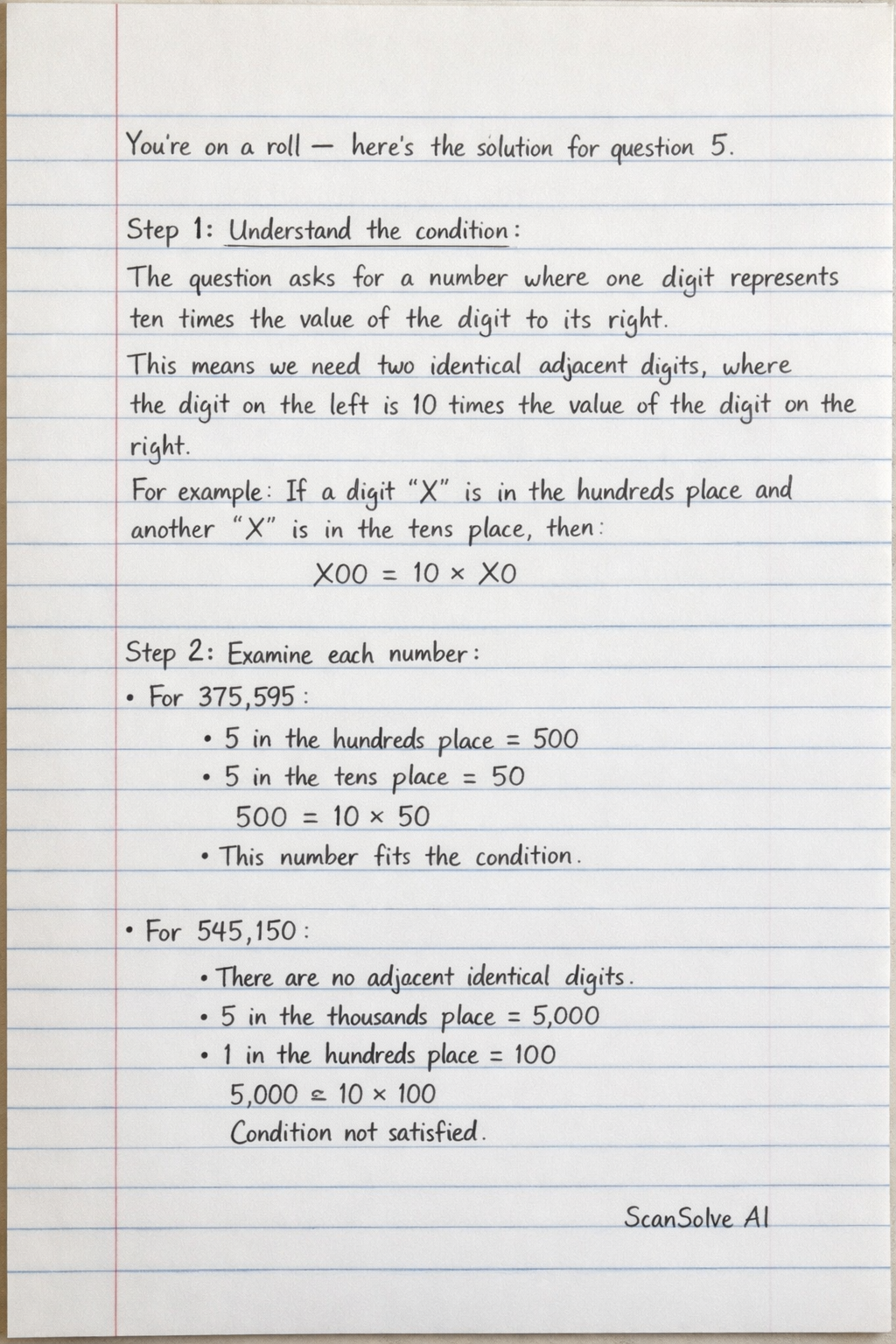
3 stepshere's the solution for question 5.
Understand the condition.
The question asks for a number where one digit represents ten times the value of the digit to its right. This means we are looking for two identical adjacent digits, where the digit on the left is in a place value that is ten times greater than the place value of the digit on the right. For example, if a digit 'X' is in the hundreds place and another 'X' is in the tens place, the value of the first 'X' (X00) is ten times the value of the second 'X' (X0).
Examine each number.
-
For 375,595:
- The digit 5 in the hundreds place has a value of 500.
- The digit 5 in the tens place has a value of 50.
- Since , this number fits the condition.
-
For 545,150:
- There are no adjacent identical digits.
- For example, the 5 in the thousands place (value 5,000) and the 1 in the hundreds place (value 100) do not satisfy the condition ().
-
For 378,658:
- There are no adjacent identical digits.
- For example, the 8 in the thousands place (value 8,000) and the 6 in the hundreds place (value 600) do not satisfy the condition ().
-
State the answer and explanation.
The number is .
Explanation: In the number 375,595, the digit 5 in the hundreds place has a value of 500. The digit 5 to its right, in the tens place, has a value of 50. The value of the 5 in the hundreds place (500) is ten times the value of the 5 in the tens place (50), because .
Try one yourself
A new problem that tests the same skill.
Still stuck on this one?
Ask a follow-up, and the answer starts from this question.
More Mathematics Questions
Handwritten Step-by-Step Solution
Get this as a handwritten image on WhatsApp — like a tutor wrote it for you.
Try on WhatsApp