
We read your photo as:
Observe the number sequence, 22, 21, 23, 22, 24, 23, ... what number should come next?
ScanSolve AI Answer
Step-by-step solution
9 stepsLet's Practise
-
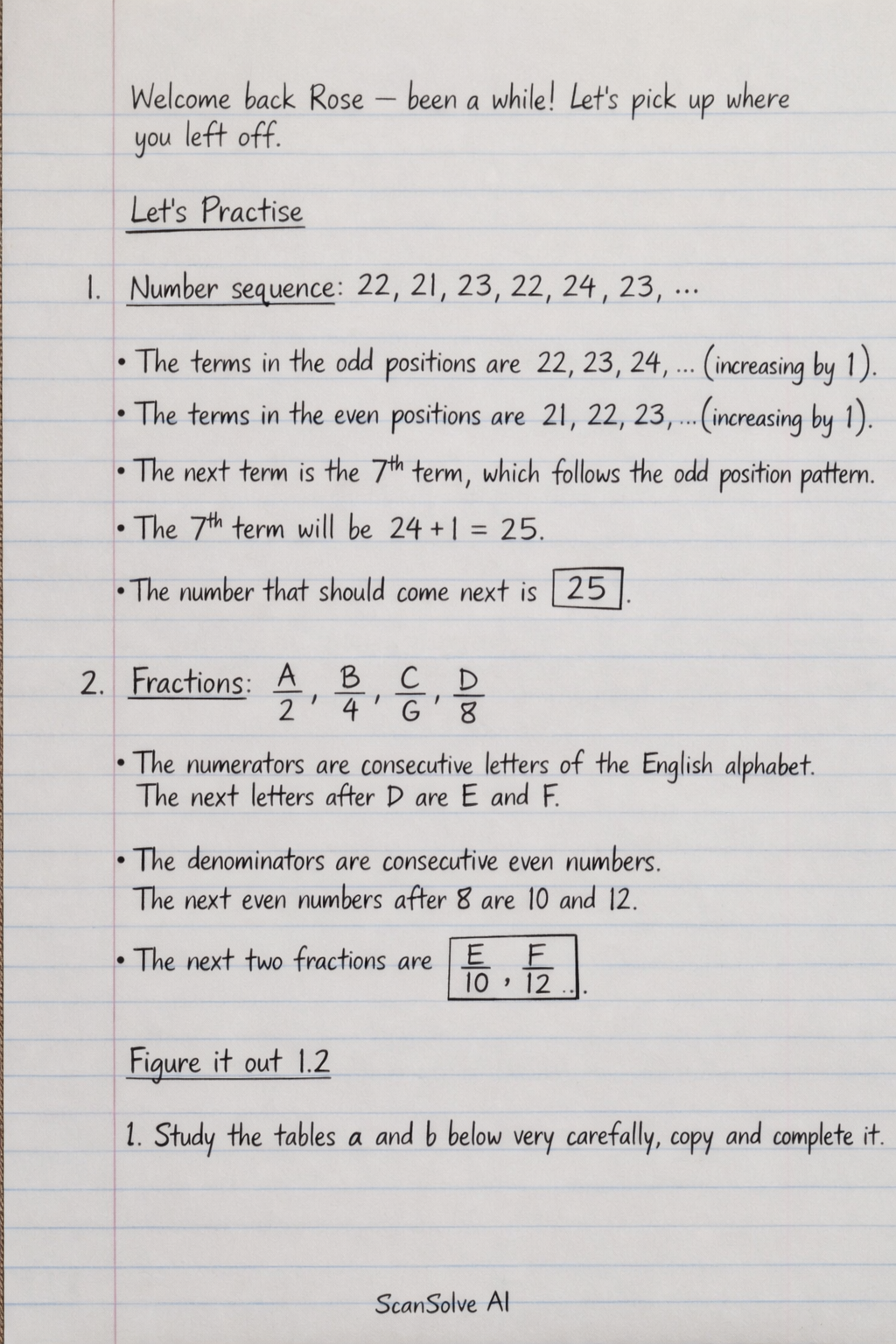
Number sequence: This sequence consists of two interleaved arithmetic progressions. The terms in the odd positions are (increasing by 1). The terms in the even positions are (increasing by 1). The next term is the 7th term, which follows the odd position pattern. The 7th term will be . The number that should come next is .
-
Fractions: The numerators are consecutive letters of the English alphabet. The next letters after D are E and F. The denominators are consecutive even numbers. The next even numbers after 8 are 10 and 12. The next two fractions are .
Figure it out 1.2
1. Study the tables a and b below very carefully, copy and complete it.
- Table a:
Identify the pattern for table a.
For Domain 2, Co-domain is 4. For Domain 3, Co-domain is 6. The pattern is Co-domain $= 2 \times \text{Domain}$.Calculate the missing values.
For Domain 1, Co-domain $= 2 \times 1 = 2$. For Domain 4, Co-domain $= 2 \times 4 = 8$. The completed table a is: Domain: 1, 2, 3, 4 Co-domain: 2, 4, 6, 8- Table b:
Identify the pattern for table b.
For Domain 20, Co-domain is 200. For Domain 40, Co-domain is 400. The pattern is Co-domain $= 10 \times \text{Domain}$.Calculate the missing values.
For Domain 10, Co-domain $= 10 \times 10 = 100$. For Domain 30, Co-domain $= 10 \times 30 = 300$. The completed table b is: Domain: 10, 20, 30, 40 Co-domain: 100, 200, 300, 400 **i)** What are the missing numbers in the co-domains in table a above? The missing numbers are $\boxed{2 \text{ and } 8}$. **ii)** Write down the set of elements in the co-domain of the relation in table b. The set of elements in the co-domain of table b is $\boxed{\{100, 200, 300, 400\}}$.- Table c: Complete table c above.
Identify the pattern for table c.
Let P be the domain and Q be the co-domain. Given pairs: $(3, 6)$, $(4, 10)$, $(?, 15)$, $(?, 28)$. Observe the differences in Q values for consecutive P values: $10 - 6 = 4$ (for P=4 and P=3) $15 - 10 = 5$ (for P=? and P=4) This suggests the differences are increasing by 1. This is a sequence of triangular numbers, where $Q = \frac{P(P+1)}{2}$.Calculate the missing values for P.
For $Q=3$: $$ 3 = \frac{P(P+1)}{2} $$ $$ 6 = P^2 + P $$ $$ P^2 + P - 6 = 0 $$ $$ (P+3)(P-2) = 0 $$ Since P must be positive, $P=2$. For $Q=15$: $$ 15 = \frac{P(P+1)}{2} $$ $$ 30 = P^2 + P $$ $$ P^2 + P - 30 = 0 $$ $$ (P+6)(P-5) = 0 $$ Since P must be positive, $P=5$. For $Q=28$: $$ 28 = \frac{P(P+1)}{2} $$ $$ 56 = P^2 + P $$ $$ P^2 + P - 56 = 0 $$ $$ (P+8)(P-7) = 0 $$ Since P must be positive, $P=7$.Calculate the missing values for Q.
For $P=1$: $$ Q = \frac{1(1+1)}{2} = \frac{2}{2} = 1 $$ For $P=6$: $$ Q = \frac{6(6+1)}{2} = \frac{42}{2} = 21 $$ The completed table c is: P: 1, 2, 3, 4, 5, 6, 7 Q: 1, 3, 6, 10, 15, 21, 28 **i)** Write down the set of elements in the domain in table c above. The set of elements in the domain of table c is $\boxed{\{1, 2, 3, 4, 5, 6, 7\}}$.2. Observe the sequence 7, 10, 8, 11, 9, 12, what are the next four terms?
Identify the pattern.
This sequence consists of two interleaved arithmetic progressions:
The terms in the odd positions are (increasing by 1).
The terms in the even positions are (increasing by 1).Determine the next four terms.
The sequence given has 6 terms. We need the 7th, 8th, 9th, and 10th terms.
7th term (odd position): .
8th term (even position): .
9th term (odd position): .
10th term (even position): .
The next four terms are .
Still stuck on this one?
Ask a follow-up, and the answer starts from this question.
More Mathematics Questions
Handwritten Step-by-Step Solution
Get this as a handwritten image on WhatsApp — like a tutor wrote it for you.
Try on WhatsApp