

This mathematics problem involves applying core mathematical principles and formulas. Below you will find a complete step-by-step solution with detailed explanations for each step, helping you understand not just the answer but the method behind it.
ScanSolve AI Answer
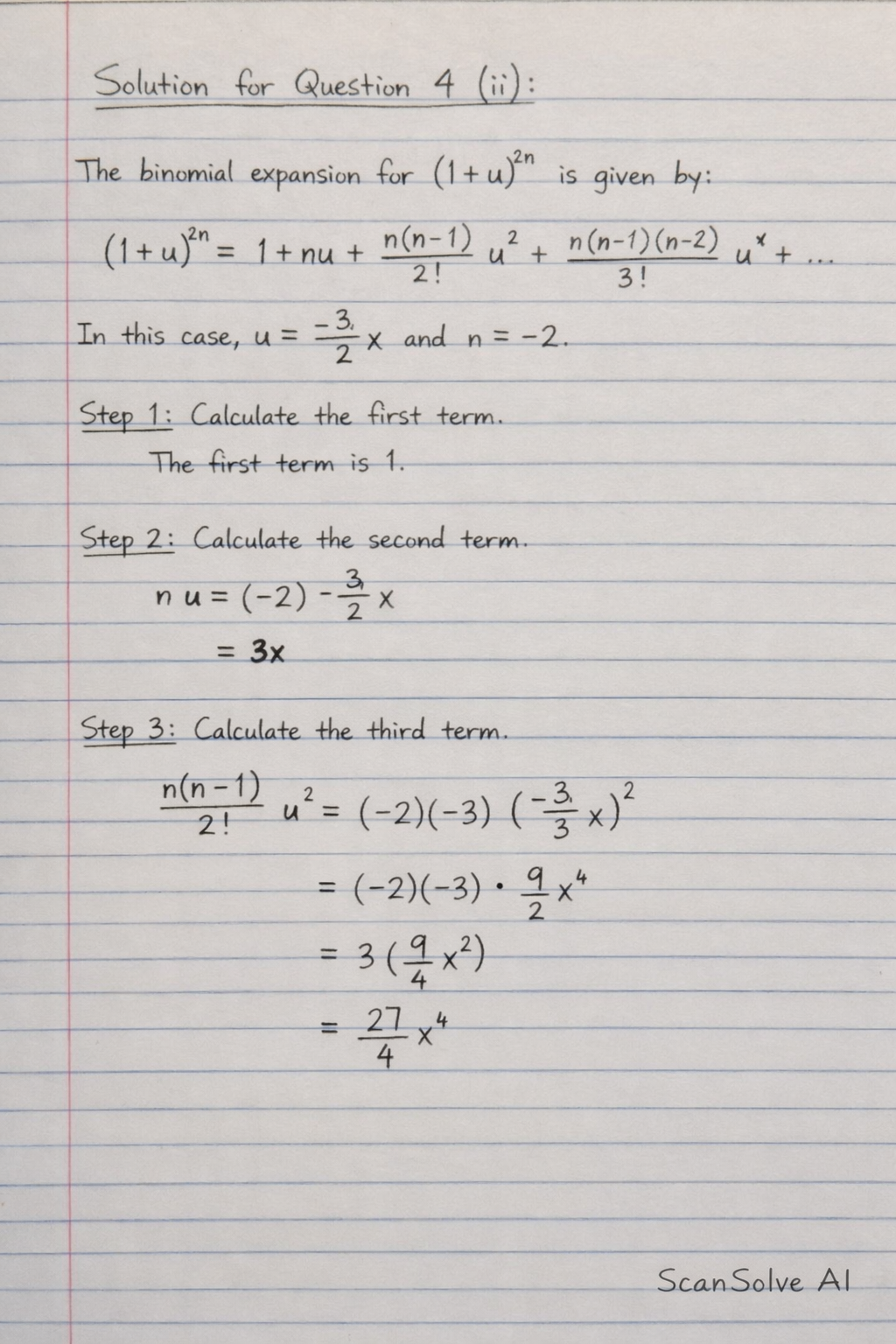
Here is the solution for Question 4 (ii): Question 4 (ii): Obtain the first four terms of the binomial expansion of (1 - (3)/(2)x)^-2 and find the set of values of x for which the expansion is valid. Hence, deduce the first four terms of the binomial expansion of (2 - 3x)^-2. Part 1: Obtain the first four terms of the binomial expansion of (1 - (3)/(2)x)^-2. The binomial expansion for (1+u)^n is given by: (1+u)^n = 1 + nu + (n(n-1))/(2!)u^2 + (n(n-1)(n-2))/(3!)u^3 + In this case, u = -(3)/(2)x and n = -2. Step 1: Calculate the first term. The first term is 1. Step 2: Calculate the second term. nu = (-2)(-(3)/(2)x) = 3x Step 3: Calculate the third term. (n(n-1))/(2!)u^2 = ((-2)(-2-1))/(2 × 1)(-(3)/(2)x)^2 = ((-2)(-3))/(2)((9)/(4)x^2) = 3((9)/(4)x^2) = (27)/(4)x^2 Step 4: Calculate the fourth term. (n(n-1)(n-2))/(3!)u^3 = ((-2)(-2-1)(-2-2))/(3 × 2 × 1)(-(3)/(2)x)^3 = ((-2)(-3)(-4))/(6)(-(27)/(8)x^3) = (-24)/(6)(-(27)/(8)x^3) = -4(-(27)/(8)x^3) = (27)/(2)x^3 The first four terms of the expansion of (1 - (3)/(2)x)^-2 are 1 + 3x + (27)/(4)x^2 + (27)/(2)x^3. Part 2: Find the set of values of x for which the expansion is valid. The binomial expansion (1+u)^n is valid when |u| < 1. Here, u = -(3)/(2)x. So, we must have: |-(3)/(2)x| < 1 (3)/(2)|x| < 1 |x| < (2)/(3) The set of values of x for which the expansion is valid is -(2)/(3) < x < (2)/(3). Part 3: Deduce the first four terms of the binomial expansion of (2 - 3x)^-2. Step 1: Rewrite (2 - 3x)^-2 in the form A(1+u)^n. (2 - 3x)^-2 = [2(1 - (3)/(2)x)]^-2 = 2^-2(1 - (3)/(2)x)^-2 = (1)/(4)(1 - (3)/(2)x)^-2 Step 2: Substitute the expansion from Part 1 into this expression. = (1)/(4)(1 + 3x + (27)/(4)x^2 + (27)/(2)x^3 + ) Step 3: Multiply each term by (1)/(4). = (1)/(4)(1) + (1)/(4)(3x) + (1)/(4)((27)/(4)x^2) + (1)/(4)((27)/(2)x^3) + = (1)/(4) + (3)/(4)x + (27)/(16)x^2 + (27)/(8)x^3 + The first four terms of the binomial expansion of (2 - 3x)^-2 are (1)/(4) + (3)/(4)x + (27)/(16)x^2 + (27)/(8)x^3.