

This mathematics problem involves applying core mathematical principles and formulas. Below you will find a complete step-by-step solution with detailed explanations for each step, helping you understand not just the answer but the method behind it.
ScanSolve AI Answer
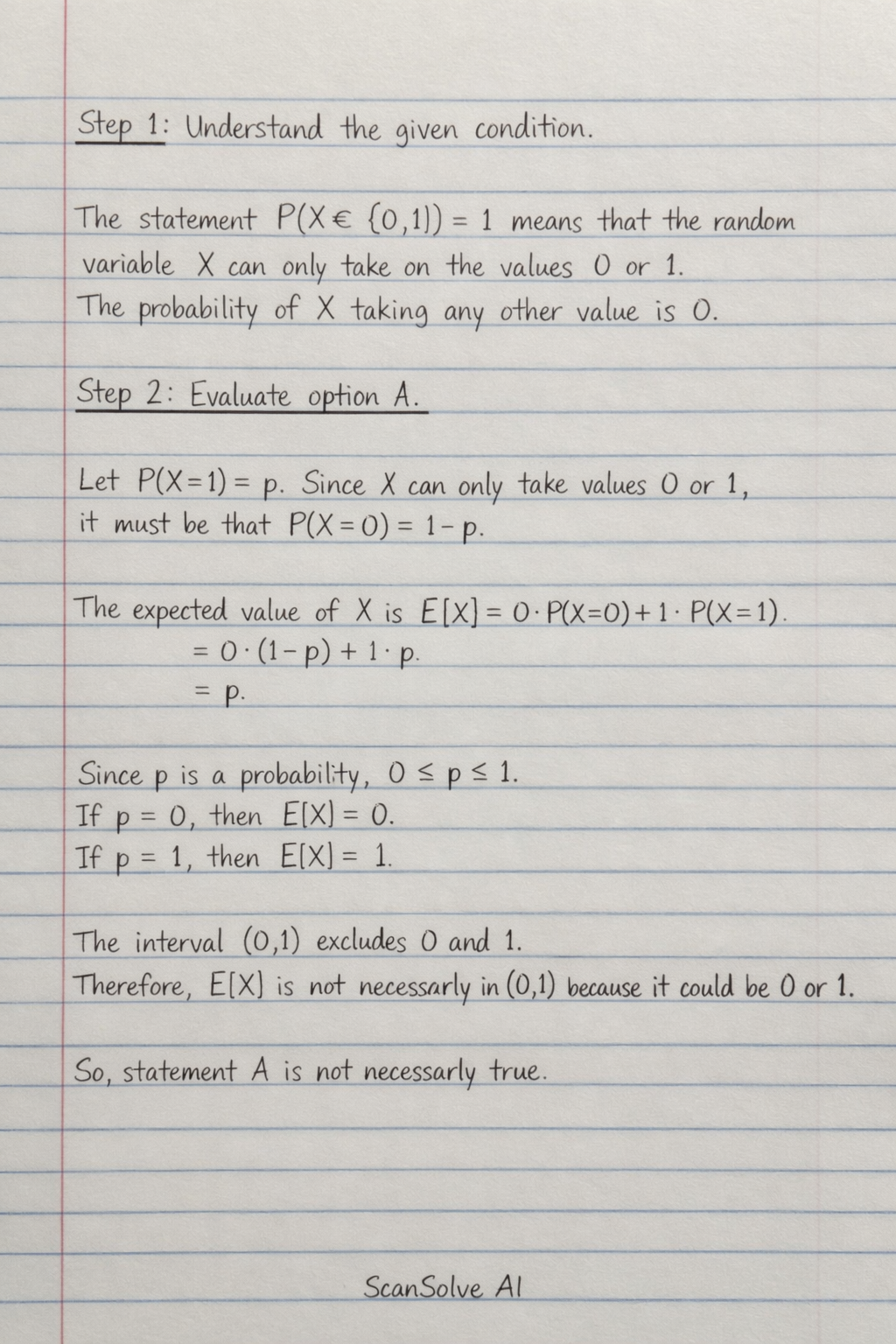
Step 1: Understand the given condition. The statement P(X \0,1\) = 1 means that the random variable X can only take on the values 0 or 1. The probability of X taking any other value is 0. Step 2: Evaluate option A. Let P(X=1) = p. Since X can only take values 0 or 1, it must be that P(X=0) = 1-p. The expected value of X is E[X] = 0 · P(X=0) + 1 · P(X=1) = 0 · (1-p) + 1 · p = p. Since p is a probability, 0 p 1. If p=0, then E[X]=0. If p=1, then E[X]=1. The interval (0,1) excludes 0 and 1. Therefore, E[X] is not necessarily in (0,1) because it could be 0 or 1. So, statement A is not necessarily true. Step 3: Evaluate option B. A random variable X is defined as a Bernoulli random variable if it takes exactly two values, typically 0 and 1, with probabilities P(X=1)=p and P(X=0)=1-p for some p [0,1]. The given condition P(X \0,1\) = 1 means that X can only take values 0 or 1. This is precisely the definition of a Bernoulli random variable. So, statement B is necessarily true. Step 4: Evaluate option D. For a Bernoulli random variable, the variance is given by Var(X) = p(1-p). To find the maximum value of p(1-p) for p [0,1], we can consider the function $f