
We read your photo as:
Calculate the overall dispensing adherence rate based on the provided data and the number of prescriptions containing antibiotics.
Mathematics
ScanSolve AI Answer
Step-by-step solution
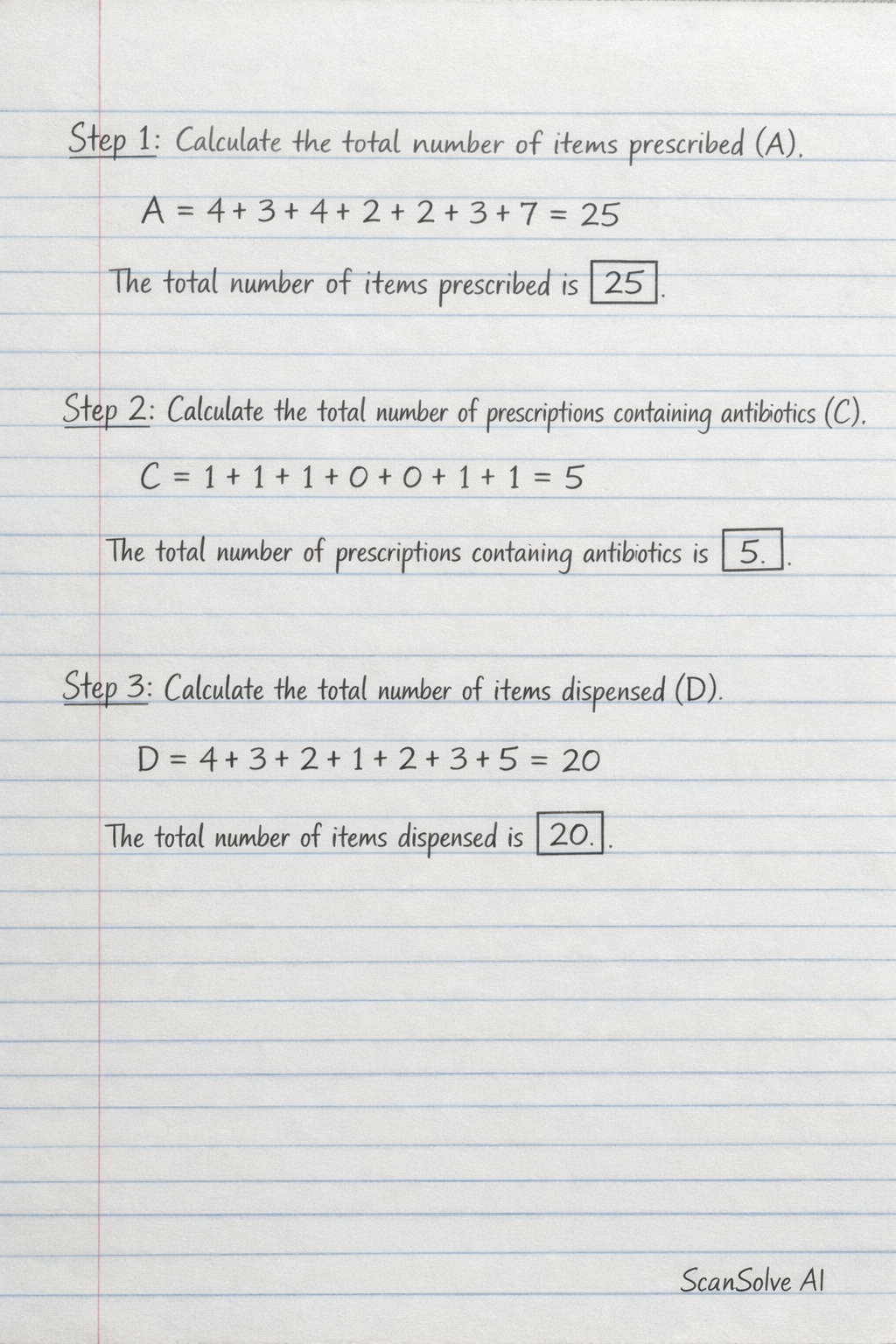
4 stepsCalculate the total number of items prescribed (A).
We sum the values in the "No of items prescribed (HF 11)" column.
The total number of items prescribed is .
Calculate the total number of prescriptions containing antibiotics (C).
We sum the values in the "Prescription Contains Antibiotic. Yes = 1 No = 0 (HF 13)" column.
The total number of prescriptions containing antibiotics is .
Calculate the total number of items dispensed (D).
We sum the values in the "No. of items dispensed (HF 3)" column.
The total number of items dispensed is .
Calculate the overall dispensing adherence rate.
The dispensing adherence rate is the ratio of the total number of items dispensed to the total number of items prescribed, expressed as a percentage.
Was this helpful?
Still stuck on this one?
Ask a follow-up, and the answer starts from this question.
Got a different question?Ask your own question
More Mathematics Questions
QThe patient is taking 2 tablets, twice a day. Calculate percentage adherence for the first period…QCalculate the correct dosage in tablets or capsules for the given medication orders.QDerive the function that relates oral dosage to the number of surviving bacteria using composition…QCalculate descriptive statistics for the provided hospital data.QCalculate the number of tablets Ethel has to receive for a complete course of promethazine 12.5mg bd…
Handwritten Step-by-Step Solution
Get this as a handwritten image on WhatsApp — like a tutor wrote it for you.
Try on WhatsApp