
We read your photo as:
P varies directly as square of Q. If P = 3 and Q = 2, find Q when P = 27.
Mathematics
ScanSolve AI Answer
Answer
Step-by-step solution
3 stepsWrite the direct variation equation.
If varies directly as the square of , the relationship can be written as:
where is the constant of variation.
Find the constant of variation ().
We are given when . Substitute these values into the equation:
To find , divide both sides by 4:
Find when .
Now use the constant and the new value in the variation equation:
To solve for , multiply both sides by :
Take the square root of both sides to find :
The possible values for are 6 and .
Was this helpful?
Try one yourself
A new problem that tests the same skill.
Still stuck on this one?
Ask a follow-up, and the answer starts from this question.
Got a different question?Ask your own question
More Mathematics Questions
QA quantity P is partly constant and partly varies as the square root of a quantity Q. Given that P…QSolve for P if P varies as the square of Q, and P=4 when Q=16. Find R if R varies inversely as the…QThe quantities P, Q and R are such that P varies directly as Q and inversely as the square root of…Qp varies directly as q and inversely as the square of r. Given p=9, q=6, r=3, find k. Then given…QGiven P = 4 + sqrt(2) and Q = 2 + sqrt(2).
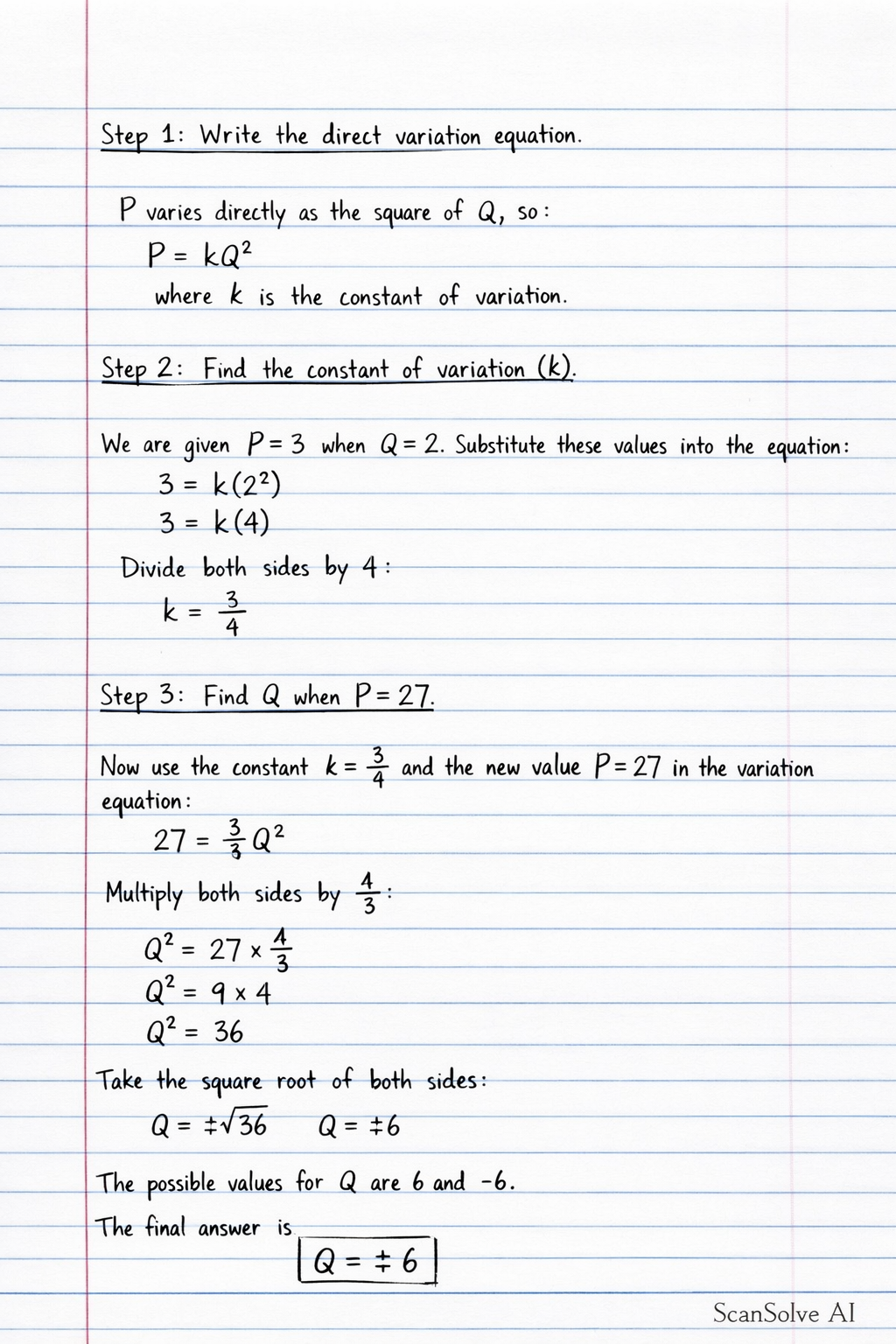
Handwritten Step-by-Step Solution
Get this as a handwritten image on WhatsApp — like a tutor wrote it for you.
Try on WhatsApp