
We read your photo as:
Describe the pattern of matchstick houses, calculate the number of matchsticks needed for different diagrams, and find the rule for this pattern.
ScanSolve AI Answer
Answer
Step-by-step solution
7 steps3 and .4.
.3: Matchstick Houses
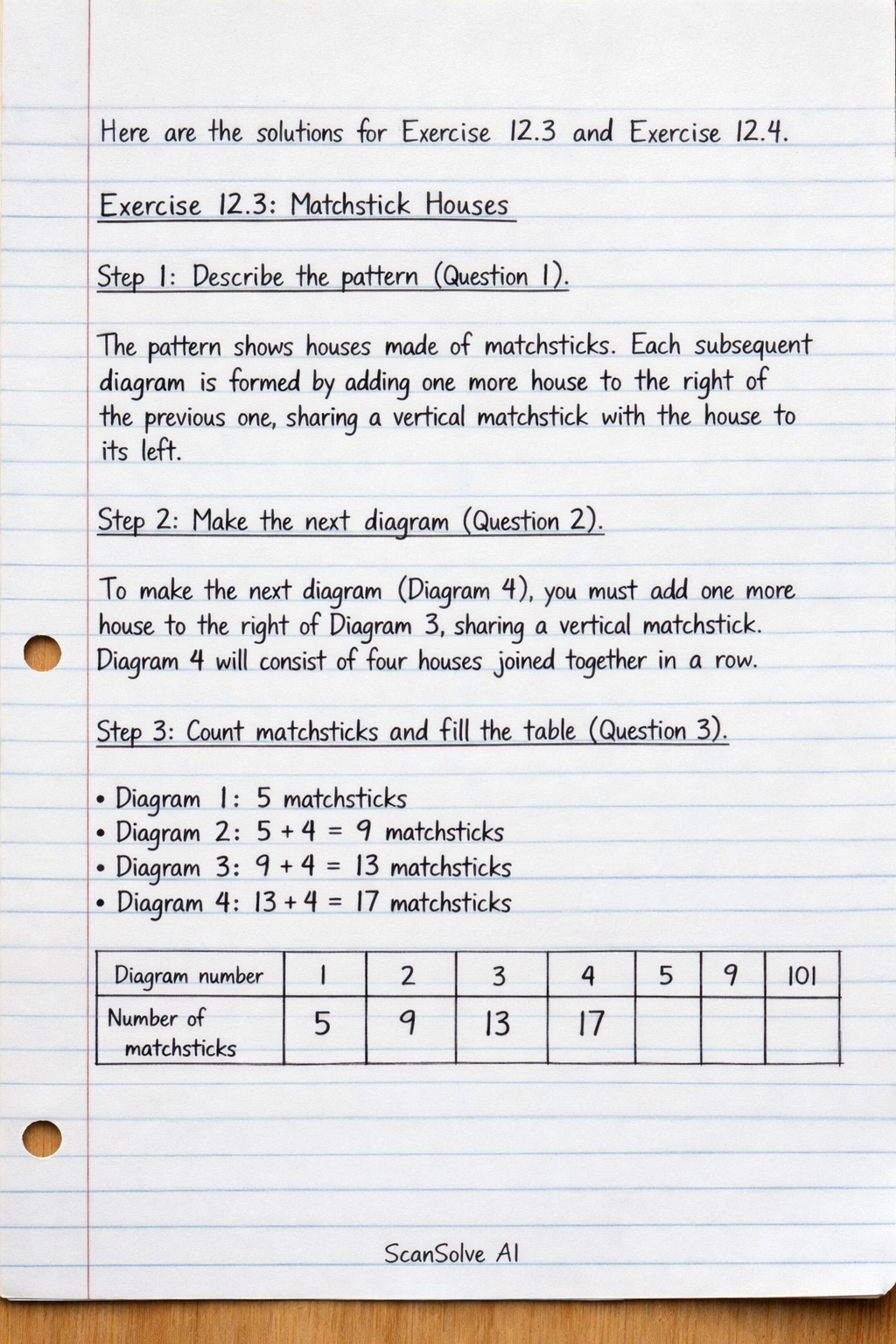
Describe the pattern (Question 1).
The pattern shows houses made of matchsticks. Each subsequent diagram is formed by adding one more house to the right of the previous one, sharing a vertical matchstick with the house to its left.
Make the next diagram (Question 2).
To make the next diagram (Diagram 4), you must add one more house to the right of Diagram 3, sharing a vertical matchstick. Diagram 4 will consist of four houses joined together in a row.
Count matchsticks and fill the table (Question 3).
- Diagram 1: 5 matchsticks
- Diagram 2: 5 (for 1st house) + 4 (for 2nd house) = 9 matchsticks
- Diagram 3: 9 (for 2 houses) + 4 (for 3rd house) = 13 matchsticks
- Diagram 4: 13 (for 3 houses) + 4 (for 4th house) = 17 matchsticks
Diagram number 1 2 3 4 5 7 12 101 Number of matchsticks 5 9 13 17 Find the rule (Question 4).
The number of matchsticks increases by 4 for each additional house. This is an arithmetic sequence with a common difference of 4.
Let be the diagram number.
The rule is:Diagram number Multiply by 4 and add 1 number of matches.
Test the rule for diagrams 2 and 3 (Question 5).
- For Diagram 2 (): Number of matchsticks . This matches the count.
- For Diagram 3 (): Number of matchsticks . This matches the count.
Fill in the table for 5, 7, and 12 houses (Question 6).
- For Diagram 5 (): Number of matchsticks .
- For Diagram 7 (): Number of matchsticks .
- For Diagram 12 (): Number of matchsticks .
Updated table:
Diagram number 1 2 3 4 5 7 12 101 Number of matchsticks 5 9 13 17 21 29 49 Calculate houses for 101 matches (Question 7).
We use the rule: Number of matchsticks .
Given 101 matchsticks:Subtract 1 from both sides:
Divide by 4:
So, 25 houses are joined together.
Final updated table:
Diagram number 1 2 3 4 5 7 12 25 Number of matchsticks 5 9 13 17 21 29 49 101
.4: Number Sequences
For each sequence, the next three numbers are provided, along with the rule.
-
Rule: Add 3 to the previous number.
-
Rule: Add 2 to the previous number.
-
Rule: Alternately subtract 11, then subtract 5 from the previous number. (, , , , )
-
Try one yourself
A new problem that tests the same skill.
Still stuck on this one?
Ask a follow-up, and the answer starts from this question.
More Mathematics Questions
Handwritten Step-by-Step Solution
Get this as a handwritten image on WhatsApp — like a tutor wrote it for you.
Try on WhatsApp