

This mathematics problem involves applying core mathematical principles and formulas. Below you will find a complete step-by-step solution with detailed explanations for each step, helping you understand not just the answer but the method behind it.
ScanSolve AI Answer
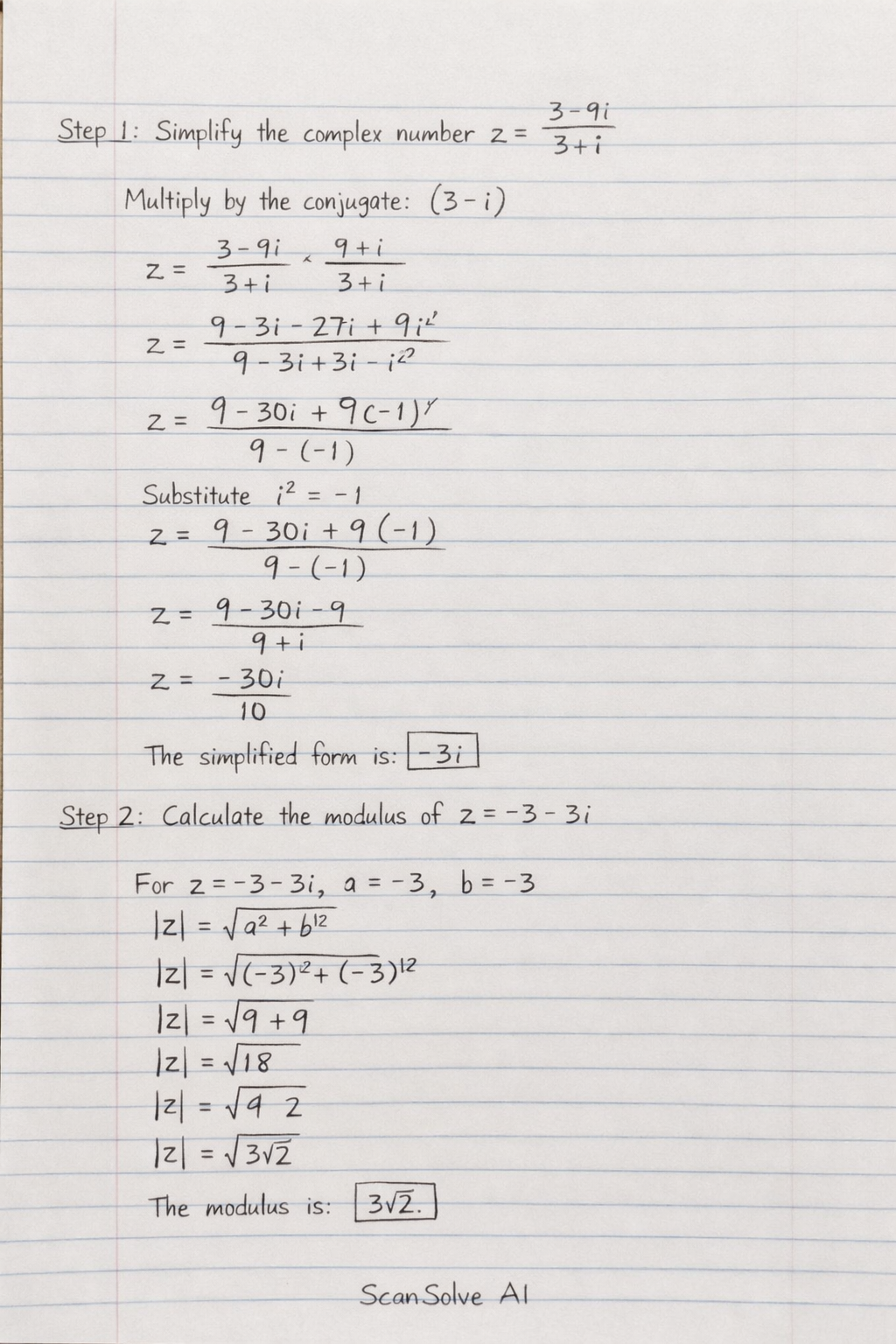
Step 1: Simplify the complex number z = (3-9i)/(3+i). To simplify, multiply the numerator and denominator by the conjugate of the denominator, which is 3-i. z = (3-9i)/(3+i) × (3-i)/(3-i) z = ((3)(3) + (3)(-i) + (-9i)(3) + (-9i)(-i))/((3)(3) + (3)(-i) + (i)(3) + (i)(-i)) z = (9 - 3i - 27i + 9i^2)/(9 - 3i + 3i - i^2) Substitute i^2 = -1: z = (9 - 30i + 9(-1))/(9 - (-1)) z = (9 - 30i - 9)/(9 + 1) z = (-30i)/(10) z = -3i The simplified form of the given complex number is -3i. Step 2: Calculate the modulus of z = -3-3i. The student's subsequent calculations for modulus, argument, and plot are based on the complex number z = -3-3i. We will proceed with this value. For z = -3-3i, the real part is a = -3 and the imaginary part is b = -3. The modulus |z| is given by the formula |z| = sqrt(a^2+b^2). |z| = sqrt((-3)^2 + (-3)^2) |z| = sqrt(9 + 9) |z| = sqrt(18) |z| = sqrt(9 × 2) |z| = 3sqrt(2) The modulus is 3sqrt(2). Step 3: Calculate the argument of z = -3-3i. To find the argument , first find the reference angle using () = |(b)/(a)|. () = |(-3)/(-3)| = |1| = 1 = (1) = 45^ Since the real part a = -3 is negative and the imaginary part b = -3 is negative, the complex number z = -3-3i lies in the third quadrant. For a complex number in the third quadrant, the argument is 180^ + . = 180^ + 45^ = 225^ The argument is 225^. Step 4: Plot the complex number z = -3-3i on an Argand diagram. An Argand diagram represents a complex number z = a+bi as a point (a,b) in the complex plane. The horizontal axis represents the real part, and the vertical axis represents the imaginary part. For z = -3-3i, the real part is -3 and the imaginary part is -3. Therefore, the complex number is plotted as the point (-3, -3) on the Argand diagram. Send me the next one 📸