We read your photo as:

Points A and B have coordinates (1, 6) and (15, 6) respectively. O is the origin. N is on OB such that 3ON = 2OB. L is on OA produced such that OL = 3OA. Find vector LN.

Mathematics

ScanSolve AI Answer

Answers

2 parts
a

(7−14)\begin{pmatrix} 7 \\ -14 \end{pmatrix}

b
(6, 12)

Step-by-step solution

6 steps

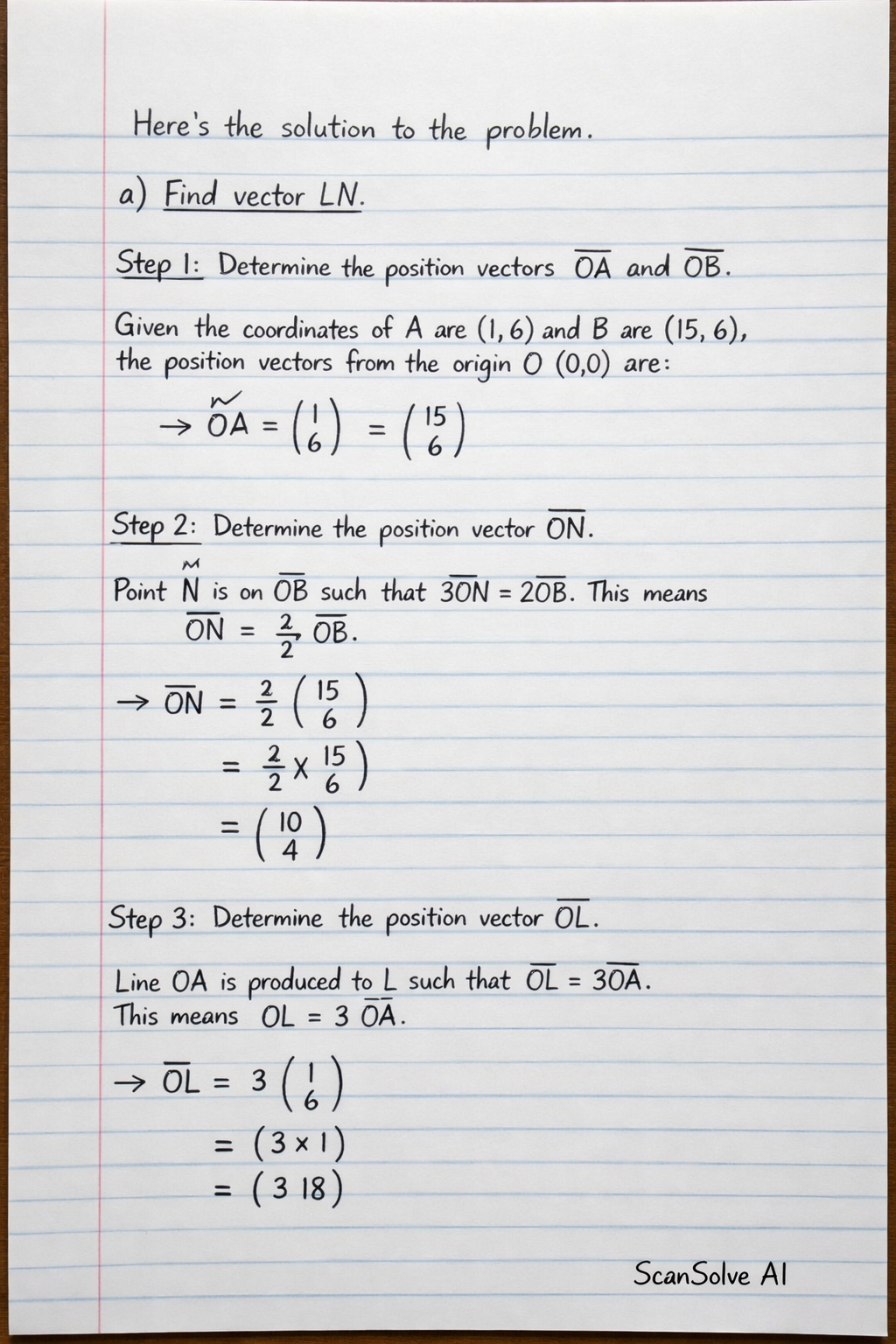
Here's the solution to the problem.

Part a· 4 steps

Find vector LN.

  1. Determine the position vectors OA⃗\vec{OA} and OB⃗\vec{OB}.

    Given the coordinates of A are (1,6)(1, 6) and B are (15,6)(15, 6), the position vectors from the origin O (0,0)(0,0) are:

    OA⃗=(16)\vec{OA} = \begin{pmatrix} 1 \\ 6 \end{pmatrix} OB⃗=(156)\vec{OB} = \begin{pmatrix} 15 \\ 6 \end{pmatrix}
  2. Determine the position vector ON⃗\vec{ON}.

    Point N is on OB such that 3ON=2OB3ON = 2OB. This means ON⃗=23OB⃗\vec{ON} = \frac{2}{3} \vec{OB}.

    ON⃗=23(156)=(23×1523×6)=(104)\vec{ON} = \frac{2}{3} \begin{pmatrix} 15 \\ 6 \end{pmatrix} = \begin{pmatrix} \frac{2}{3} \times 15 \\ \frac{2}{3} \times 6 \end{pmatrix} = \begin{pmatrix} 10 \\ 4 \end{pmatrix}
  3. Determine the position vector OL⃗\vec{OL}.

    Line OA is produced to L such that OL=3OAOL = 3OA. This means OL⃗=3OA⃗\vec{OL} = 3 \vec{OA}.

    OL⃗=3(16)=(3×13×6)=(318)\vec{OL} = 3 \begin{pmatrix} 1 \\ 6 \end{pmatrix} = \begin{pmatrix} 3 \times 1 \\ 3 \times 6 \end{pmatrix} = \begin{pmatrix} 3 \\ 18 \end{pmatrix}
  4. Calculate vector LN⃗\vec{LN}.

    Vector LN⃗\vec{LN} can be found using the formula LN⃗=ON⃗−OL⃗\vec{LN} = \vec{ON} - \vec{OL}.

    LN⃗=(104)−(318)=(10−34−18)=(7−14)\vec{LN} = \begin{pmatrix} 10 \\ 4 \end{pmatrix} - \begin{pmatrix} 3 \\ 18 \end{pmatrix} = \begin{pmatrix} 10 - 3 \\ 4 - 18 \end{pmatrix} = \begin{pmatrix} 7 \\ -14 \end{pmatrix}

    The vector LN⃗\vec{LN} is (7−14)\boxed{\begin{pmatrix} 7 \\ -14 \end{pmatrix}}.

Part b(6, 12)

Given that a point M is on LN such that LM:MN=3:4LM:MN = 3:4, find the coordinate of M.

  1. Use the section formula for position vectors.

    Point M divides the line segment LN in the ratio LM:MN=3:4LM:MN = 3:4. This means M divides LN internally in the ratio m:n=3:4m:n = 3:4.
    The position vector OM⃗\vec{OM} is given by the formula:

    OM⃗=nOL⃗+mON⃗m+n\vec{OM} = \frac{n \vec{OL} + m \vec{ON}}{m+n}

    Substitute m=3m=3, n=4n=4, OL⃗=(318)\vec{OL} = \begin{pmatrix} 3 \\ 18 \end{pmatrix}, and ON⃗=(104)\vec{ON} = \begin{pmatrix} 10 \\ 4 \end{pmatrix}.

    OM⃗=4(318)+3(104)3+4\vec{OM} = \frac{4 \begin{pmatrix} 3 \\ 18 \end{pmatrix} + 3 \begin{pmatrix} 10 \\ 4 \end{pmatrix}}{3+4} OM⃗=(4×34×18)+(3×103×4)7\vec{OM} = \frac{\begin{pmatrix} 4 \times 3 \\ 4 \times 18 \end{pmatrix} + \begin{pmatrix} 3 \times 10 \\ 3 \times 4 \end{pmatrix}}{7} OM⃗=(1272)+(3012)7\vec{OM} = \frac{\begin{pmatrix} 12 \\ 72 \end{pmatrix} + \begin{pmatrix} 30 \\ 12 \end{pmatrix}}{7} OM⃗=(12+3072+12)7\vec{OM} = \frac{\begin{pmatrix} 12 + 30 \\ 72 + 12 \end{pmatrix}}{7} OM⃗=(4284)7\vec{OM} = \frac{\begin{pmatrix} 42 \\ 84 \end{pmatrix}}{7} OM⃗=(427847)=(612)\vec{OM} = \begin{pmatrix} \frac{42}{7} \\ \frac{84}{7} \end{pmatrix} = \begin{pmatrix} 6 \\ 12 \end{pmatrix}
  2. State the coordinates of M.

    The position vector OM⃗=(612)\vec{OM} = \begin{pmatrix} 6 \\ 12 \end{pmatrix} corresponds to the coordinates of M.
    The coordinate of M is (6,12)\boxed{(6, 12)}.

Was this helpful?

Try one yourself

A new problem that tests the same skill.

Still stuck on this one?

Ask a follow-up, and the answer starts from this question.

Got a different question?Ask your own question
Handwritten step-by-step solution preview

Handwritten Step-by-Step Solution

Get this as a handwritten image on WhatsApp — like a tutor wrote it for you.

Try on WhatsApp