
We read your photo as:
PQ is the straight line passing through the points P(6,1) and Q(0,-3). a) Find the gradient (m) of the line PQ. b) Write down the equation of the line PQ. c) Calculate the perpendicular bisector meets
ScanSolve AI Answer
Answers
5 partsStep-by-step solution
11 stepsOkay, Meendahmwanakashi1, let's go through Question Two completely.
Question Two: PQ is the straight line passing through the points P(6,1) and Q(0,-3).
Part a· 2 steps
Find the gradient (m) of the line PQ.
Use the gradient formula .
Let P be and Q be .
Calculate the gradient.
The gradient of the line PQ is .
Part b
Write down the equation of the line PQ.
Use the point-slope form with the gradient and point Q(0,-3).
Simplify the equation.
Isolate .
The equation of the line PQ is .
Part c(3, -1)
Calculate the perpendicular bisector meets PQ intersects at A.
This question asks for the point A where the perpendicular bisector of PQ intersects the line segment PQ. This point is the midpoint of PQ.
Use the midpoint formula .
Let P be and Q be .
Calculate the coordinates of A.
The point A is .
Part d(3, -1)
Find the coordinates of A.
This is the same as part c).
The coordinates of A are .
Part e
Write down the equation of the perpendicular line.
This refers to the equation of the perpendicular bisector of PQ.
Find the gradient of the perpendicular bisector.
The gradient of PQ is . The gradient of a line perpendicular to PQ, , is the negative reciprocal.
Use the point-slope form with the gradient and the midpoint A(3,-1).
Simplify the equation.
Isolate .
The equation of the perpendicular line is .
Part f
State any two (2) real life applications of Coordinate Geometry.
- Navigation and GPS: Coordinate geometry is fundamental to mapping and global positioning systems, allowing us to locate positions and plan routes.
- Engineering and Architecture: It is used in designing structures, buildings, and bridges by defining points, lines, and shapes in a coordinate system.
Try one yourself
A new problem that tests the same skill.
Still stuck on this one?
Ask a follow-up, and the answer starts from this question.
More Mathematics Questions
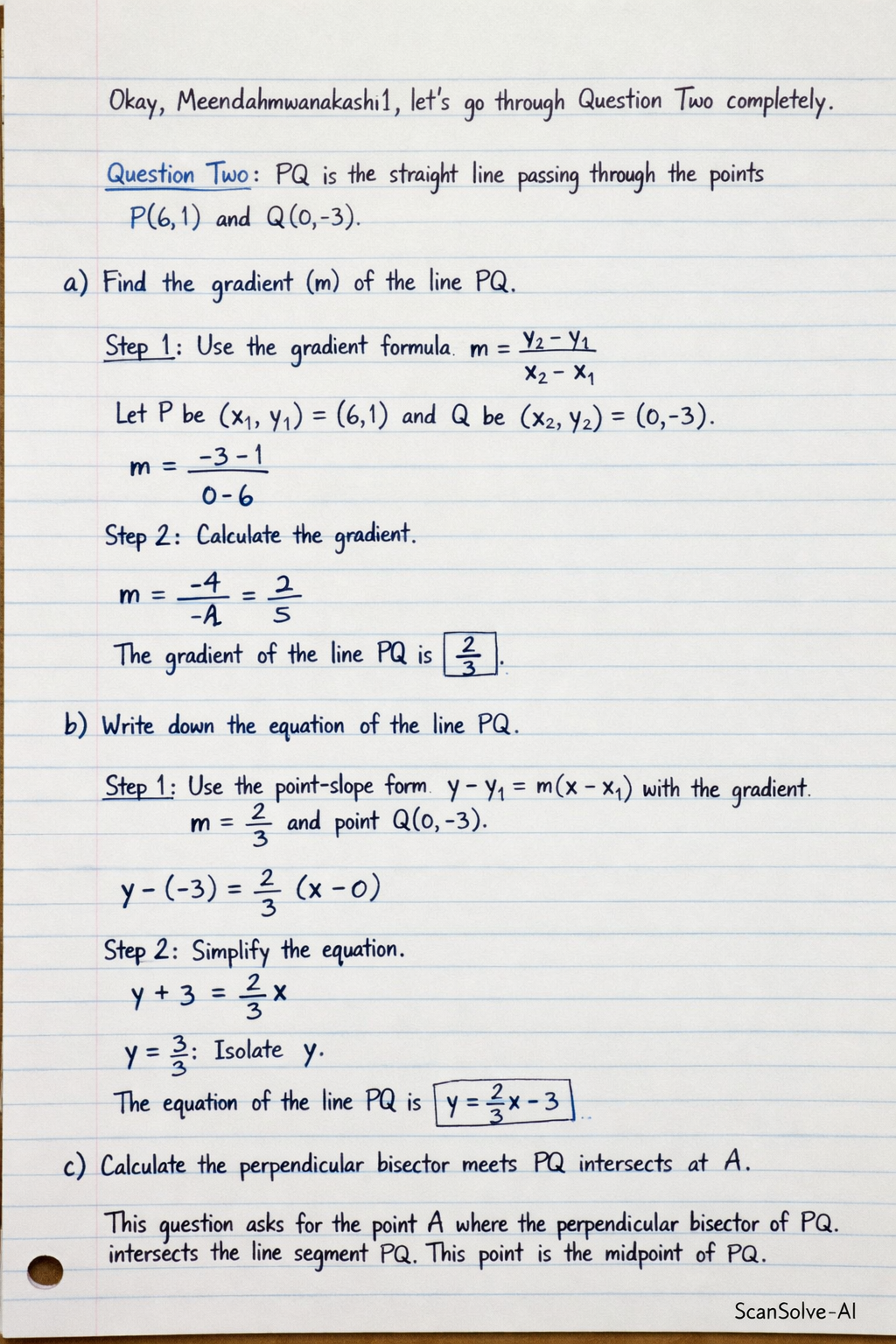
Handwritten Step-by-Step Solution
Get this as a handwritten image on WhatsApp — like a tutor wrote it for you.
Try on WhatsApp