
We read your photo as:
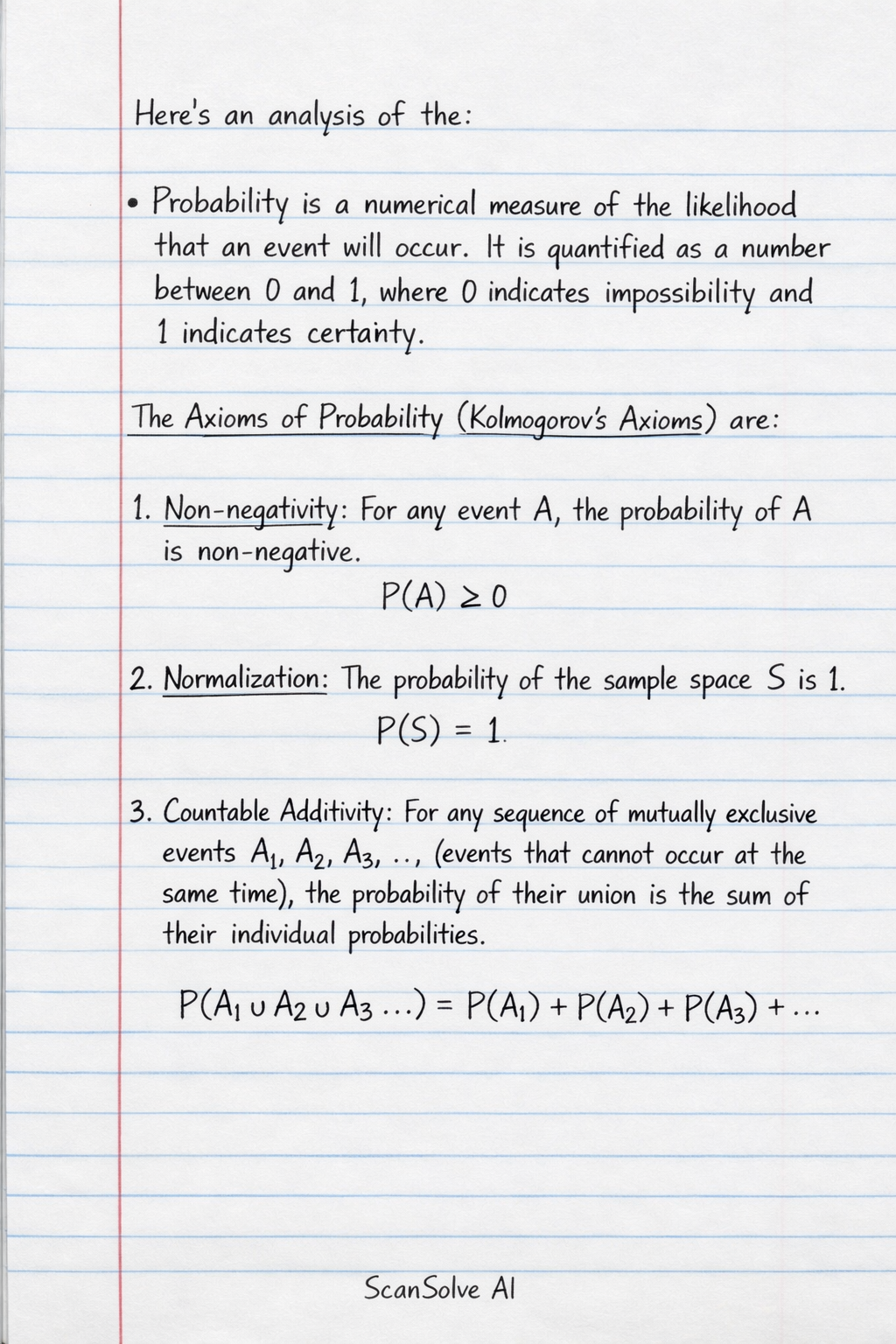
Define Probability and state its Axioms.
Mathematics
ScanSolve AI Answer
Answer
v
Step-by-step solution
3 stepsDefine Probability and state its Axioms.
-
a) Probability is a numerical measure of the likelihood that an event will occur. It is quantified as a number between 0 and 1, where 0 indicates impossibility and 1 indicates certainty.
The Axioms of Probability (Kolmogorov's Axioms) are:
- Non-negativity: For any event , the probability of is non-negative.
- Normalization: The probability of the sample space (the set of all possible outcomes) is 1.
- Countable Additivity: For any sequence of mutually exclusive events (events that cannot occur at the same time), the probability of their union is the sum of their individual probabilities.
-
Write short notes on the given terms.
- b)
- i) An Experiment is any process that yields an observation or an outcome. For example, tossing a coin or rolling a die.
- ii) A Sample Space () is the set of all possible outcomes of a random experiment. For example, when rolling a die, .
- iii) An Event Space (or simply an Event) is a subset of the sample space, consisting of one or more outcomes. For example, rolling an even number on a die is an event .
- iv) A Sample Point is an individual outcome in the sample space. For example, when rolling a die, '3' is a sample point.
- v) Trials are individual repetitions of an experiment. For example, if you toss a coin 10 times, each toss is a trial.
- b)
Calculate the probability of not getting a perfect square.
- c) When a fair die is tossed once, the sample space is . The total number of possible outcomes is 6. The perfect squares in this sample space are . Let be the event that a perfect square shows up. The number of outcomes in event is 2. The probability of event is: The probability that a perfect square did not show up is , which is . The probability that a perfect square did not show up is .
Was this helpful?
Try one yourself
A new problem that tests the same skill.
Still stuck on this one?
Ask a follow-up, and the answer starts from this question.
Got a different question?Ask your own question
More Mathematics Questions
QA) What is Probability? State the Axioms of Probability. b) Write short notes on the following: i)…QWrite a brief Historic Perspective of Probability Define the following: i) Permutation ii)…QA) i) Probability is a numerical measure of the likelihood that an event will occur. It is expressed…
Browse by topic:Statistics
Handwritten Step-by-Step Solution
Get this as a handwritten image on WhatsApp — like a tutor wrote it for you.
Try on WhatsApp