

This mathematics problem involves applying core mathematical principles and formulas. Below you will find a complete step-by-step solution with detailed explanations for each step, helping you understand not just the answer but the method behind it.
ScanSolve AI Answer
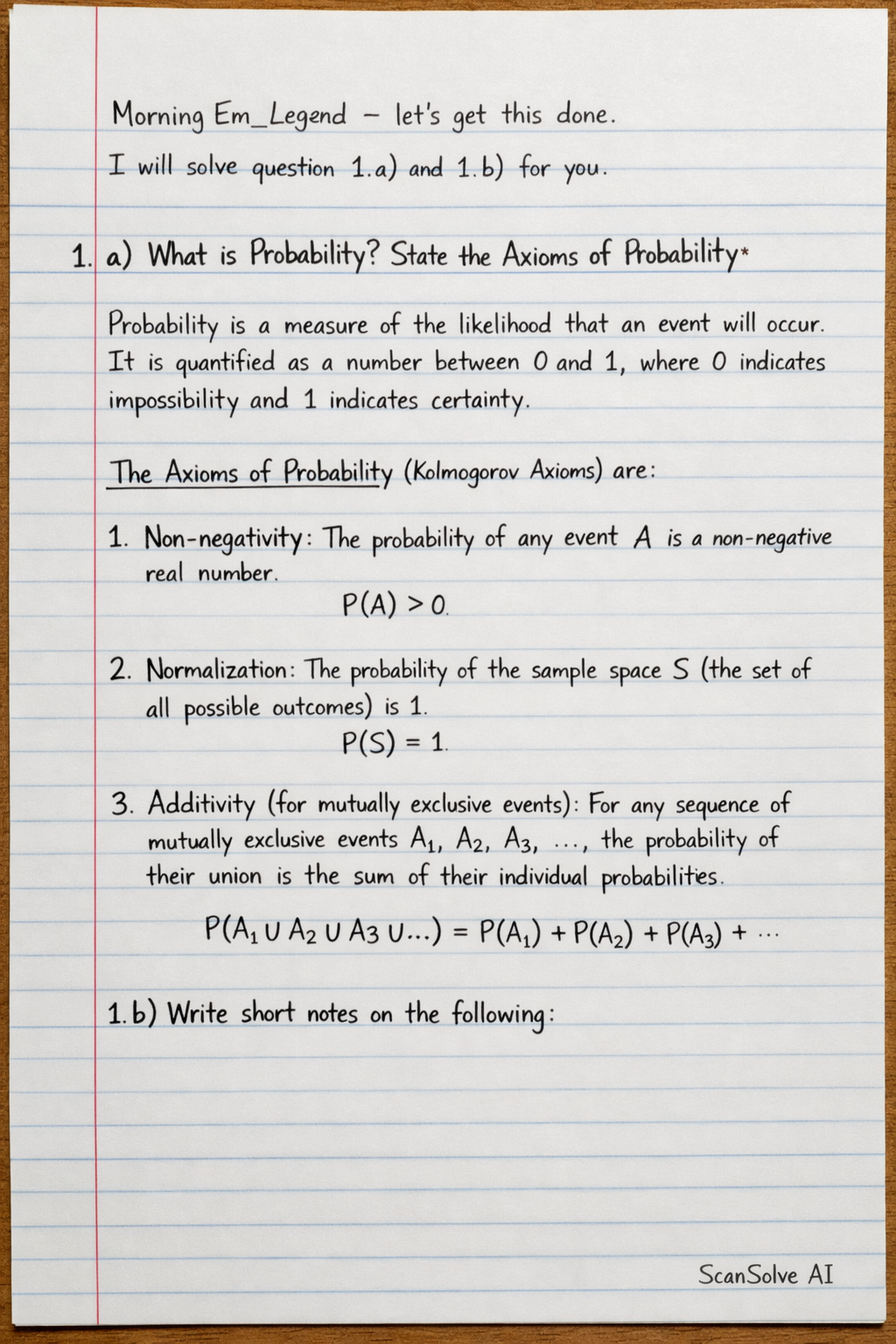
I will solve question 1.a) and 1.b) for you. 1. a) What is Probability? State the Axioms of Probability Probability is a measure of the likelihood that an event will occur. It is quantified as a number between 0 and 1, where 0 indicates impossibility and 1 indicates certainty. The Axioms of Probability (Kolmogorov Axioms) are: 1. Non-negativity: The probability of any event A is a non-negative real number. P(A) 0 2. Normalization: The probability of the sample space S (the set of all possible outcomes) is 1. P(S) = 1 3. Additivity (for mutually exclusive events): For any sequence of mutually exclusive events A_1, A_2, A_3, , the probability of their union is the sum of their individual probabilities. P(A_1 A_2 A_3 ) = P(A_1) + P(A_2) + P(A_3) + 1. b) Write short notes on the following: i) Experiment An experiment is any process that generates a set of well-defined outcomes. Examples include tossing a coin, rolling a die, or measuring a person's height. ii) Sample Space The sample space (S) of an experiment is the set of all possible outcomes. For example, when rolling a standard six-sided die, the sample space is S = \1, 2, 3, 4, 5, 6\. iii) Event Space An event space (or simply an event) is a subset of the sample space. It represents a specific outcome or a collection of outcomes. For example, when rolling a die, the event "rolling an even number" is the subset \2, 4, 6\. iv) Sample Point A sample point is an individual outcome in the sample space. It is a single element of the sample space. For example, when rolling a die, '3' is a sample point. v) Trials A trial is a single performance of an experiment. If an experiment is repeated multiple times, each repetition is considered a trial. For example, tossing a coin 10 times involves 10 trials. Send me the next one 📸