
This mathematics problem involves applying core mathematical principles and formulas. Below you will find a complete step-by-step solution with detailed explanations for each step, helping you understand not just the answer but the method behind it.
ScanSolve AI Answer
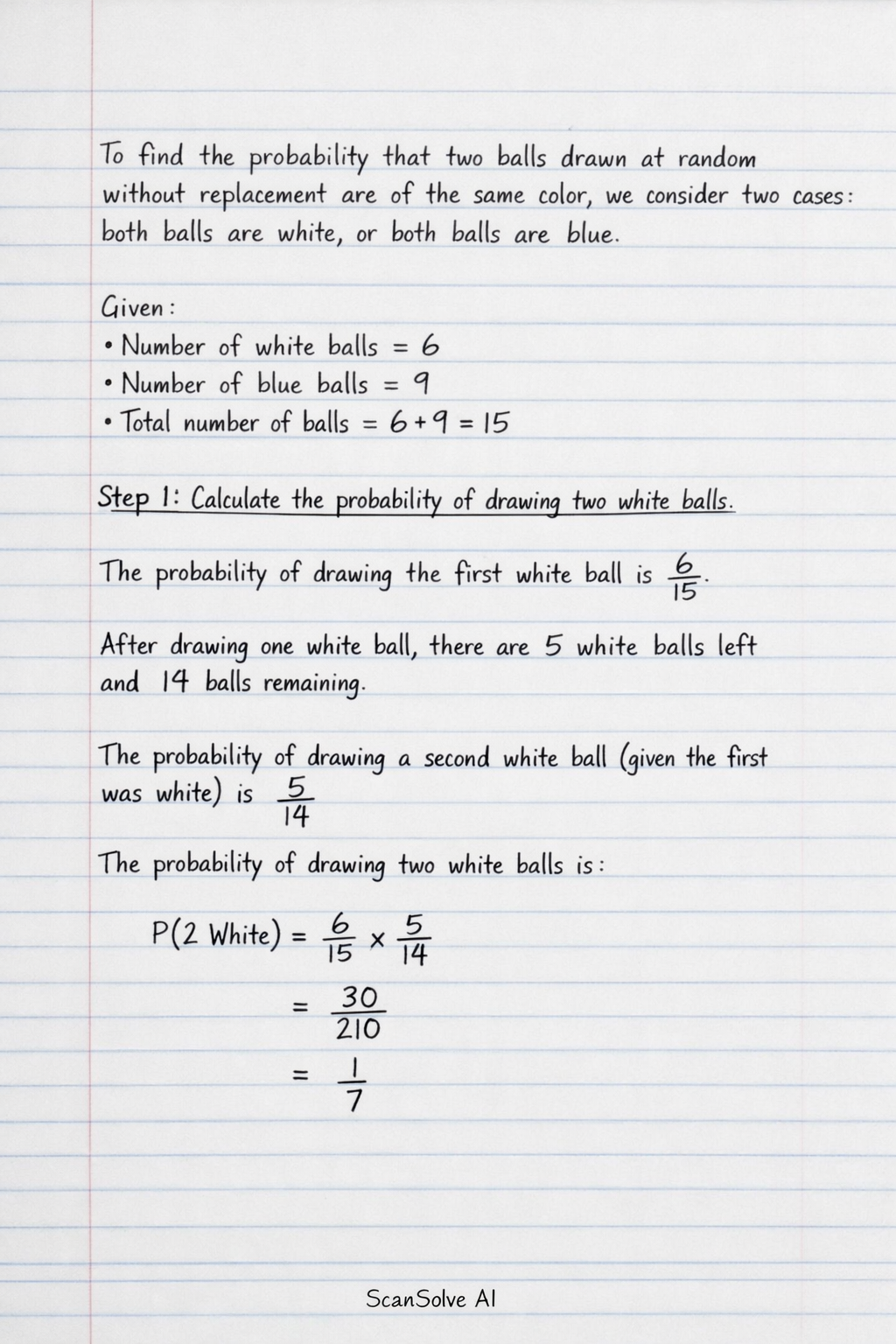
To find the probability that two balls drawn at random without replacement are of the same color, we consider two cases: both balls are white, or both balls are blue. Given: • Number of white balls = 6 • Number of blue balls = 9 • Total number of balls = 6 + 9 = 15 Step 1: Calculate the probability of drawing two white balls. The probability of drawing the first white ball is (6)/(15). After drawing one white ball, there are 5 white balls left and a total of 14 balls remaining. The probability of drawing a second white ball (given the first was white) is (5)/(14). The probability of drawing two white balls is: P(2 White) = (6)/(15) × (5)/(14) = (30)/(210) = (1)/(7) Step 2: Calculate the probability of drawing two blue balls. The probability of drawing the first blue ball is (9)/(15). After drawing one blue ball, there are 8 blue balls left and a total of 14 balls remaining. The probability of drawing a second blue ball (given the first was blue) is (8)/(14). The probability of drawing two blue balls is: P(2 Blue) = (9)/(15) × (8)/(14) = (72)/(210) = (12)/(35) Step 3: Add the probabilities of these two mutually exclusive events. The probability of drawing two balls of the same color is the sum of the probabilities of drawing two white balls and drawing two blue balls. P(Same Color) = P(2 White) + P(2 Blue) P(Same Color) = (1)/(7) + (12)/(35) To add these fractions, find a common denominator, which is 35. P(Same Color) = (1 × 5)/(7 × 5) + (12)/(35) = (5)/(35) + (12)/(35) P(Same Color) = (5 + 12)/(35) = (17)/(35) The probability that two balls drawn at random without replacement are of the same color is (17)/(35). 3 done, 2 left today. You're making progress.