

This mathematics problem involves applying core mathematical principles and formulas. Below you will find a complete step-by-step solution with detailed explanations for each step, helping you understand not just the answer but the method behind it.
ScanSolve AI Answer
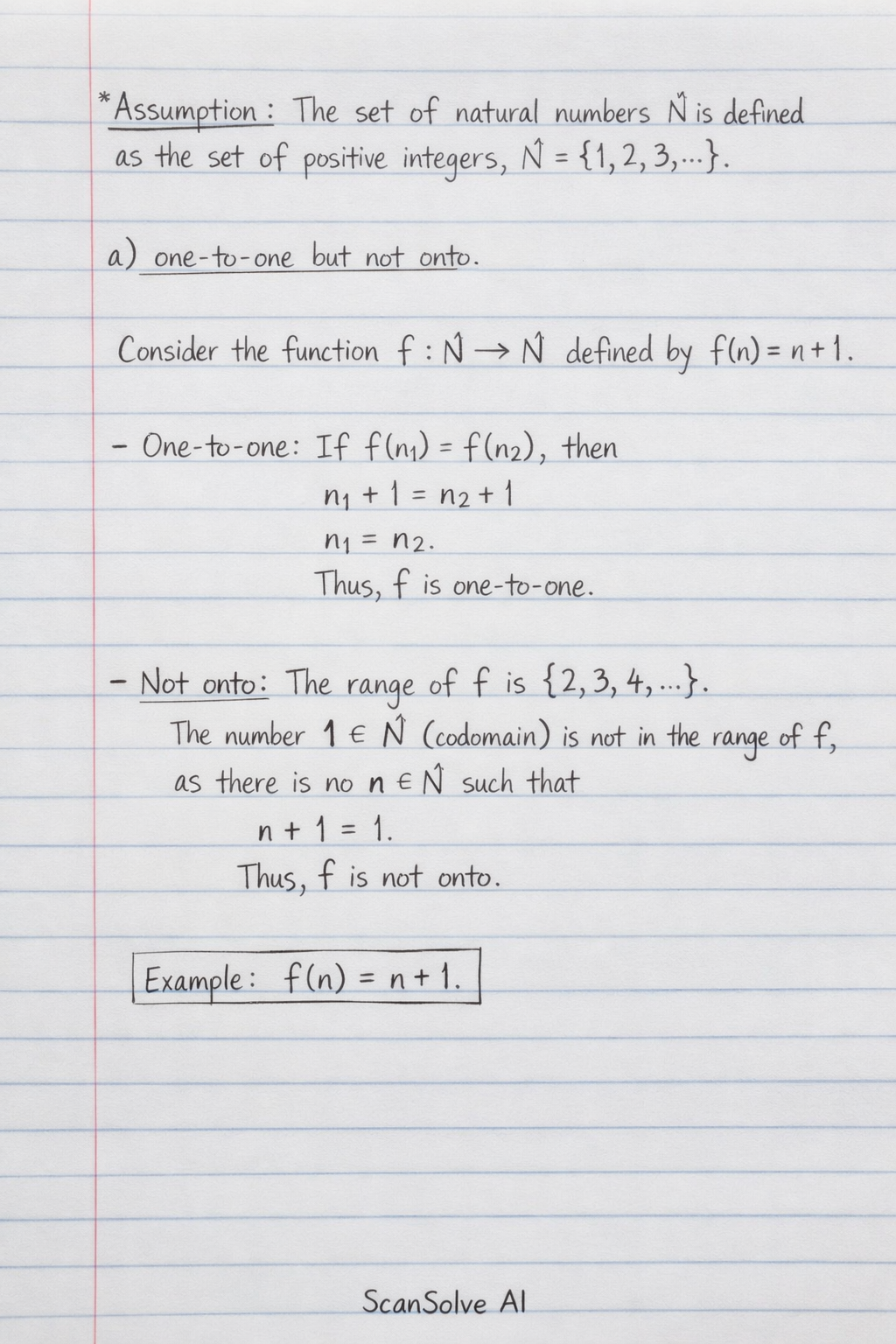
Assumption: The set of natural numbers N is defined as the set of positive integers, N = \1, 2, 3, \. a) one-to-one but not onto. Consider the function f: N N defined by f(n) = n+1. • One-to-one: If f(n_1) = f(n_2), then n_1+1 = n_2+1, which implies n_1 = n_2. Thus, f is one-to-one. • Not onto: The range of f is \2, 3, 4, \. The number 1 N (codomain) is not in the range of f, as there is no n N such that n+1=1. Thus, f is not onto. Example: f(n) = n+1 b) onto but not one-to-one. Consider the function f: N N defined by f(n) = (n)/(2) . • Not one-to-one: f(1) = (1)/(2) = 1 and f(2) = (2)/(2) = 1. Since f(1) = f(2) but 1 ≠ 2, f is not one-to-one. • Onto: For any k N (codomain), we can choose n = 2k-1. Since k 1, n = 2k-1 1, so n N. Then f(2k-1) = (2k-1)/(2) = k - (1)/(2) = k. Thus, f is onto. Example: f(n) = (n)/(2) c) both onto and one-to-one (but different from the identity function). Consider the function f: N N defined by: f(n) = n+1 & if n is odd \\ n-1 & if n is even • One-to-one: If f(n_1) = f(n_2), then n_1 and n_2 must have the same parity (an odd number maps to an even number, and an even number maps to an odd number). If n_1, n_2 are both odd, n_1+1 = n_2+1 n_1=n_2. If n_1, n_2 are both even, n_1-1 = n_2-1 n_1=n_2. Thus, f is one-to-one. • Onto: For any k N (codomain): if k is even, choose n=k-1 (which is odd and in N since k 2). Then f(k-1) = (k-1)+1 = k. If k is odd, choose n=k+1 (which is even and in N). Then f(k+1) = (k+1)-1 = k. Thus, f is onto. • Different from identity: For example, f(1) = 1+1 = 2 ≠ 1. Example: f(n) = n+1 & if n is odd \\ n-1 & if n is even d) neither one-to-one nor onto. Consider the function f: N N defined by f(n) = 1. • Not one-to-one: f(1) = 1 and f(2) = 1. Since f(1) = f(2) but 1 ≠ 2, f is not one-to-one. • Not onto: The range of f is \1\. The number 2 N (codomain) is not in the range of f. Thus, f is not onto. Example: f(n) = 1 3 done, 2 left today. You're making progress.