

This biology question covers important biological concepts and processes. The step-by-step explanation below helps you understand the underlying mechanisms and reasoning.
ScanSolve AI Answer
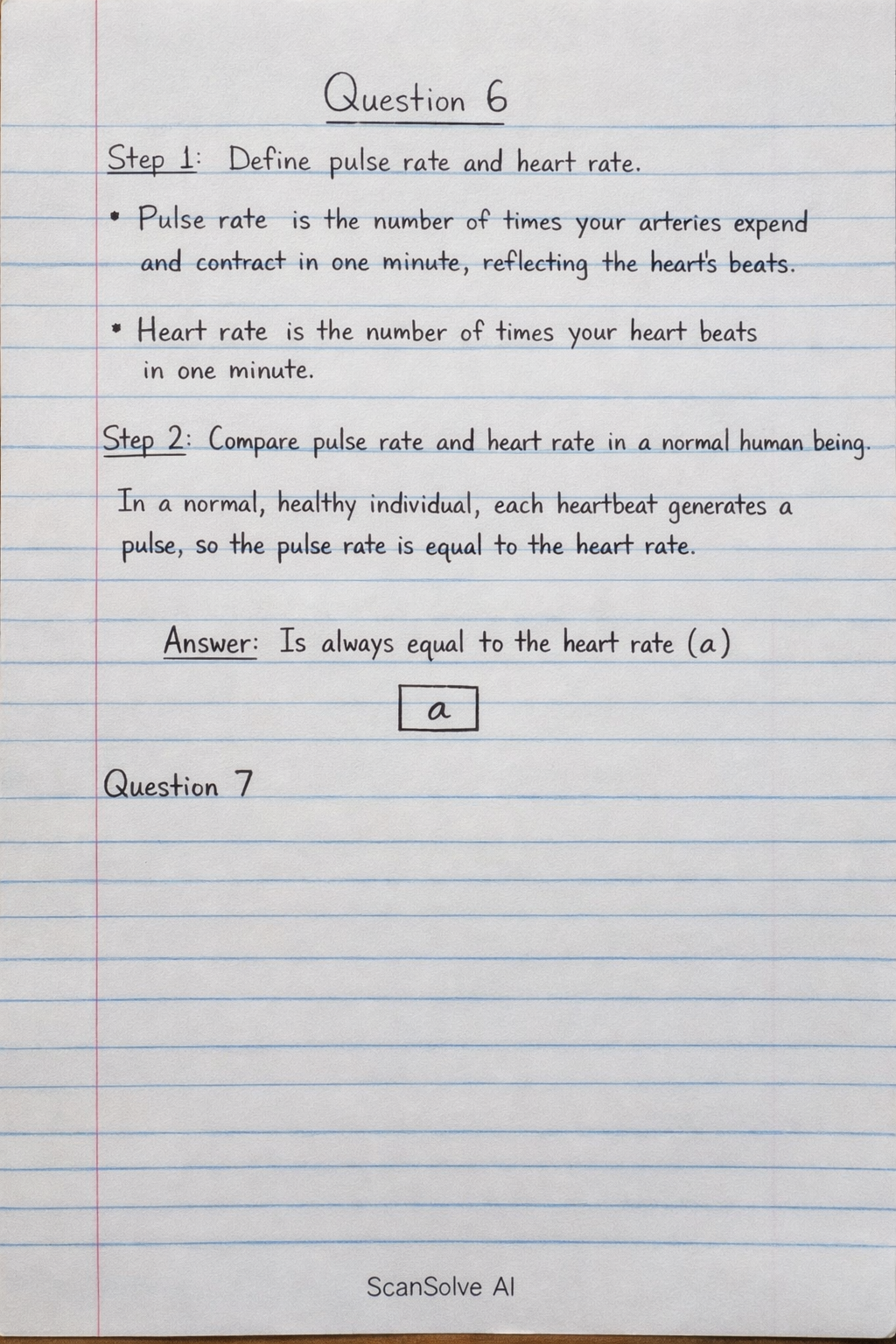
Question 6 Step 1: Define pulse rate and heart rate. Pulse rate* is the number of times your arteries expand and contract in one minute, reflecting the heart's beats. Heart rate* is the number of times your heart beats in one minute. Step 2: Compare pulse rate and heart rate in a normal human being. In a normal, healthy individual, each heartbeat generates a pulse, so the pulse rate is equal to the heart rate. Answer: Is always equal to the heart rate (a) a Question 7 Step 1: Evaluate each statement regarding heart valves. a) A tricuspid valve has three cusps: Right AV valve. This is true*. The tricuspid valve is located between the right atrium and right ventricle and has three leaflets (cusps). b) It is the flow of blood pushes the cusps of the tricuspid valves open. This is true*. As the right atrium contracts and blood flows into the right ventricle, the pressure pushes the tricuspid valve open. c) A bicuspid valve has two cusps. This is true*. The bicuspid valve (also known as the mitral valve) is located between the left atrium and left ventricle and has two leaflets. d) Semilunar valves are also called mitral valves. This is false*. The semilunar valves are the aortic valve and the pulmonary valve. The mitral valve is the bicuspid valve. Answer: Semilunar valves are also called mitral valves (d) d Question 8 Step 1: Evaluate each statement regarding blood flow through the heart. a) Right Atrium receives O_2-poor blood from body. This is true*. Deoxygenated blood from the systemic circulation enters the right atrium via the superior and inferior vena cava. b) Right Ventricle receives O_2-poor blood from right atrium through bicuspid valve. This is false. The right ventricle receives O_2-poor blood from the right atrium through the tricuspid* valve, not the bicuspid valve. The bicuspid valve is on the left side of the heart. c) Pumps blood to lungs via Pulmonary semilunar Valve in pulmonary trunk. This is true*. The right ventricle pumps deoxygenated blood through the pulmonary semilunar valve into the pulmonary trunk, which leads to the lungs. d) Left Atrium receives O_2-rich blood from pulmonary Veins. This is true*. Oxygenated blood from the lungs returns to the left atrium via the pulmonary veins. Answer: Right Ventricle receives O_2-poor blood from right atrium through bicuspid valve (b) b Question 9 Step 1: Recall the intrinsic rates of the heart's pacemakers. The SA Node* (sinoatrial node) is the primary pacemaker, with an intrinsic rate of 60 - 100 beats/minute. The AV Node* (atrioventricular node) is a secondary pacemaker, with an intrinsic rate of 40 - 60 beats/minute. The Purkinje fibers* (and ventricular cells) are tertiary pacemakers, with an intrinsic rate of 20 - 45 beats/minute. Step 2: Evaluate each statement. a) The SA Node is the dominant pacemaker with an intrinsic rate of 60 - 100 beats/minute. This is correct*. b) The AV Node is a back-up pacemaker with an intrinsic rate of 40 - 60 beats/minute. This is correct*. c) The Ventricular cells are a back-up pacemaker with an intrinsic rate of 20 - 45 beats/minute. This is correct*. d) Purkinje fibres are a back-up pacemaker with an intrinsic rate of 80 - 120 beats/minute. This is not correct*. Purkinje fibers have an intrinsic rate of 20 - 45 beats/minute. Answer: Purkinje fibres are a back-up pacemaker with an intrinsic rate of 80 - 120 beats/minute (d) d Question 10 Step 1: Evaluate each statement concerning heart murmurs. a) Murmurs are shorter than heart sounds. This is incorrect*. Murmurs are typically longer than normal heart sounds (S1, S2) as they represent turbulent blood flow over a period. b) They can be systolic, diastolic, continuous murmurs. This is correct*. Murmurs are classified based on when they occur in the cardiac cycle: during systole, diastole, or continuously. c) Location of maximum intensity is determined by the site where the murmur ends. This is incorrect. The location of maximum intensity (point of maximal impulse) is determined by the site where the murmur originates* or is best transmitted. d) They can be graded on a 6 point scale where grade 1 is the loudest and grade 6 the faintest in intensity. This is incorrect. Murmurs are graded on a 6-point scale, but Grade 1 is the faintest (barely audible) and Grade 6 is the loudest* (audible without a stethoscope, with a palpable thrill). Answer: They can be systolic, diastolic, continuous murmurs (b) b