
We read your photo as:
Q1. Find the centroidal axes, Moment of Inertia, and Polar moment of inertia of the section shown below. Q2a. Write briefly on the following: Proof Resilience, Strain Energy, Impact Loading, Modulus of Resilience, Obliquity and how it is determined, Principal plane, Mohr's Circle
ScanSolve AI Answer
Answers
3 partsStep-by-step solution
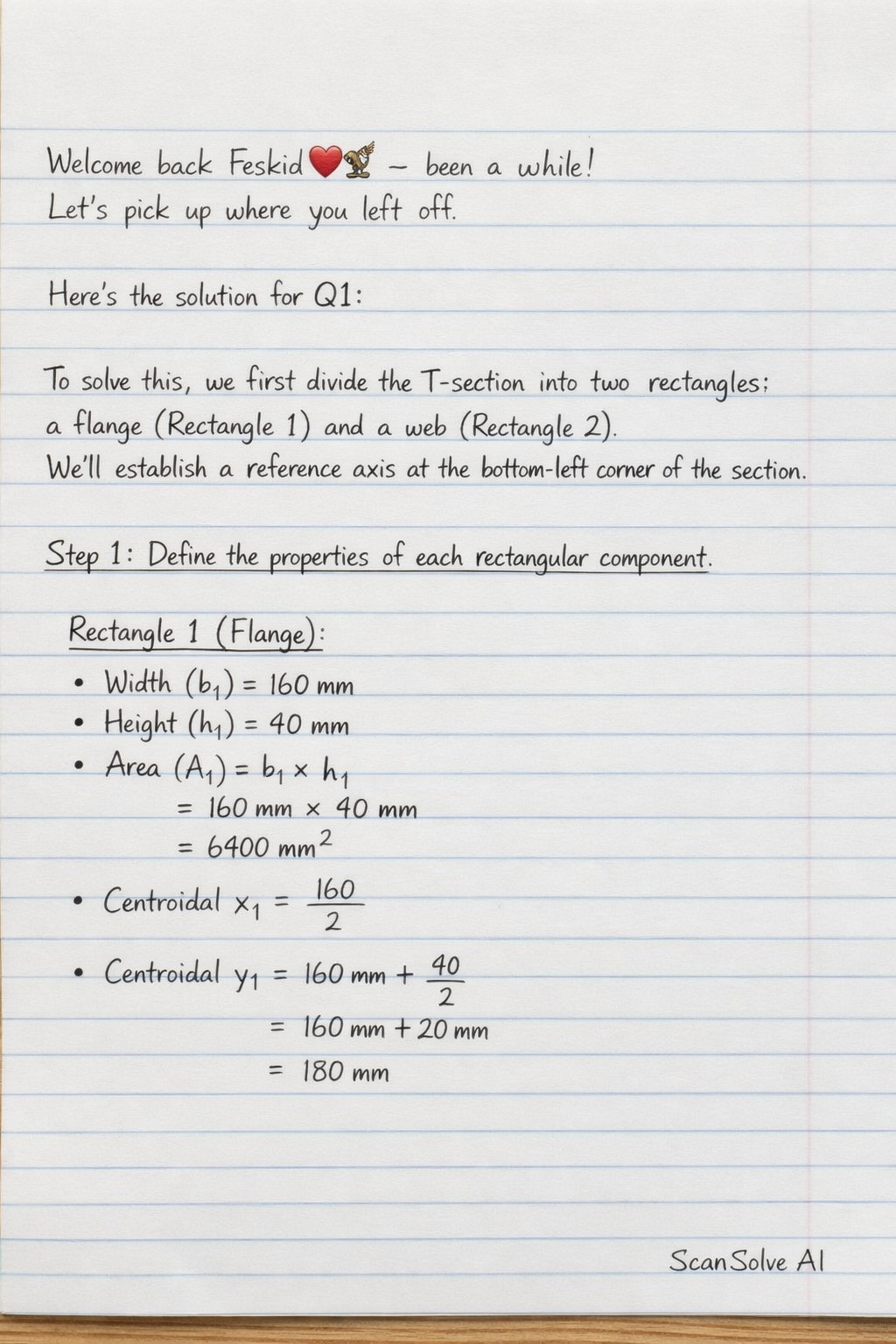
3 stepsHere's the solution for Q1:
To solve this, we first divide the T-section into two rectangles: a flange (Rectangle 1) and a web (Rectangle 2). We'll establish a reference axis at the bottom-left corner of the section.
Step 1: Define the properties of each rectangular component.
-
Rectangle 1 (Flange):
- Width () =
- Height () =
- Area () =
- Centroidal x-coordinate from left edge () =
- Centroidal y-coordinate from bottom reference () =
-
Rectangle 2 (Web):
- Width () =
- Height () =
- Area () =
- Centroidal x-coordinate from left edge () = (since it's centered)
- Centroidal y-coordinate from bottom reference () =
Step 2: Calculate the centroidal axes ().
The total area .
-
Centroidal x-coordinate (): Due to symmetry about the vertical axis, is at the center of the width.
-
Centroidal y-coordinate ():
Part a· 2 steps
Centroidal axes
The centroid of the section is located at from the bottom-left corner.
Calculate the Moment of Inertia about the centroidal x-axis ().
We use the parallel axis theorem: , where and is the distance from the component's centroid to the overall centroidal x-axis.
-
For Rectangle 1 (Flange):
-
For Rectangle 2 (Web):
Total :
-
Calculate the Moment of Inertia about the centroidal y-axis ().
Since the section is symmetrical about the y-axis, the centroidal y-axis passes through the centroid of each component, so . We sum the individual moments of inertia .
-
For Rectangle 1 (Flange):
-
For Rectangle 2 (Web):
Total :
-
Part b
Moment of Inertia
The moment of inertia about the centroidal x-axis is .
The moment of inertia about the centroidal y-axis is .
Calculate the Polar Moment of Inertia ().
The polar moment of inertia about the centroid is the sum of the moments of inertia about the centroidal x and y axes:
Part c
Polar moment of inertia
The polar moment of inertia is .
Still stuck on this one?
Ask a follow-up, and the answer starts from this question.
More Mathematics Questions
Handwritten Step-by-Step Solution
Get this as a handwritten image on WhatsApp — like a tutor wrote it for you.
Try on WhatsApp