
We read your photo as:
Q1. Proof each of the following trigonometric identities a. (tanx)/(1+secx) + (tanx)/(1−secx) = (2tanx)/(-sin2x) b. (sinx)/(1+cosx) - (1+cosx)/(sinx) = 2cosec x c. (tan2x - 1)/(tan2x + 1) = 1 − 2cos2x d. cosec2x tan2x − 1 = tan2x
ScanSolve AI Answer
Answers
4 partsStep-by-step solution
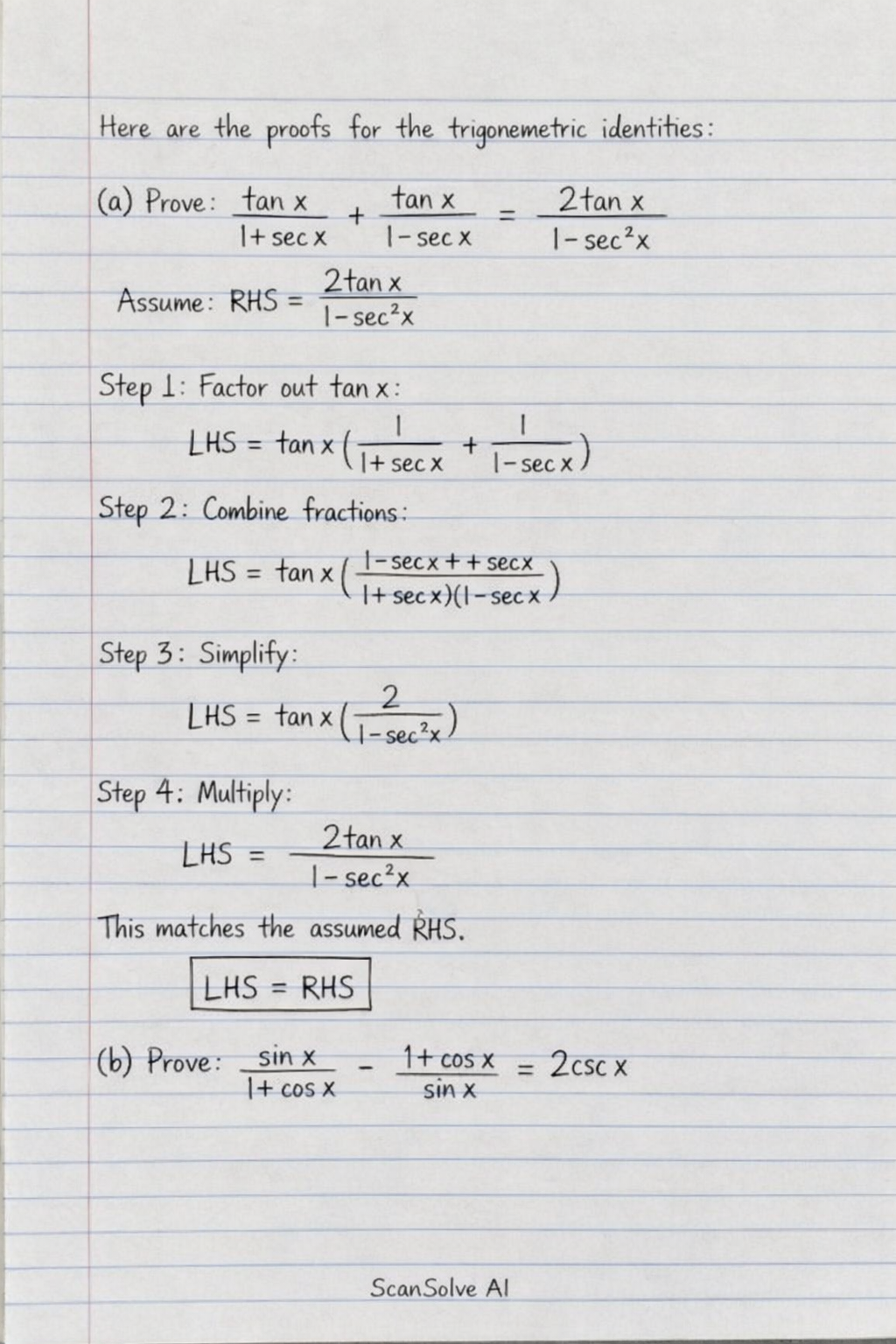
18 stepsHere are the proofs for the trigonometric identities:
Part a· 4 steps
Prove:
Assumption: Due to the image clarity, we assume the Right Hand Side (RHS) denominator is , which makes the identity provable. The identity will be proven as .
Start with the Left Hand Side (LHS) and factor out .
Combine the fractions inside the parenthesis.
Simplify the numerator and multiply the denominators.
Multiply to get the final expression.
This matches the assumed RHS.
Therefore, .
Part b
Prove:
Assumption: Due to the image clarity, we assume the operation between the two fractions is addition, not subtraction, which makes the identity provable. The identity will be proven as .
Start with the LHS and find a common denominator to combine the fractions.
Expand the numerator and use the identity .
Simplify the numerator by factoring out 2.
Cancel out the common term .
Use the identity .
This matches the RHS.
Therefore, .
Part c
Prove:
Start with the LHS and express in terms of and .
Combine the terms in the numerator and denominator.
Simplify by canceling from the numerator and denominator.
Use the identity in the denominator.
Use the identity to express the LHS in terms of .
This matches the RHS.
Therefore, .
Part d
Prove:
Start with the LHS and express and in terms of and .
Simplify the product.
Use the identity .
Use the Pythagorean identity , which implies .
This matches the RHS.
Therefore, .
Try one yourself
A new problem that tests the same skill.
Still stuck on this one?
Ask a follow-up, and the answer starts from this question.
More Mathematics Questions
Handwritten Step-by-Step Solution
Get this as a handwritten image on WhatsApp — like a tutor wrote it for you.
Try on WhatsApp