

This mathematics problem involves applying core mathematical principles and formulas. Below you will find a complete step-by-step solution with detailed explanations for each step, helping you understand not just the answer but the method behind it.
ScanSolve AI Answer
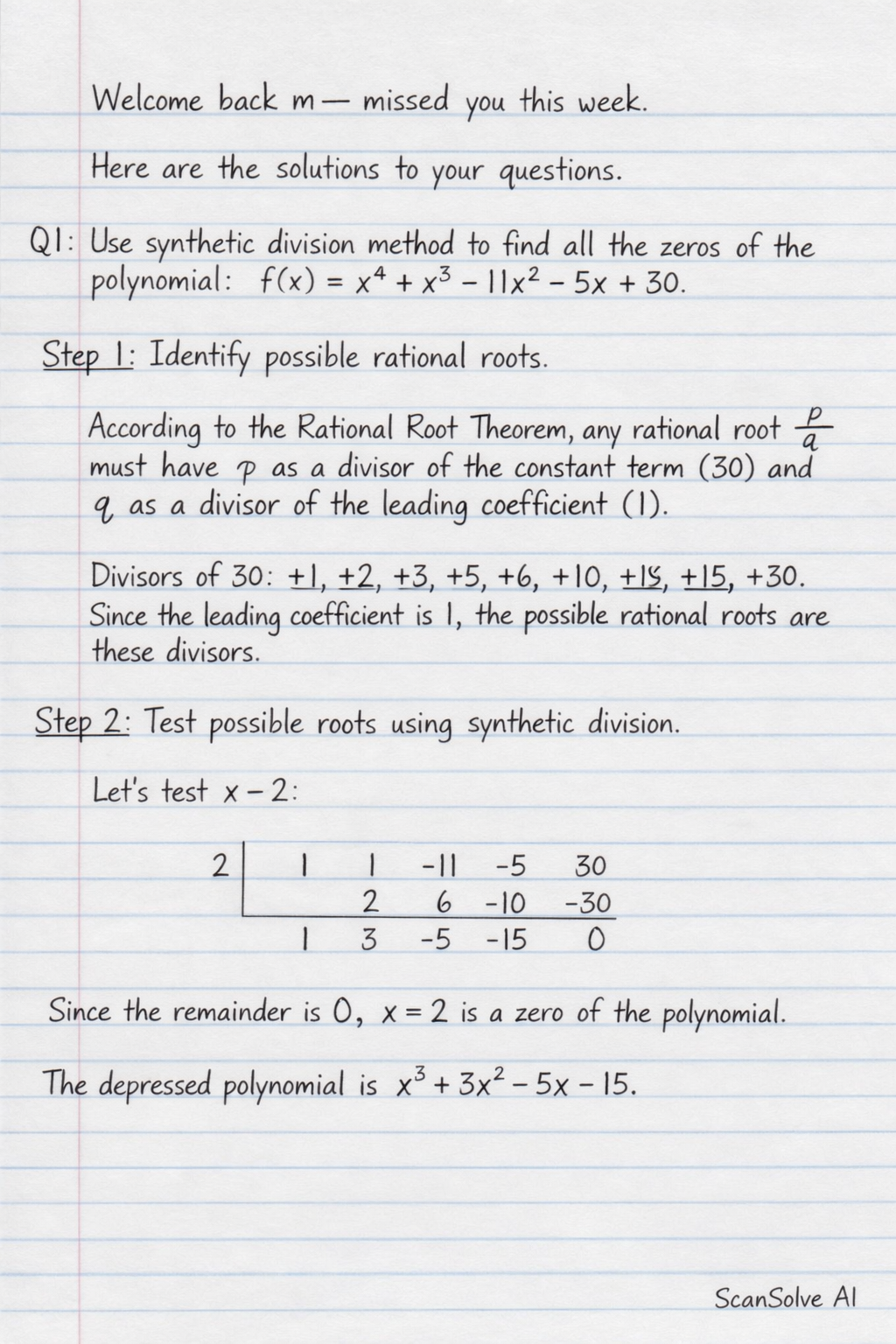
Here are the solutions to your questions. Q1: Use synthetic division method to find all the zeros of the polynomial: f(x) = x^4 + x^3 - 11x^2 - 5x + 30 Step 1: Identify possible rational roots. According to the Rational Root Theorem, any rational root (p)/(q) must have p as a divisor of the constant term (30) and q as a divisor of the leading coefficient (1). Divisors of 30: ± 1, ± 2, ± 3, ± 5, ± 6, ± 10, ± 15, ± 30. Since the leading coefficient is 1, the possible rational roots are these divisors. Step 2: Test possible roots using synthetic division. Let's test x=2: c|ccccc 2 & 1 & 1 & -11 & -5 & 30 \\ & & 2 & 6 & -10 & -30 \\ & 1 & 3 & -5 & -15 & 0 \\ Since the remainder is 0, x=2 is a zero of the polynomial. The depressed polynomial is x^3 + 3x^2 - 5x - 15. Step 3: Factor the depressed polynomial to find the remaining zeros. We can factor x^3 + 3x^2 - 5x - 15 by grouping: x^3 + 3x^2 - 5x - 15 = x^2(x+3) - 5(x+3) = (x^2 - 5)(x+3) Set the factors to zero to find the remaining roots: x+3 = 0 x = -3 x^2 - 5 = 0 x^2 = 5 x = ± sqrt(5) The zeros of the polynomial are 2, -3, sqrt(5), and -sqrt(5). The zeros of the polynomial are 2, -3, sqrt(5), -sqrt(5). Q2: Employ the Newton-Raphson method and determine the zeros of the polynomial: f(x) = 0.5x^3 - 4x^2 + 6x - 2 using initial guess of 4.2 to a level of accuracy of ± 10^-1. Step 1: Find the derivative of the function. Given f(x) = 0.5x^3 - 4x^2 + 6x - 2. The derivative is f'(x) = (d)/(dx)(0.5x^3 - 4x^2 + 6x - 2) = 1.5x^2 - 8x + 6. Step 2: Apply the Newton-Raphson formula x_n+1 = x_n - (f(x_n))/(f'(x_n)) iteratively until the desired accuracy is met. The initial guess is x_0 = 4.2. The accuracy required is |x_n+1 - x_n| < 0.1. • Iteration 1: x_0 = 4.2 f(x_0) = f(4.2) = 0.5(4.2)^3 - 4(4.2)^2 + 6(4.2) - 2 = 37.044 - 70.56 + 25.2 - 2 = -10.316 f'(x_0) = f'(4.2) = 1.5(4.2)^2 - 8(4.2) + 6 = 26.46 - 33.6 + 6 = -1.14 x_1 = 4.2 - (-10.316)/(-1.14) = 4.2 - 9.04912 = -4.84912 |x_1 - x_0| = |-4.84912 - 4.2| = 9.04912 > 0.1 • Iteration 2: x_1 = -4.84912 f(x_1) = 0.5(-4.84912)^3 - 4(-4.84912)^2 + 6(-4.84912) - 2 = -56.9895 - 94.0552 - 29.0947 - 2 = -182.1394 f'(x_1) = 1.5(-4.84912)^2 - 8(-4.84912) + 6 = 35.2707 + 38.7929 + 6 = 80.0636 x_2 = -4.84912 - (-182.1394)/(80.0636) = -4.84912 - (-2.27494) = -2.57418 |x_2 - x_1| = |-2.57418 - (-4.84912)| = 2.27494 > 0.1 • Iteration 3: x_2 = -2.57418 f(x_2) = 0.5(-2.57418)^3 - 4(-2.57418)^2 + 6(-2.57418) - 2 = -8.5204 - 26.5041 - 15.4451 - 2 = -52.4696 f'(x_2) = 1.5(-2.57418)^2 - 8(-2.57418) + 6 = 9.9392 + 20.5934 + 6 = 36.5326 x_3 = -2.57418 - (-52.4696)/(36.5326) = -2.57418 - (-1.43624) = -1.13794 |x_3 - x_2| = |-1.13794 - (-2.57418)| = 1.43624 > 0.1 • Iteration 4: x_3 = -1.13794 f(x_3) = 0.5(-1.13794)^3 - 4(-1.13794)^2 + 6(-1.13794) - 2 = -0.7370 - 5.1799 - 6.8276 - 2 = -14.7445 f'(x_3) = 1.5(-1.13794)^2 - 8(-1.13794) + 6 = 1.9425 + 9.1035 + 6 = 17.0460 x_4 = -1.13794 - (-14.7445)/(17.0460) = -1.13794 - (-0.86498) = -0.27296 |x_4 - x_3| = |-0.27296 - (-1.13794)| = 0.86498 > 0.1 • Iteration 5: x_4 = -0.27296 f(x_4) = 0.5(-0.27296)^3 - 4(-0.27296)^2 + 6(-0.27296) - 2 = -0.0102 - 0.2980 - 1.6378 - 2 = -3.9460 f'(x_4) = 1.5(-0.27296)^2 - 8(-0.27296) + 6 = 0.1118 + 2.1837 + 6 = 8.2955 x_5 = -0.27296 - (-3.9460)/(8.2955) = -0.27296 - (-0.47566) = 0.20270 |x_5 - x_4| = |0.20270 - (-0.27296)| = 0.47566 > 0.1 • Iteration 6: x_5 = 0.20270 f(x_5) = 0.5(0.20270)^3 - 4(0.20270)^2 + 6(0.20270) - 2 = 0.0042 - 0.1643 - 1.2162 - 2 = -0.9440 f'(x_5) = 1.5(0.20270)^2 - 8(0.20270) + 6 = 0.0616 - 1.6216 + 6 = 4.4400 x_6 = 0.20270 - (-0.9440)/(4.4400) = 0.20270 - (-0.21261) = 0.41531 |x_6 - x_5| = |0.41531 - 0.20270| = 0.21261 > 0.1 • Iteration 7: x_6 = 0.41531 f(x_6) = 0.5(0.41531)^3 - 4(0.41531)^2 + 6(0.41531) - 2 = 0.0359 - 0.6906 + 2.4919 - 2 = -0.1628 f'(x_6) = 1.5(0.41531)^2 - 8(0.41531) + 6 = 0.2588 - 3.3225 + 6 = 2.9363 x_7 = 0.41531 - (-0.1628)/(2.9363) = 0.41531 - (-0.05544) = 0.47075 |x_7 - x_6| = |0.47075 - 0.41531| = 0.05544 < 0.1 Step 3: Round the final answer to the specified accuracy. Since |x_7 - x_6| < 0.1, we take x_7 as the approximation. Rounding 0.47075 to one decimal place (accuracy of ± 10^-1), we get 0.5. The zero of the polynomial using the Newton-Raphson method with an initial guess of 4.2 to an accuracy of ± 10^-1 is 0.5. Drop the next question! 📸