Q13. Compute the integral: integral(sin2 x / (1 + cos x)) dx

Mathematics
Q13. Compute the integral: integral(sin2 x / (1 + cos x)) dx

ScanSolve AI Answer

Answer

x - \ln|x+1| + C

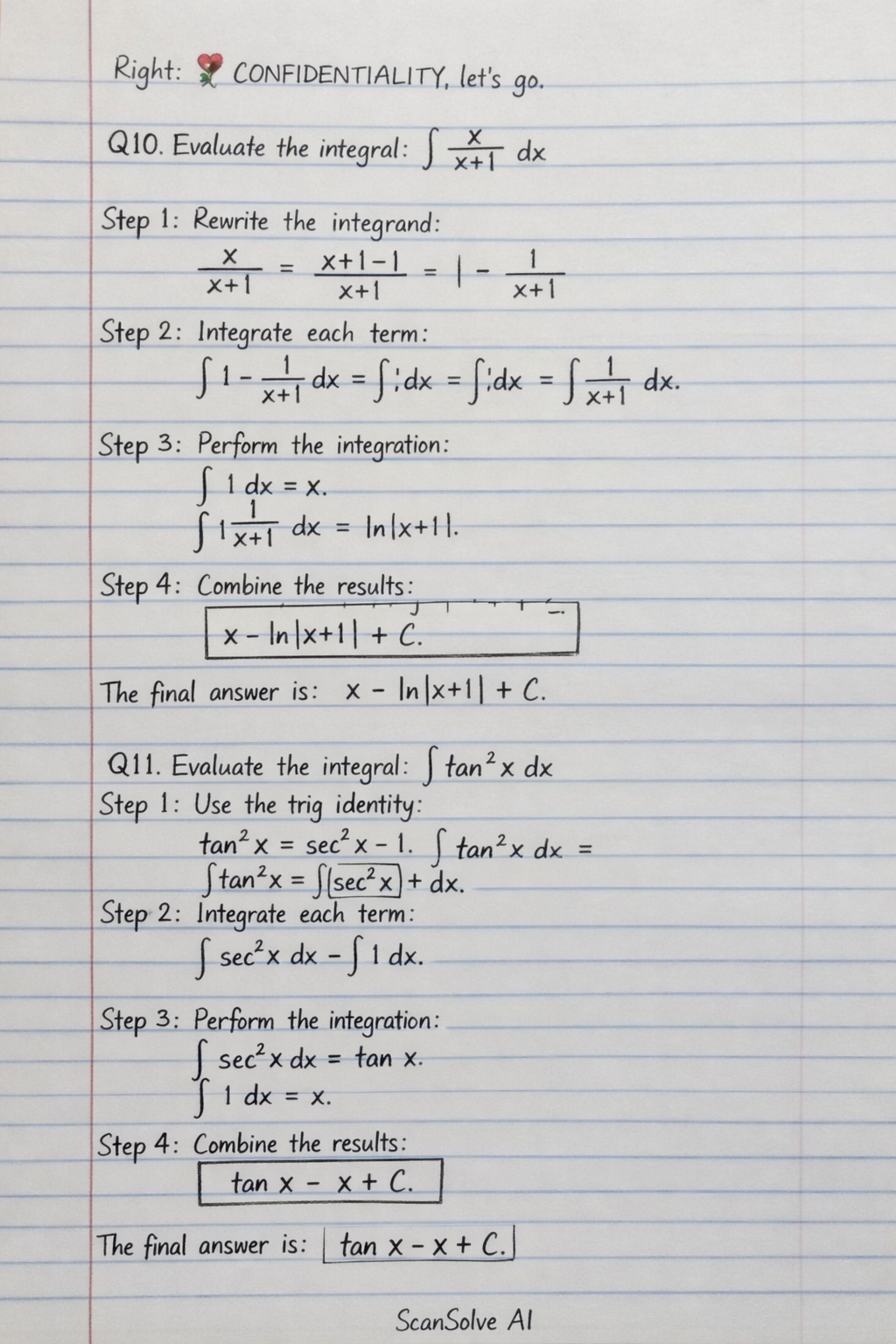
Q10. Evaluate the integral: (xx+1)dx\int \left(\frac{x}{x+1}\right) dx

Step 1: Rewrite the integrand using algebraic manipulation. xx+1=x+11x+1=11x+1\frac{x}{x+1} = \frac{x+1-1}{x+1} = 1 - \frac{1}{x+1} Step 2: Integrate each term. (11x+1)dx=1dx1x+1dx\int \left(1 - \frac{1}{x+1}\right) dx = \int 1 \, dx - \int \frac{1}{x+1} \, dx Step 3: Perform the integration. 1dx=x\int 1 \, dx = x 1x+1dx=lnx+1\int \frac{1}{x+1} \, dx = \ln|x+1| Step 4: Combine the results and add the constant of integration. xlnx+1+Cx - \ln|x+1| + C The final answer is xlnx+1+C\boxed{x - \ln|x+1| + C}.

Q11. Evaluate the integral: tan2xdx\int \tan^2 x \, dx

Step 1: Use the trigonometric identity tan2x=sec2x1\tan^2 x = \sec^2 x - 1. tan2xdx=(sec2x1)dx\int \tan^2 x \, dx = \int (\sec^2 x - 1) \, dx Step 2: Integrate each term. sec2xdx1dx\int \sec^2 x \, dx - \int 1 \, dx Step 3: Perform the integration. sec2xdx=tanx\int \sec^2 x \, dx = \tan x 1dx=x\int 1 \, dx = x Step 4: Combine the results and add the constant of integration. tanxx+C\tan x - x + C The final answer is tanxx+C\boxed{\tan x - x + C}.

Q12. Compute the indefinite integral: 1sin2xdx\int \sqrt{1-\sin 2x} \, dx

Step 1: Use the identities 1=sin2x+cos2x1 = \sin^2 x + \cos^2 x and sin2x=2sinxcosx\sin 2x = 2 \sin x \cos x to rewrite the expression under the square root. 1sin2x=sin2x+cos2x2sinxcosx=(cosxsinx)21 - \sin 2x = \sin^2 x + \cos^2 x - 2 \sin x \cos x = (\cos x - \sin x)^2 Step 2: Substitute this back into the integral. (cosxsinx)2dx=cosxsinxdx\int \sqrt{(\cos x - \sin x)^2} \, dx = \int |\cos x - \sin x| \, dx Step 3: For simplicity, assume cosxsinx0\cos x - \sin x \ge 0 over the interval of integration, allowing us to remove the absolute value. (cosxsinx)dx\int (\cos x - \sin x) \, dx Step 4: Integrate each term. cosxdxsinxdx\int \cos x \, dx - \int \sin x \, dx Step 5: Perform the integration. cosxdx=sinx\int \cos x \, dx = \sin x sinxdx=cosx\int \sin x \, dx = -\cos x Step 6: Combine the results and add the constant of integration. sinx(cosx)+C=sinx+cosx+C\sin x - (-\cos x) + C = \sin x + \cos x + C The final answer is sinx+cosx+C\boxed{\sin x + \cos x + C}.

Q13. Compute the integral: sin2x1+cosxdx\int \frac{\sin^2 x}{1+\cos x} \, dx

Step 1: Use the trigonometric identity sin2x=1cos2x\sin^2 x = 1 - \cos^2 x. 1cos2x1+cosxdx\int \frac{1 - \cos^2 x}{1+\cos x} \, dx Step 2: Factor the numerator using the difference of squares formula a2b2=(ab)(a+b)a^2 - b^2 = (a-b)(a+b). 1cos2x=(1cosx)(1+cosx)1 - \cos^2 x = (1 - \cos x)(1 + \cos x) Step 3: Substitute the factored numerator back into the integral and simplify. (1cosx)(1+cosx)1+cosxdx=(1cosx)dx\int \frac{(1 - \cos x)(1 + \cos x)}{1+\cos x} \, dx = \int (1 - \cos x) \, dx Step 4: Integrate each term. 1dxcosxdx\int 1 \, dx - \int \cos x \, dx Step 5: Perform the integration. 1dx=x\int 1 \, dx = x cosxdx=sinx\int \cos x \, dx = \sin x Step 6: Combine the results and add the constant of integration. xsinx+Cx - \sin x + C The final answer is xsinx+C\boxed{x - \sin x + C}.

Send me the next one 📸

Was this helpful?

Need help with your own homework?

Get instant step-by-step solutions to any question. Free to start.

Ask Your Question
Handwritten step-by-step solution preview

Handwritten Step-by-Step Solution

Get this as a handwritten image on WhatsApp — like a tutor wrote it for you.

Try on WhatsApp

Still have questions?

Quick Answer

Q10. Evaluate the integral: ((x)/(x+1)) dx Step 1: Rewrite the integrand using algebraic manipulation.

Q13. Compute the integral: integral(sin2 x / (1 + cos x)) dx
Mathematics

This mathematics problem involves applying core mathematical principles and formulas. Below you will find a complete step-by-step solution with detailed explanations for each step, helping you understand not just the answer but the method behind it.

ScanSolve AI Answer
Q10. Evaluate the integral: ((x)/(x+1)) dx Step 1: Rewrite the integrand using algebraic manipulation. (x)/(x+1) = (x+1-1)/(x+1) = 1 - (1)/(x+1) Step 2: Integrate each term. (1 - (1)/(x+1)) dx = 1 \, dx - (1)/(x+1) \, dx Step 3: Perform the integration. 1 \, dx = x (1)/(x+1) \, dx = |x+1| Step 4: Combine the results and add the constant of integration. x - |x+1| + C The final answer is x - |x+1| + C. Q11. Evaluate the integral: ^2 x \, dx Step 1: Use the trigonometric identity ^2 x = ^2 x - 1. ^2 x \, dx = (^2 x - 1) \, dx Step 2: Integrate each term. ^2 x \, dx - 1 \, dx Step 3: Perform the integration. ^2 x \, dx = x 1 \, dx = x Step 4: Combine the results and add the constant of integration. x - x + C The final answer is x - x + C. Q12. Compute the indefinite integral: sqrt(1- 2x) \, dx Step 1: Use the identities 1 = ^2 x + ^2 x and 2x = 2 x x to rewrite the expression under the square root. 1 - 2x = ^2 x + ^2 x - 2 x x = ( x - x)^2 Step 2: Substitute this back into the integral. sqrt(( x - x)^2) \, dx = | x - x| \, dx Step 3: For simplicity, assume x - x 0 over the interval of integration, allowing us to remove the absolute value. ( x - x) \, dx Step 4: Integrate each term. x \, dx - x \, dx Step 5: Perform the integration. x \, dx = x x \, dx = - x Step 6: Combine the results and add the constant of integration. x - (- x) + C = x + x + C The final answer is x + x + C. Q13. Compute the integral: (^2 x)/(1+ x) \, dx Step 1: Use the trigonometric identity ^2 x = 1 - ^2 x. (1 - ^2 x)/(1+ x) \, dx Step 2: Factor the numerator using the difference of squares formula a^2 - b^2 = (a-b)(a+b). 1 - ^2 x = (1 - x)(1 + x) Step 3: Substitute the factored numerator back into the integral and simplify. ((1 - x)(1 + x))/(1+ x) \, dx = (1 - x) \, dx Step 4: Integrate each term. 1 \, dx - x \, dx Step 5: Perform the integration. 1 \, dx = x x \, dx = x Step 6: Combine the results and add the constant of integration. x - x + C The final answer is x - x + C. Send me the next one 📸